Mon–Sat 7am–6pm · 24/7 Emergency Line
Serving Santa Ana & Central OC

A stain on the ceiling under a bathroom has five plausible causes, and they range from a ten-dollar wax seal to a four-figure shower pan. The timing tells you most of it, and the stain almost certainly is not directly under the source, which is the mistake that costs people the most.
| When the ceiling gets wet | What it points at |
|---|---|
| Only after somebody showers | Shower pan, the shower drain, or grout |
| Only after a bath | The tub, its drain or overflow, not the shower |
| Only after a toilet is flushed | The wax seal or the closet flange |
| Only after a sink is used | The sink drain, the trap or a supply connector |
| All the time, nobody has used anything | A supply line or the shower valve body |
| Worse in humid weather, no water used | Possibly condensation, not a leak |
This is the expensive misunderstanding, and it is worth a section on its own.
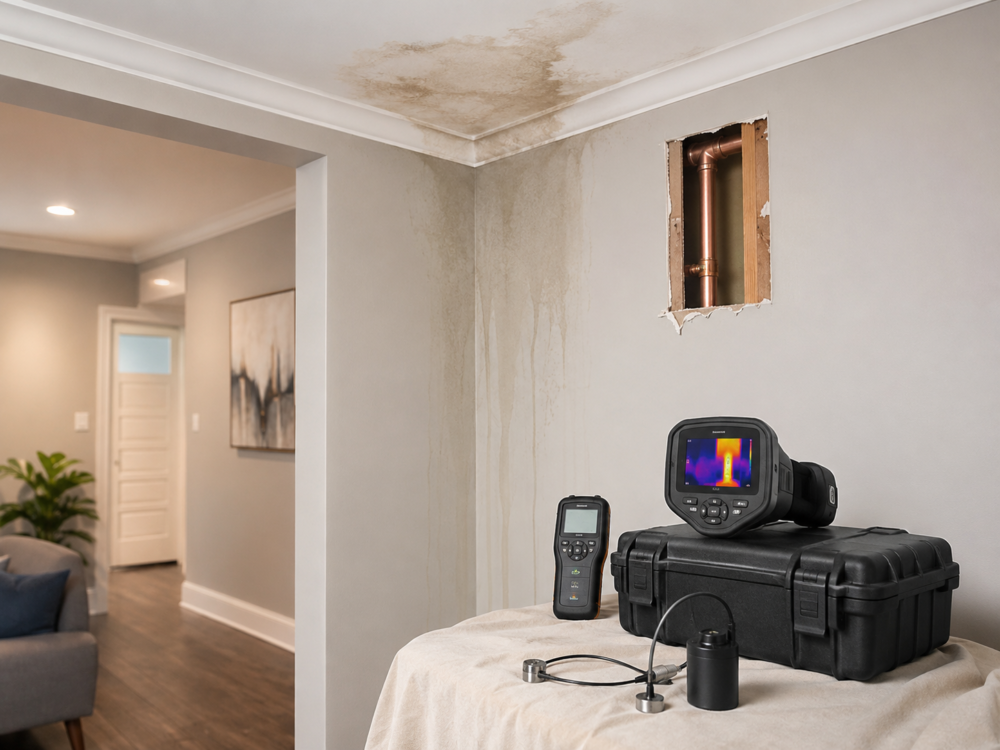
Opening the ceiling directly under the stain is therefore a coin toss, and the second hole costs more than locating would have. Thermal imaging and moisture mapping read the path without opening anything.
A shower pan replacement runs $2,000 to $6,000, and four cheaper things on this page produce the same stain. The flood test settles it properly.
Full method on the shower pan leak test.
| Method | What it establishes |
|---|---|
| Thermal imaging | Where moisture sits in the ceiling and how far it extends |
| Moisture meters | The wet area’s actual boundary, which is usually larger than the stain |
| Acoustic listening | A pressurised leak, the wet-all-the-time case |
| Flood testing the pan | Whether the pan holds water |
| Filling and testing the tub | Whether the tub, its drain or its overflow leaks |
| Running each fixture separately | Which fixture reproduces it — simple and decisive |
The last row is the one homeowners can do themselves. Run one fixture, wait, check below. Then the next. It takes an afternoon and it frequently answers the question outright.
The spread between the cheapest and the most expensive answer on this page is enormous, which is the entire argument for diagnosing before deciding. Everything we price is on the pricing page.
We are licensed and insured plumbers, and this site is about leaks — finding the ones you cannot see and repairing them properly. Roughly half of what looks like a plumbing leak turns out not to be one, so the boundary is worth stating plainly.
Roof leaks are a roofer. Water under an air handler is an HVAC technician clearing a condensate drain. Water under an appliance is appliance repair. Drying, restoration and mold are separate trades again, and gas line repair is SoCalGas or a licensed gas fitter. We detect gas leaks, we do not repair gas lines.
The full list, with the trade to call for each, is on what we don’t do.
We repair the plumbing and we will tell you plainly when drying is needed. Taking on the drying ourselves to keep the invoice in one place would mean doing it badly.
| Situation | What to do |
|---|---|
| You own the unit below | Notify the association and the owner above in writing, now |
| You rent | Shut nothing you cannot reach; notify the landlord in writing |
| The source is in another unit | Access has to be arranged — do not delay asking |
| An HOA is involved | The governing documents decide who pays, not the damage |
| Anybody is arguing about it | The detection report is what settles it |
We establish which line failed and where, in writing with photographs. We do not adjudicate who pays, because being the party that decides would compromise the value of the report to everyone. More at who is responsible for a water leak.

Five possible causes, a huge spread in price. We find out which one before you spend.
(714) 386-7923Call or text, day or nightSchedule a VisitFive common causes: the shower pan, a shower or tub drain, a toilet wax seal, grout and sealant, or a supply line and the shower valve. Timing separates them — note whether it happens after a shower, after a flush, or all the time.
A pressurised line: a supply pipe or the shower valve body inside the wall. Pans, tubs and wax seals can only leak while water is running through them, so constant damp rules all three out.
No, and assuming so is expensive: a pan replacement is $2,000 to $6,000 while a wax seal is a fraction of that. The flood test proves whether the pan holds before anybody pays to replace it.
Because water runs along joists, ducts and wiring until it finds a gap, then comes down there. The stain marks where it escaped, not where it started, which is why opening the ceiling under the stain is so often the wrong hole.
Yes, at the lowest point of the bulge, with a bucket underneath. A ceiling holding water will come down eventually and it is far better that it drains where you chose.
Often. Run one fixture only, wait, check the ceiling below, then move to the next. It takes an afternoon and it frequently answers the question outright, and it makes any visit that follows much shorter.
Anywhere from a wax seal to a $2,000 to $6,000 pan replacement. Detection is a flat $150 to $500, credited toward the repair. Given the spread, diagnosing before deciding is the whole point.
A restoration contractor dries it, and finish trades patch and paint. Wet insulation does not recover and comes out. Closing a ceiling over damp framing is how a leak turns into a mold job.
Read your policy. Most treat sudden damage more favourably than slow deterioration, and a pan liner that failed gradually is often argued as the latter. Dated photographs taken before cleanup are what any claim rests on.
Notify the association and the owner above in writing straight away, and photograph everything. Access to the source has to be arranged. Our report establishes which line failed and where; who pays is decided by the lease or the governing documents.