Mon–Sat 7am–6pm · 24/7 Emergency Line
Serving Santa Ana & Central OC

LEAK GUIDE · SANTA ANA & CENTRAL ORANGE COUNTY

Why Is My Water Bill So High? 5 Common Causes (Santa Ana Homeowners)

A sudden jump in your water bill almost always has a knowable cause, and most of the time it isn’t a slab leak. A stuck toilet fill valve, left unnoticed, can waste up to 4,300 gallons of water a day and add as much as $1,400 to a single month’s water costs, according to the U.S. Environmental Protection Agency’s WaterSense program, which is often enough by itself to explain a spike that has nothing to do with hidden plumbing damage. Before assuming the worst, a handful of ordinary explanations (a worn toilet flapper or stuck fill valve, an irrigation timer left on too long, more people staying at the house, a new appliance, or a rate increase from your water utility) are worth ruling out first.

If none of those explain it, a simple water-meter test can confirm whether water is being used somewhere in your system before you call anyone.

Leak Detection Santa Ana service van used to trace the cause of a high water bill in Santa Ana

Common Non-Leak Reasons

Before assuming a leak, rule out the ordinary explanations: a running toilet or worn fill valve, an irrigation timer left on too long, more people staying at the house, a new water-using appliance, or a rate or tier increase from your water utility.

A running toilet or worn fill valve.
A toilet that runs continuously, even quietly, wastes real water every hour it goes unnoticed; a stuck fill valve specifically can waste up to 4,300 gallons a day, per the EPA's WaterSense program. Self-check: drop a few drops of food coloring in the tank and check the bowl 10-15 minutes later without flushing; color in the bowl means it's leaking.
An irrigation timer left on too long.
Sprinkler systems left on an outdated schedule, or with a stuck valve, can run far longer than intended. Self-check: walk your yard right after a scheduled cycle and confirm every zone actually shut off.
More people staying at the house.
Guests, a returning college student, or a new roommate all add real, ordinary water use that shows up on the next bill. Self-check: compare the timing of the bill spike against any change in who's living there.
A new water-using appliance.
A new washing machine, dishwasher, water softener, or even a new pool fill cycle adds usage that wasn't there before. Self-check: think back to any new appliance installed or reconnected in the last billing cycle.
A rate or tier increase from your water utility.
Water utilities periodically raise rates or move a household into a higher usage tier, which raises the dollar amount on the bill even when actual usage hasn't changed. Self-check: compare the gallons used, not just the dollar total, against last year's bill for the same period.

If none of these five explain the spike, the next question is whether a leak, rather than ordinary use, is behind it.

When It's a Leak

A hidden leak becomes the more likely explanation once the ordinary causes above are ruled out and usage still looks abnormally high. A slab leak, a break in a supply line running under your home's foundation, is one possibility, and it often (though not always) comes with a warm spot on the floor or the sound of running water when everything is off; see our full slab leak signs and symptoms checklist for the complete list.

A running toilet flapper sits in a gray area here too: it's not a structural leak. If it's been running unnoticed for weeks, it can produce a bill spike large enough to look exactly like one. Either way, a bill spike alone doesn't confirm which of these it is, which is exactly why the self-check below matters before anyone assumes a worst-case answer.

Check It Yourself First

Here's a simple way to check for a hidden leak yourself: turn off every faucet and appliance that uses water, find your water meter, note the reading, wait 30 minutes without using any water, then check the meter again. If it moved, something is using water somewhere in the system.

1
Turn off every faucet and water-using appliance in the house, including anything on an automatic cycle like a dishwasher or irrigation timer.
2
Find your water meter, usually near the curb or at the front of the property in a small in-ground box.
3
Note the exact reading shown on the meter's dial or digital display.
4
Wait at least 30 minutes without using any water anywhere on the property.
5
Check the meter again and compare it to your first reading.

If the reading moved with everything off, water is being used somewhere in the system, though this test alone doesn't tell you where. If it didn't move, revisit the non-leak causes above, or check whether the bill period itself covers an unusual number of days. Either way, this test costs nothing and takes half an hour, which makes it worth doing before booking anything.

Meter moved with everything off?

That's the point where detection equipment beats more guessing. We pinpoint where the water is going.

Leak Detection Santa Ana service van

A High Water Bill That Never Comes Back Down

A one-month spike and a permanently high water bill are different problems. A spike that corrects itself was usually an event: a guest, a filled pool, an irrigation cycle left running. A bill that stays high month after month is a leak until proven otherwise, because nothing else runs continuously without you noticing.

The tell is consistency. Leaks do not take weekends off, so a leak-driven bill climbs by a similar amount every cycle rather than jumping once and settling.

Where those leaks hide is worth knowing, because the ones that inflate a bill quietly are rarely the ones you can see. A pinhole leak in a copper line inside a wall can run for months. A concealed leak above a ceiling shows as a stain long after the water started. Neither leaves a puddle to find.

Before You Call, Two Things Worth Doing

Both take minutes and both make the visit shorter.

  • Find your shut-off valve. Knowing where it is does not lower the bill. It is the thing you will need if a slow leak turns into a fast one.
  • Run the meter test twice, a day apart. One reading can be misread. Two consistent readings turn a suspicion into a fact you can hand to a technician.

People often ask how to save on water bill costs generally, and the honest answer is that fixing an active leak dwarfs every other saving available. Once the leak is gone, the ordinary measures matter again. While it is running, they are noise.

If the meter test says water is moving, the next step is locating it precisely rather than opening walls to look. That visit is a flat-rate detection fee agreed in advance, carries our no-find-no-fee guarantee, and produces a firm written quote before any repair begins.

When to Call a Professional

Call a professional once the meter test shows movement with everything off, or once you've ruled out every ordinary explanation and the bill still doesn't make sense. At that point, non-invasive detection can pinpoint exactly where the water is going, using the same acoustic, thermal, and pressure-testing equipment described on our slab leak detection and repair page, and if we can't locate the leak, there's no detection fee.

A detection visit is a flat-rate $150 to $500, credited toward the repair if you move forward; see our slab leak repair cost guide for what happens after that. There's no need to wait for visible damage before calling, since catching a leak earlier generally means a smaller, less disruptive repair later.

Contact us to schedule a detection visit if your own meter test confirms something is running; scheduled visits and quotes run Monday through Saturday, 7am to 6pm. If what you're seeing is active flooding or a burst pipe right now, our 24/7 emergency line is answered day or night, in English or Spanish.

Confirming It Is a Leak, and Then Finding It

Once the meter test says water is escaping, the question stops being whether and becomes where, and the answer should come from equipment rather than from opening things up.

Acoustic listening picks up the sound of water escaping a pressurised line and follows it to its loudest point, which is what locates most supply-line failures. Thermal imaging reads the temperature signature escaping water leaves in a floor, wall or ceiling, and confirms or corrects the acoustic result. Where several lines run close together, pressure testing isolates each one and identifies which will not hold. Where all three leave doubt, tracer gas is introduced into the drained line and detected at the point it surfaces.

Between them, a leak becomes a marked spot rather than a search. The repair that follows carries a 2-year workmanship warranty, which is the part of the bill you should be able to stop worrying about.
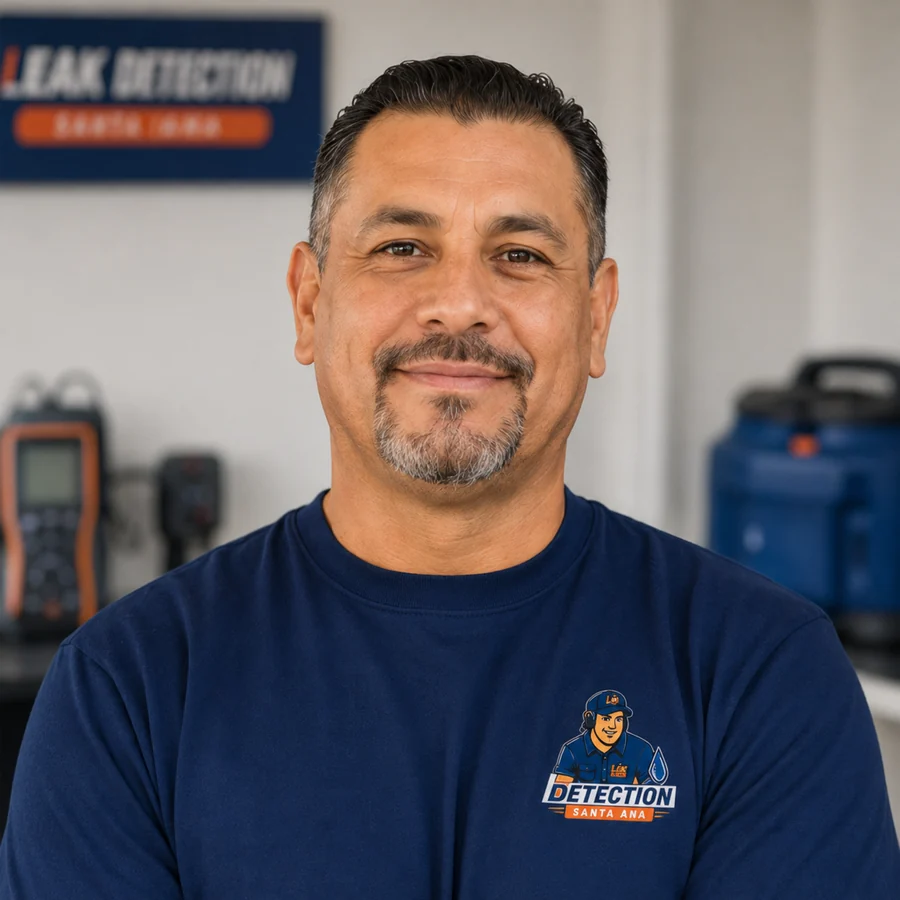
By David Herrera, Founder & Lead Leak Detection Technician at Leak Detection Santa Ana. This page offers general causes and a self-check, not a diagnosis of your specific home; a bill spike can have several explanations, and only an on-site check confirms which one applies.
David Herrera, Founder & Lead Leak Detection Technician
About the Author
David Herrera, Founder & Lead Leak Detection Technician
founded Leak Detection Santa Ana after 15+ years of hands-on plumbing and leak-detection work across Orange County. He specializes in locating slab leaks without tearing up a home's floor, and in planning whole-house repipes for the area's older, hard-water housing stock. Read more about David →

Meter Still Moving?

If water is running with everything off, we pinpoint exactly where. No detection fee if we can't find it.

(714) 386-7923Call or text, day or night Get a Leak Checked

What's Included

  • Acoustic, thermal & pressure testing
  • No digging or demolition to locate the leak
  • Flat-rate detection visit, credited toward the repair
  • Firm written quote on-site, never over the phone
  • Bilingual, English and Spanish
  • No-find-no-fee & 2-year workmanship warranty

Frequently Asked Questions

It doesn’t take much. A stuck toilet fill valve can waste up to 4,300 gallons a day on its own, per the EPA’s WaterSense program, and a slab leak can run continuously around the clock, so either one can show up clearly on a single billing cycle even without any change in how you use water day to day.

Yes. A slab leak in particular can run for a while before a warm floor spot, a sound of running water, or a wet yard patch becomes noticeable. See our full slab leak signs and symptoms checklist for what to watch for even when nothing looks obviously wrong yet.

A slab leak is worth addressing promptly, but it’s rarely an instant emergency the moment it’s suspected. It’s a leak worth diagnosing and fixing without unnecessary delay, not a reason to panic before you’ve even confirmed one exists.

That’s exactly the situation non-invasive detection is built for. We locate the leak using acoustic, thermal, and pressure-testing equipment, and if we can’t find it, there’s no detection fee, so confirming the “where” carries no wasted-money risk on your end.