Mon–Sat 7am–6pm · 24/7 Emergency Line
Serving Santa Ana & Central OC

Sewer line repair starts with a camera inspection to find the break, the blockage or the root intrusion, then a repair chosen to match the damage. A single cracked section is spot-repaired. Root intrusion in a pipe that still holds its shape is lined. A collapsed or bellied line is replaced. Nobody should price a pipe they have not seen, the camera inspection and locate is a flat $150 to $500.
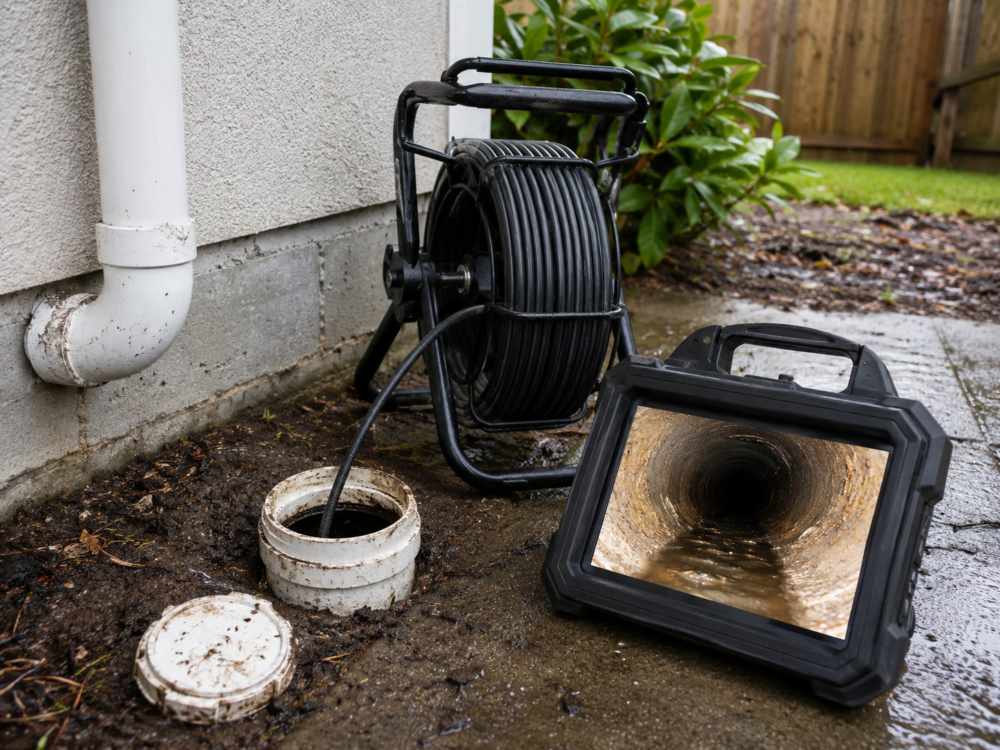
A sewer problem announces itself differently from a supply leak, and the difference is worth knowing before you call anyone. A supply leak shows up on the meter. A sewer problem shows up in how the house drains.
| Service | When it is the right call |
|---|---|
| Camera inspection and locate | Before any quote — nobody prices a pipe they have not seen |
| Spot or sectional repair | A single break or offset joint on an otherwise sound line |
| Trenchless lining (CIPP) | Cracks and root intrusion where the host pipe still holds its shape |
| Pipe bursting | A collapsed, crushed or undersized line where a full trench is not wanted |
| Sewer cleanout installation | No accessible cleanout, which is what forces roof-vent or pulled-toilet access |
| Sewer lateral repair | The building lateral between the house and the property-line connection |
| Cast iron descaling | Scale narrowing the bore of an old cast iron line before it ever leaks |
What we do not do is recurring drain cleaning. If a drain keeps clogging after it has been cleared, that is a pipe-condition problem and it is squarely our work. Clearing the same clog every few months is a rooter company’s business, not ours. See drain keeps clogging after snaking.
| Method | Best for | Digging | Typical lifespan |
|---|---|---|---|
| Spot repair | A single break on a shallow line | Small excavation | 20–40 years |
| Trenchless lining (CIPP) | Cracks and root intrusion, pipe still round | Two access pits | About 50 years |
| Pipe bursting | Collapsed or undersized line | Two access pits | 50+ years |
| Full replacement | Collapse, severe belly, badly misaligned | Full trench | 50+ years |
Sewer lines fail by material, and the material tells you the likely failure mode. These are general properties of the pipe rather than claims about any particular street:
| Material | Era | How it fails |
|---|---|---|
| Vitrified clay | The Southern California standard until ABS and PVC displaced it | Joints open and roots enter through them. The pipe is durable; the joints are not |
| Orangeburg (bituminized fibre) | Roughly 1945–1972 | Deforms rather than cracks: the bore goes oval and then closes |
| Cast iron | Common through the mid-century | Graphitic corrosion and scale narrowing the bore, often long before it leaks |
| ABS and PVC | Post-1980 | Joints and bellies rather than collapse. Sags hold waste and clog repeatedly |
Roots are the single most common cause we see, and they are opportunists rather than attackers. They enter through a joint or crack that was already there. That is why cutting them out without repairing the opening buys a season. See tree roots in a sewer line.
Sewage backing up into the house is not a next-week problem. We answer 24/7 and we dispatch 24/7 — someone picks up the phone at 3am, and someone comes out. Call in English or Spanish.
What we will not do is put a number on how fast. Nobody has given us an honest after-hours response window and we are not going to invent one. What is confirmed is that the phone is answered and a technician is dispatched, at any hour.
Those are ranges rather than quotes. Length is the single biggest variable on a sewer job, which is exactly why somebody else’s total tells you nothing about yours, and why a price given before a camera has been down the line is a guess with a decimal point on it.
| Factor | Effect |
|---|---|
| Length of the run | The largest single driver. A short lateral and a long one are different jobs |
| Depth | Deeper means more excavation, more shoring, more time |
| What is on top | Lawn is cheap. A driveway, decking or mature landscaping is not |
| An accessible cleanout | Without one, access has to be created before anything else |
| Pipe condition | A line that can be lined is cheaper than one that must be replaced |
| A belly | Rules lining out entirely |
Your price is quoted in writing after we see the job, and on sewer work that means after the camera, not before. Full detail is on sewer line repair cost.
Sewer work is expensive, largely invisible once finished, and easy to do badly. Four questions separate the contractors worth having, and they work on us as well as on anyone else:
The full list, with the red flags, is on how to choose a leak detection company.
We are licensed and insured plumbers, and this site is about leaks and the pipes that cause them. On sewer work the boundary is worth stating plainly, because the adjacent trades are close enough to be confusing.
Standalone or recurring drain cleaning is a rooter company. Hydro-jetting as a maintenance service is a drain service. Septic systems are a septic contractor, and most of Orange County is on municipal sewer anyway. The city main past your property line is the city’s. Hardscape and landscape reinstatement after an excavation is the relevant trade, and we say so before the quote rather than after.
The full list, with the trade to call for each, is on what we don’t do.
All four, whether or not you go ahead. Repairs carry a two-year workmanship warranty — full terms on guarantees and warranties.
Drains backing up? We camera the line first, then quote the repair in writing.
(714) 386-7923Call or text, day or nightSchedule a VisitCamera inspection and locate is $250 to $500, charged whether or not a fault is found. A spot repair typically runs $1,500 to $3,500, trenchless work $4,000 to $12,000, and a full open-trench replacement $6,000 to $20,000. Length, depth and what sits on top of the line drive all of it, which is why somebody else’s total tells you nothing about yours. Your price is quoted in writing after the camera inspection, not before.
Yes, and so does anyone quoting you. A sewer line is underground and the difference between a crack, a belly and a collapse changes both the method and the price. A quote given without a camera is a guess with a number attached.
Often. Trenchless lining and pipe bursting both work from two access pits rather than a trench along the whole run. The exception is a belly, a low spot that holds waste. A liner follows the shape of the pipe it is inside, so a belly is still a belly afterwards.
The pipe running from your house to the connection at the property line. The lateral is generally the property owner’s responsibility; the main it connects to in the street is the city’s. Most of what we repair is the lateral. See what is a sewer lateral.
Not as a service in its own right. If a drain keeps clogging after it has been cleared, that is usually the pipe’s condition rather than a clog, and diagnosing and fixing that is our work. Clearing the same drain every few months is a rooter company’s business.
Not through a repaired section. Roots enter through an opening that was already there, so cutting them out without closing the opening buys a season at best. Lining or replacing the affected section removes the way in.
Count the fixtures. One slow drain is that fixture. Several backing up together, or a toilet that gurgles when the washing machine drains, points at the line they share. That is the point at which a camera is worth more than a plunger.
Yes. We answer 24/7 and we dispatch 24/7, in English or Spanish. We will not quote you a response time, because no honest after-hours window has been established — what is confirmed is that the phone is answered and someone comes out.
On-site sewer alterations and repairs are permitted work in Santa Ana, and they are available as a same-day express permit rather than needing a full plan review. See plumbing permits in Santa Ana.
Backfill of the excavation is included; hardscape reinstatement is not. On a run under a driveway that can be a significant fraction of the total, so it is named in the quote rather than discovered afterwards.