Mon–Sat 7am–6pm · 24/7 Emergency Line
Serving Santa Ana & Central OC

Somebody has already been out. Possibly two somebodies. The bill is still high, the damp patch is still there, and nobody can tell you why. This is the call we get most often from people who have run out of patience, and it needs a different approach than looking harder in the same places.
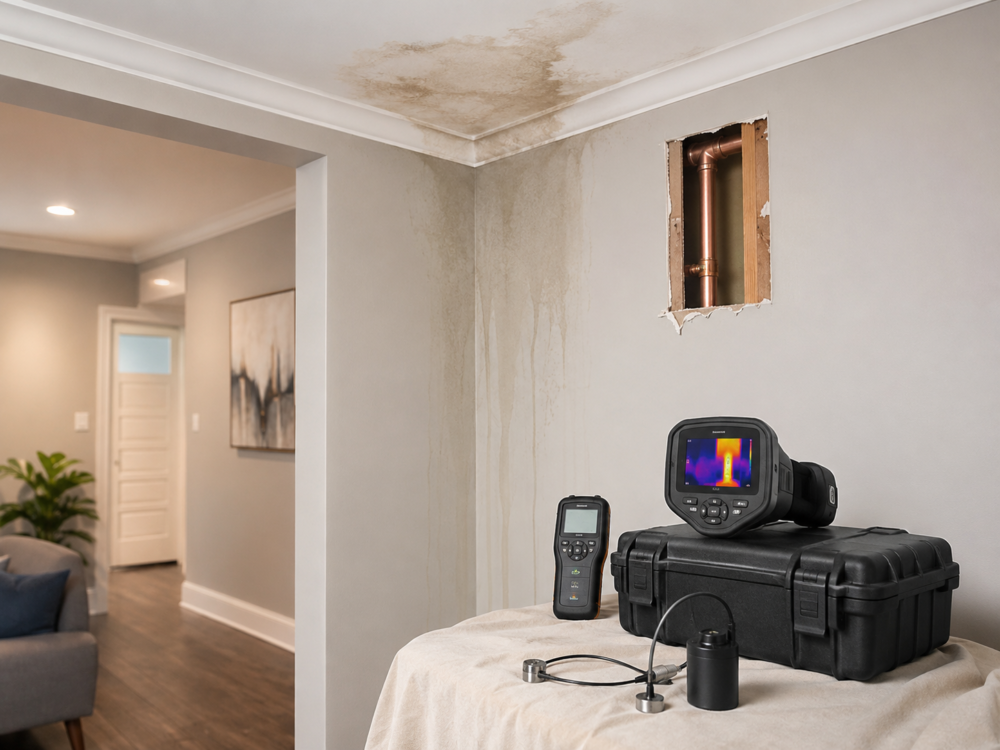
Almost always one of six reasons, and none of them is that the leak is supernatural.
| Reason | What happened |
|---|---|
| They searched where the water appeared | Water travels. It surfaces where it can escape, not where it started |
| One method only | Acoustic alone misses quiet leaks. Thermal alone misses cold-line leaks |
| The house was noisy | Acoustic listening needs a quiet, settled system to work at all |
| It is intermittent | A leak that only runs under certain conditions is not there when they listened |
| It is not the plumbing | Roof, HVAC condensate, an appliance, grading, genuinely common |
| They stopped at the first finding | There were two, and only one got fixed |
Every detection method has a blind spot. Knowing them is most of the skill, and it is why a single-method search on a difficult leak is a coin toss.
| Method | Finds | Blind spot |
|---|---|---|
| Acoustic | Pressurised leaks through concrete and soil | Quiet leaks, drains, background noise |
| Thermal imaging | Hot lines, wet areas by temperature | Cold-water leaks with no thermal contrast |
| Tracer gas | Very small and very deep leaks | Needs the line drained and isolated |
| Moisture meters | Where material is wet right now | Says wet, not where the water came from |
| Camera | Drain and sewer condition | Drains are not pressurised — no leak test |
| Pressure testing | Whether a section holds | Tells you which section, not which inch |
Put differently: an acoustic-only company will miss a cold-line pinhole under a quiet slab, and a thermal-only company will miss it too. Together they usually will not.
Condensation is its own category and it fools people constantly. See is it condensation or a leak.
Flat, not hourly, and that matters more here than on any other page on this site. A mystery leak takes longer by definition; an hourly rate would charge you most for exactly the search you called about. If we cannot locate it during your paid visit, there is no detection fee.
Everything we price is on the pricing page.
A leak that is not leaking when the technician is standing there is the genuinely hard case, and it deserves a straight description rather than confidence.
That week of notes is not busywork. It is the difference between a search and a test: if the patch appears only when the air conditioning has run for hours, we know what to test first, and the visit gets much shorter.
We are licensed and insured plumbers, and this site is about leaks — finding the ones you cannot see and repairing them properly. Roughly half of what looks like a plumbing leak turns out not to be one, so the boundary is worth stating plainly.
Roof leaks are a roofer. Water under an air handler is an HVAC technician clearing a condensate drain. Water under an appliance is appliance repair. Drying, restoration and mold are separate trades again, and gas line repair is SoCalGas or a licensed gas fitter. We detect gas leaks, we do not repair gas lines.
The full list, with the trade to call for each, is on what we don’t do.
It happens, and it is a result rather than a failure. What you get in that case is specific enough to act on.
Charging somebody for a search and handing them nothing because the answer was inconvenient is not a service. The report is the deliverable, and it exists either way.
After enough of these, patterns emerge. None of this is a substitute for testing your specific house, but it is where experience says to look when the obvious places have already been ruled out.
| Symptom nobody could explain | What it often turns out to be |
|---|---|
| High bill, nothing wet anywhere | Irrigation, or a toilet flapper that only leaks sometimes |
| Damp patch that moves around | Water tracking along a joist from a single source |
| Wet only in summer | HVAC condensate, not plumbing at all |
| Wet only after rain | Roof, flashing, or grading against the foundation |
| Musty smell, nothing visible | Long-running moisture under a raised floor |
| Repaired leak, bill still high | A second leak that was never looked for |
| Meter still turns with the house isolated | A supply line outside the building envelope |
Notice how many rows are not plumbing. That is the honest shape of this category, and it is why the method starts with proving whether the supply is losing water at all rather than with searching for a leak somebody has already assumed exists.
We start from zero, test every system, and write down what was ruled out as well as what was found.
(714) 386-7923Call or text, day or nightSchedule a VisitOften, yes, usually because we start from zero rather than from their conclusion, and because we run more than one method. What we will not do is promise it. If we cannot locate it during your paid detection visit, there is no detection fee.
Six common reasons: searching where the water appeared instead of where it started, using one method only, a house too noisy for acoustic listening, an intermittent leak that was not running during the visit, a second leak nobody looked for, and the plumbing being sound in the first place.
You get that in writing, with what was tested, what was ruled out, and which trade to call next. That is a real result. It stops you paying three trades to guess in turn.
The same flat $150 to $500 as any detection visit, credited toward the repair. Flat rather than hourly matters most on exactly this kind of call, because a hard search is the one an hourly rate punishes.
Bring it, but we read it afterwards, not first. Starting from somebody else’s conclusion is how you confirm their mistake with better equipment. Once we have our own result, comparing the two is genuinely useful.
Most often irrigation, a running toilet, or a leak in a place that drains away without ever surfacing — under a slab into permeable soil, for instance. The meter test with the irrigation isolated separates those quickly.
Yes, but the pattern is the key and you are the one who can record it. Note when it happens, what else was running, and photograph the patch at its worst. That turns an open search into a specific test.
More often than people expect, particularly in older houses where the plumbing is all the same age. A repaired leak followed by a bill that stayed high is the classic sign, and it is why we run the full house rather than stopping at the first finding.
Longer than a straightforward one — commonly a couple of hours or more, because the point is to test systematically rather than quickly. The flat fee is what makes that possible without the clock changing what gets done.
No detection fee, and you still get the written record of everything that was tested and ruled out. That document has value: it is what the next trade starts from instead of starting over.