Mon–Sat 7am–6pm · 24/7 Emergency Line
Serving Santa Ana & Central OC
CORE SERVICE · SANTA ANA & CENTRAL ORANGE COUNTY

Trenchless Sewer Repair in Santa Ana, CA

Trenchless sewer repair fixes a damaged sewer line through one or two small access points instead of digging up your entire yard. At Leak Detection Santa Ana, we perform this repair ourselves, and because it’s a repair option rather than a detection method, it always follows a camera inspection that shows us exactly what’s wrong and where, never a repair we recommend on a guess.

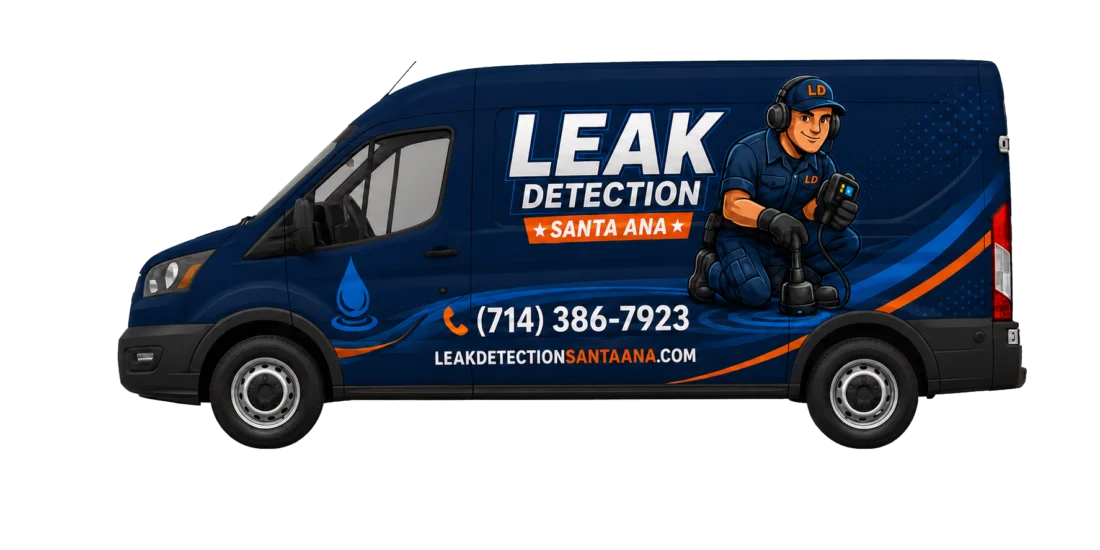
Leak Detection Santa Ana trenchless sewer repair service van

How We Perform a Trenchless Sewer Repair

We handle trenchless sewer repair end to end: the same team that runs the camera inspection and confirms the damage also plans and completes the repair. Because the work always follows that inspection, we know exactly what the line needs before anything begins, the location of the damage, its extent, and whether trenchless is genuinely the right method for it, rather than guessing. From your first call through the finished repair, you're working with one company, so there's no hand-off to a separate contractor and you never have to explain your situation twice.

Estimated Trenchless Sewer Repair Costs in Santa Ana

Sewer work is priced by method rather than as one band, because lining a pipe and replacing it are different pieces of work. Lining (CIPP) is estimated at $80 to $250 per linear foot, pipe bursting at $60 to $200 per linear foot, and a full trenchless project at $8,000 to $18,000.

MethodEstimated price
Sewer lining (CIPP)$80 – $250 per linear foot
Pipe bursting$60 – $200 per linear foot
Trenchless repair, full project$8,000 – $18,000
Open-trench replacement$6,500 – $22,000

Estimates based on Orange County pricing, reviewed August 2026. Your price is quoted in writing after we see the job.

Lining a cracked but structurally continuous pipe uses less material and less time than bursting a collapsed one and pulling a new pipe through, so a lining job sits toward the lower end and a full bursting replacement toward the higher. Line length moves it next, since both methods are priced by the run. Access is the third factor: a lateral reachable through an existing cleanout near the foundation is a shorter job than one where the cleanout sits at the property line or is buried under landscaping.

What the old pipe is made of matters to the method, and therefore to the price. Clay cracks at the joints and cast iron scales from the inside, and both can usually be lined provided the host pipe still holds its shape. A section that has collapsed cannot support a liner, which moves the job to bursting or to a dig, and that is the end of the range where the number climbs.

Trenchless usually beats open-trench in California once concrete and landscaping restoration is counted, even where the per-foot figure looks higher. We confirm the actual number in a firm written quote on-site, after the camera inspection has shown us exactly what the repair involves, never a phone-estimate figure. See our full sewer camera inspection cost breakdown for how this fits alongside our other pricing.

Sewer line damaged? Find out what the repair actually needs.
Call (714) 386-7923

Trenchless Repair and Trenchless Replacement Are Two Different Jobs

Trenchless work splits into two methods, and the difference decides your cost and your timeline. Trenchless pipe repair keeps the existing pipe and restores it from the inside. Trenchless sewer line replacement puts a new pipe in, without trenching the yard to do it.

  • Lining (trenchless sewer line repair). A resin-saturated liner is drawn through the damaged pipe and cured in place, forming a new pipe wall inside the old one. The industry name for this is cured-in-place pipe, or CIPP. It suits a line that is cracked, has separated joints, or has root intrusion, but is still structurally continuous.
  • Bursting (trenchless sewer replacement). A new pipe is pulled through the old line while the old pipe is broken outward into the surrounding soil. It suits a line that is collapsed, badly misaligned, or too far gone to line, and it is the method used when the honest answer is to replace the sewer line rather than patch it.

Both avoid the full-length trench that traditional dig-and-replace requires, and both work from one or two access points instead. Which one a line needs is not a preference or an upsell, it is decided by what the camera inspection shows about the pipe's condition. We confirm the method before quoting, so the number you receive is for the work your line actually needs.

There is a third answer, and it is sometimes the right one: no trenchless at all. A line that has collapsed under a driveway or shifted badly out of alignment can be a genuine dig-and-replace job, and we will say so rather than sell a method that will not hold.

What Gets Repaired, and Where the Access Points Are

Trenchless work is done on the sewer lateral, the private line running from your house to the city main, and it is the homeowner's responsibility for its full length on the property.

Access is through the cleanout, the capped pipe that gives direct entry to the lateral, usually near the foundation or at the property line. That access point is why the method is non-invasive relative to digging: the liner or bursting head is drawn through the existing pipe rather than exposing it.

What the old pipe is made of matters. Clay was standard on the oldest Santa Ana laterals and cracks at the joints, which is where roots get in. Cast iron corrodes from the inside and scales until the bore narrows. Both are good candidates for lining, provided the camera inspection shows the host pipe still holds its shape; a fully collapsed section is a bursting or dig job instead, and we say so rather than lining something that cannot support a liner.

The camera inspection that determines this is a flat-rate fee agreed before we arrive. You don't pay that fee when the camera cannot reach or the line cannot be assessed.

Trenchless vs. Traditional Dig-and-Replace

Trenchless repair isn't automatically the better choice for every situation. It works well for many types of damage using one or two small access points, but a pipe that's severely collapsed or badly misaligned may still need traditional dig-and-replace instead. Which path fits your home depends on what the camera inspection actually finds, not a default we push toward because one option happens to be higher-ticket. See our full trenchless vs. traditional sewer repair comparison for the honest, side-by-side breakdown of cost, timeline, and disruption.

Trenchless Sewer Repair Near Me: What to Ask

Three things separate one trenchless contractor from another: whether they inspect before quoting, whether they will tell you when trenchless is the wrong answer, and what the inspection costs.

The first matters because trenchless pipe repair is only possible where the host pipe still holds its shape, and that is a camera question, not a phone question. Anyone quoting a liner before seeing the line is quoting a hope.

The second matters because a collapsed or badly offset section supports no liner, and the honest recommendation there is to replace the sewer line by digging, which costs more and pays us less to say.

The third is simply arithmetic. Ours is a flat-rate fee agreed before the visit, and you keep the footage either way.

Our guarantees: If we can't locate the problem during a paid detection visit, there's no detection fee. Every repair we complete ourselves, including trenchless sewer repair, is backed by our 2-year workmanship warranty. See our full Guarantees & Warranties for the complete, current scope.
For the full camera-inspection service that identifies whether trenchless repair is even the right fit for your line, see our sewer line leak detection and camera inspection service.
Kevin Nguyen, Field Inspector and Quality Control at Leak Detection Santa Ana
About the Author
Kevin Nguyen, Field Inspector & Quality Control
brings 10 years of construction and plumbing inspection experience to the sewer-camera quality-control side of this work, and documents every repair the team completes. He wrote this page from that inspection perspective. Read more about Kevin →
David Herrera, Founder and Lead Leak Detection Technician at Leak Detection Santa Ana
Technical Reviewer
David Herrera, Founder & Lead Leak Detection Technician
reviewed this page for accuracy and guardrail compliance before it published, so what you're reading is checked work rather than one person's unreviewed claim. Read more about David →

Sewer Line Damaged?

We run the camera inspection first, then perform the trenchless repair ourselves. One company from your first call through the finished repair.

(714) 386-7923Call or text, day or night Book a Camera Inspection

What's Included

  • Camera inspection first, never a guess
  • Repair performed by our own team
  • One or two small access points, not a full-yard trench
  • Firm written quote on-site
  • 2-year workmanship warranty

Frequently Asked Questions

A repair method that fixes a damaged sewer line through one or two small access points instead of a full excavation trench across your yard. At Leak Detection Santa Ana, we perform this repair in-house, always after a camera inspection confirms exactly what your line needs.

Yes. Our own team performs the trenchless sewer repair, the same team that runs the camera inspection and confirms the damage first. You work with one company from the first call through the finished repair, with no hand-off to a separate contractor.

Sewer work is priced by method. Lining (CIPP) is estimated at $80 to $250 per linear foot, pipe bursting at $60 to $200 per linear foot, and a full trenchless project at $8,000 to $18,000. An open-trench replacement runs $6,500 to $22,000. Your price is quoted in writing after the camera inspection has shown us the specific damage and your line’s access. See our full sewer camera inspection cost guide for the complete pricing picture.

Neither is universally better. Trenchless works well for many kinds of damage with far less yard disruption, and usually beats open-trench in California once concrete and landscaping restoration is counted, but severely collapsed or misaligned pipe may still need traditional dig-and-replace. See our full trenchless vs. traditional comparison for the honest, criteria-based answer.

It depends on the specific cause and how the damage occurred, not a blanket yes or no. California homeowners insurance policies generally distinguish between sudden, accidental damage, which is typically covered, and gradual, long-term damage, which is typically excluded, a distinction that varies by policy and carrier. The pipe itself is usually not covered even when resulting damage is. We can help you organize the documentation a claim needs, but we don’t promise a specific coverage outcome, since that call belongs to your policy and your carrier.

There’s no fixed number of hours or days we’ll promise without seeing your specific situation first. The timeline depends on your line’s length, the extent of the damage found, and our current scheduling. We’ll give you a realistic timeline as part of the same on-site quote that covers cost, once we actually know what the repair involves.