Mon–Sat 7am–6pm · 24/7 Emergency Line
Serving Santa Ana & Central OC

A slab leak is repaired one of three ways: a spot repair through a small opening in the slab, a reroute that abandons the failed line and runs new pipe overhead, or a whole-house repipe when the system rather than the pipe is failing. Which one is right comes down to the pipe’s condition and how many times it has already failed, not to preference. It is also called foundation leak repair, and in plumbing that usually means the same job. Detection is a flat $150 to $500, credited toward the repair.
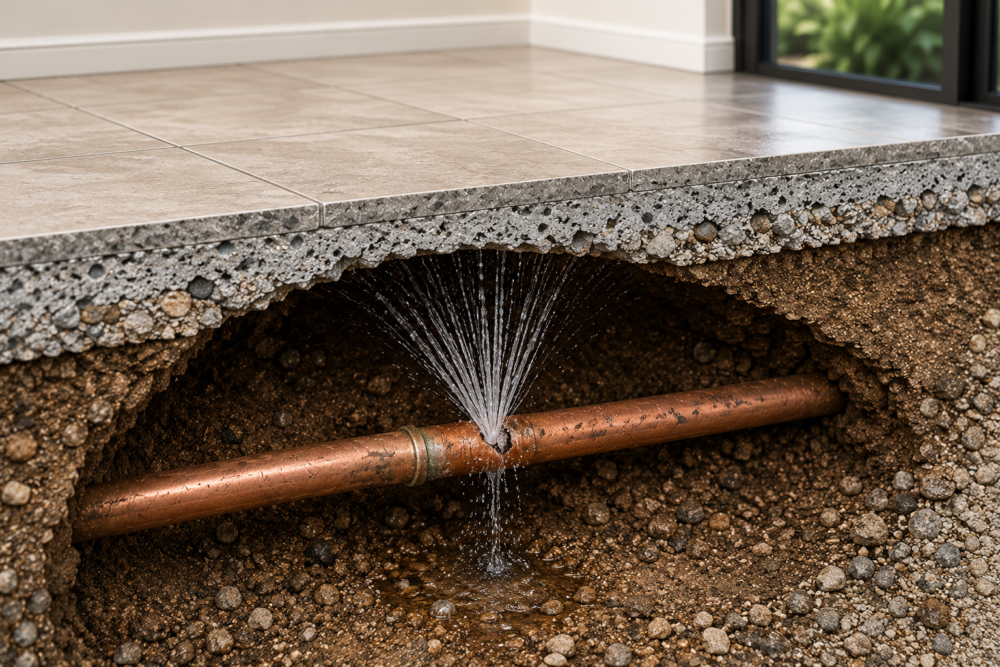
There are only three, and which one is right is not a matter of preference or of what a contractor prefers to sell. It comes down to the pipe’s condition, how many times it has already failed, and what sits on top of it.
| Option | When it’s the right call | What gets opened | How long it lasts |
|---|---|---|---|
| Spot repair, accessible | First leak, pipe otherwise sound, garage or closet | One small slab opening | As long as the rest of the pipe has left |
| Spot repair, finished floor | Same, but under tile or hardwood | Slab opening plus floor restoration | As long as the rest of the pipe has left |
| Pipe reroute | Second leak, or a run that is hard to reach | Overhead or wall routing, drywall patched | Full life of the new pipe |
| Whole-house repipe | Several leaks, or pinholes appearing in copper | Several walls | 50+ years |
This is the option most homeowners have never heard of, and on a second slab leak it is usually the right answer. Worth understanding before anyone quotes you.
Instead of chasing a failed line through the concrete, the run is abandoned in place — isolated and capped at both ends — and new pipe takes a different path, normally through the attic and down inside walls. The slab is never opened.
The reroute in depth is on pipe rerouting.
A post-tension slab holds steel cables under tension inside the concrete. Cutting one is not a plumbing mistake that costs a bit more. It is a structural repair, and an expensive one.
So the concrete is scanned and the cable runs mapped before anything is opened, and the cut is set out against those positions. We do work post-tension slabs, and the scan is not an optional extra on one.
If you do not know which kind of slab you have, that is the normal situation and it gets established before quoting. See post-tension slab leak repair.
Detection is charged flat rather than hourly, which matters more than it sounds: the leaks that take longest to find are exactly the ones an hourly rate would punish you for.
The most common unpleasant surprise in slab leak work, so it is here rather than on the invoice:
| Included | Not included |
|---|---|
| Locating the leak and marking it | Tile |
| The pipe repair, reroute or replacement | Flooring reinstatement |
| Concrete patch where the slab was opened | Paint and texture matching |
| Drywall patch where a wall was opened | Drying and restoration |
| Written report, photos and a written quote | Mold remediation |
Your price is quoted in writing after we see the job. Full breakdown on slab leak repair cost.
Four mechanisms account for most of them. These are properties of plumbing rather than of any particular street:
Hot-water lines fail more often than cold. They expand and contract with every use, and on a slab that movement has nowhere to go, which is also why a warm patch on the floor is one of the more reliable signs. See warm spot on the floor and slab leak signs and symptoms.
We work across Santa Ana including Floral Park, Washington Square, Park Santiago, Wilshire Square, Historic French Park, Fisher Park, Logan and Santa Anita. What is actually under any given house is something we establish on the visit rather than assume from the street.
We are licensed and insured plumbers, and this site is about leaks — finding the ones you cannot see and repairing them properly. Slab leak work drifts into neighbouring trades faster than anything else we do, so the boundary is worth stating before the quote rather than after.
Water damage drying and restoration is a restoration contractor. Mold remediation is a licensed specialty of its own. Flooring, tile and paint are a flooring contractor. Structural and foundation questions are a structural engineer’s call. Gas line repair is SoCalGas or a licensed gas fitter. We detect gas leaks, we do not repair gas lines.
The full list, with the trade to call for each, is on what we don’t do.
It depends on the policy, and the distinction that usually decides it is between the pipe and the damage. Policies commonly cover the damage the water did, and often the cost of getting to the pipe, while treating the pipe repair itself differently.
Sudden failures are also treated differently from long-running ones, which is why acting quickly matters beyond the plumbing: a leak found and reported now is a different claim from the same leak reported in six months.
We do not handle claims and we do not bill carriers. What we give you is the written report, the photographs and an itemised quote, which is what a claim actually needs. See does insurance cover water leaks.
All four, whether or not you go ahead with the repair. The repair carries a two-year workmanship warranty, and if we cannot locate the leak during your paid detection visit there is no detection fee — full terms on guarantees and warranties.

Suspect a slab leak? We locate it precisely first, then quote the repair in writing.
(714) 386-7923Call or text, day or nightSchedule a VisitA spot repair in an accessible area runs $1,500 to $2,500, and $2,500 to $3,500 under tile or hardwood because restoring the floor drives the cost. A single-line reroute runs $2,000 to $4,500, and a whole-house repipe $6,000 to $15,000. Detection is a flat $150 to $500 and comes off the repair. Your price is quoted in writing after we see the job.
Often, yes. A reroute abandons the failed run in place and takes new pipe overhead or through walls instead, so the slab is never opened. It is usually the right answer on a second leak, or where the failed run is hard to reach. The trade-off is drywall rather than concrete.
It depends on whether the pipe has failed before. On a first leak in otherwise sound pipe a spot repair is cheaper and less disruptive. On a second leak in the same system a spot repair tends to buy time rather than fix the problem, and a reroute gives you the full life of new pipe instead.
Three or more leaks, or pinholes starting to appear in copper. At that point the system is failing rather than the pipe, and repairing it one hole at a time costs more than replacing it. Repipe vs slab leak repair covers the comparison.
That is between you and your carrier, and it usually turns on the difference between the pipe and the damage it caused. We will not tell you what your policy does. We will give you the written report and photos a claim needs.
We patch the concrete where the slab was opened and drywall where a wall was opened. Tile, flooring and paint are not included. That is a flooring or tile contractor. We say so before the quote rather than after.
The system is pressure tested after the repair. A repair that holds pressure has held; one that has not shows up on the test rather than on your next bill. The repair also carries a two-year workmanship warranty.
Yes. A post-tension slab holds steel cables under tension, so the slab is scanned and the cable runs mapped before anything is opened. Cutting a cable is a structural repair, not a plumbing one, which is why the scan is not optional there.
In plumbing, usually yes — people often say foundation leak when they mean a pipe leaking under the slab. It is worth being sure, because the same words are used for water getting in through the foundation from outside, which is a waterproofing problem. Foundation leak or slab leak sets out the difference.
We do both, and it is the same crew. Detection is a flat $150 to $500 credited toward the repair, so finding it and fixing it is one engagement rather than two. See slab leak detection.