Mon–Sat 7am–6pm · 24/7 Emergency Line
Serving Santa Ana & Central OC

A patch of floor that is warmer than the rest, in a house on a concrete slab, is one of the more reliable signs there is: a hot-water line under the slab is leaking and heating the concrete above it. Not always. Often enough that it is worth checking today rather than next month.
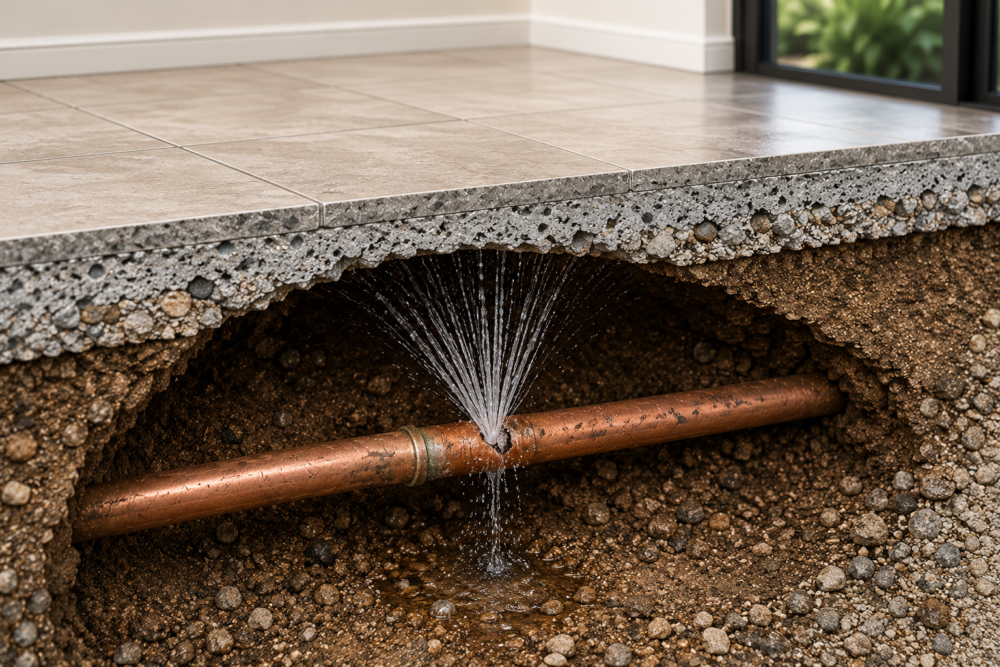
The mechanism is simple, which is what makes the sign so reliable.
Those three take twenty minutes and cost nothing. If the meter is moving and the floor is warm, you almost certainly have a hot-water slab leak and the next call is a real one.
| Cause | How to tell it apart |
|---|---|
| Radiant floor heating | Warms the whole zone, on a schedule, and you know you have it |
| Sun through a window | Moves during the day and disappears at night |
| A heating duct under the slab | Warm only while the heating runs |
| A water heater nearby | Warmth is around the appliance and does not extend |
| A hot-water line running under that spot normally | Warm along a line, not in a patch, and no other symptoms |
| A hot-water slab leak | Constant, day and night, and the meter moves |
The distinguishing feature is constancy. Sun moves, heating cycles, appliances warm their surroundings. A slab leak is warm at three in the morning in July with everything in the house switched off.
Any two of those alongside a warm patch makes the diagnosis fairly safe. All of them together means it has been running a while, and the flooring row in particular means moisture has already reached the surface material.
The leak itself is rarely the expensive part. What it does while nobody stops it is.
| What is happening | While you wait |
|---|---|
| Water escaping under pressure | Billed continuously, day and night |
| The water heater reheating | A second bill, on gas or electricity |
| Water washing soil from under the slab | Support disappears. This is the expensive one |
| Moisture rising into flooring | Wood cups, tile cracks, adhesive fails |
| Damp in the structure | Mold conditions, and a separate trade |
| The slab settling unevenly | Doors stop closing, cracks appear across floors |
The soil row is why this one matters more than an equivalent leak in a wall. Concrete is only as flat as what it sits on, and water moving under a slab takes the fine material with it.
The warm-floor call is a common one here, and the housing stock explains most of it.
| Factor | What it does |
|---|---|
| Slab-on-grade construction | The supply lines are in or under the concrete, unreachable |
| Mid-century copper | Decades of flow thin the pipe wall from the inside |
| Hard water | Santa Ana runs around 250 ppm — scale narrows the bore and raises wear |
| Clay soil | Swells and shrinks with moisture; the slab and the pipe move with it |
| Friction against concrete | A line rubbing on the slab wears through at one point |
| High supply pressure | Anything much over 80 psi works every joint harder |
| Hot lines specifically | Thermal expansion adds constant movement the cold line does not have |
Read the last two rows together and the pattern makes sense: the hot line moves more, against concrete, under pressure, in water that scales. That is why the warm patch is so much more common a call than its cold-water equivalent, and why a second hot-line failure on the same run shifts the answer toward a reroute.
On a hot-water slab leak under finished flooring, a reroute is very often the better answer. It leaves the floor intact and takes the failing run out of service rather than repairing one point on a line that is exactly as old everywhere else. See pipe rerouting.
We are licensed and insured plumbers, and this site is about leaks — finding the ones you cannot see and repairing them properly. Roughly half of what looks like a plumbing leak turns out not to be one, so the boundary is worth stating plainly.
Roof leaks are a roofer. Water under an air handler is an HVAC technician clearing a condensate drain. Water under an appliance is appliance repair. Drying, restoration and mold are separate trades again, and gas line repair is SoCalGas or a licensed gas fitter. We detect gas leaks, we do not repair gas lines.
The full list, with the trade to call for each, is on what we don’t do.
| Situation | Usually |
|---|---|
| First leak, floor is vinyl or unfinished | Spot repair is reasonable |
| First leak, floor is tile or hardwood | Reroute, the flooring is the real cost |
| Second leak on the same line | Reroute that run |
| Hot-water line specifically | Reroute — hot lines fail again more often |
| Third leak anywhere in two years | Repipe: the pipe is telling you |
| Post-tension slab | Reroute, almost always — no cutting |
On a post-tension slab the calculus changes further, because cutting means locating cables first. See post-tension slab leak repair.
If you need to reduce the loss while you arrange a visit, turning the water heater off stops the reheating cost, though the leak continues while the cold system is pressurised.

Warm floor and a moving meter is a slab leak. We locate it precisely before anything is opened.
(714) 386-7923Call or text, day or nightSchedule a VisitNot always. It is one of the more reliable signs there is. Radiant heating, sun through a window, a heating duct under the slab and a nearby water heater can all mimic it. A slab leak is warm constantly — including at night with everything switched off.
Run the water meter leak test. Turn off every fixture including irrigation and watch the meter’s leak indicator. If it is moving and the floor is warm, you almost certainly have a hot-water line leaking under the slab.
Hot lines fail more often. They carry water that is chemically more aggressive, they expand and contract with every use, and that movement against concrete wears the pipe. It is also why a second leak on a hot run is common.
Often, yes. In a quiet house at night, an ear near the warm patch may pick up a faint continuous rush. That is water escaping under pressure. It is the same sound our ground microphones pick up.
Urgent enough not to leave for a month. Water under a slab washes fine material out of the soil supporting it, and that settling is far more expensive to correct than a pipe. The water and reheating costs are running the whole time too.
Not necessarily. A reroute runs a new line above slab level through walls or an attic and leaves the floor untouched, which on tile or hardwood is usually the better trade. A spot repair means cutting the concrete.
A spot repair typically runs $1,500 to $3,500 and a reroute $2,000 to $4,500 per line. Detection is a flat $150 to $500, credited toward the repair. What moves the numbers most is what is on top of the slab.
It stops you paying to reheat water that goes into the ground, so it reduces the bleeding while you arrange a visit. It does not stop the leak — the line stays pressurised as long as the cold supply is on.
Yes, and that is the mechanism worth understanding. Water moving under concrete carries away the fine soil supporting it, so the slab settles unevenly. A new crack across a tiled floor, or a door that suddenly will not close, follows from that.
Read your policy. Many cover the resulting damage more readily than the pipe itself, and sudden damage more readily than deterioration. Photographs, a dated written report and the failed section of pipe are what a claim rests on.