Mon–Sat 7am–6pm · 24/7 Emergency Line
Serving Santa Ana & Central OC

Rerouting abandons a failing line where it lies and runs a new one somewhere reachable, through a wall, an attic, a ceiling. On a slab home it is usually the answer that leaves your floor intact, takes the bad run permanently out of service, and costs less than cutting concrete to fix one inch of it.
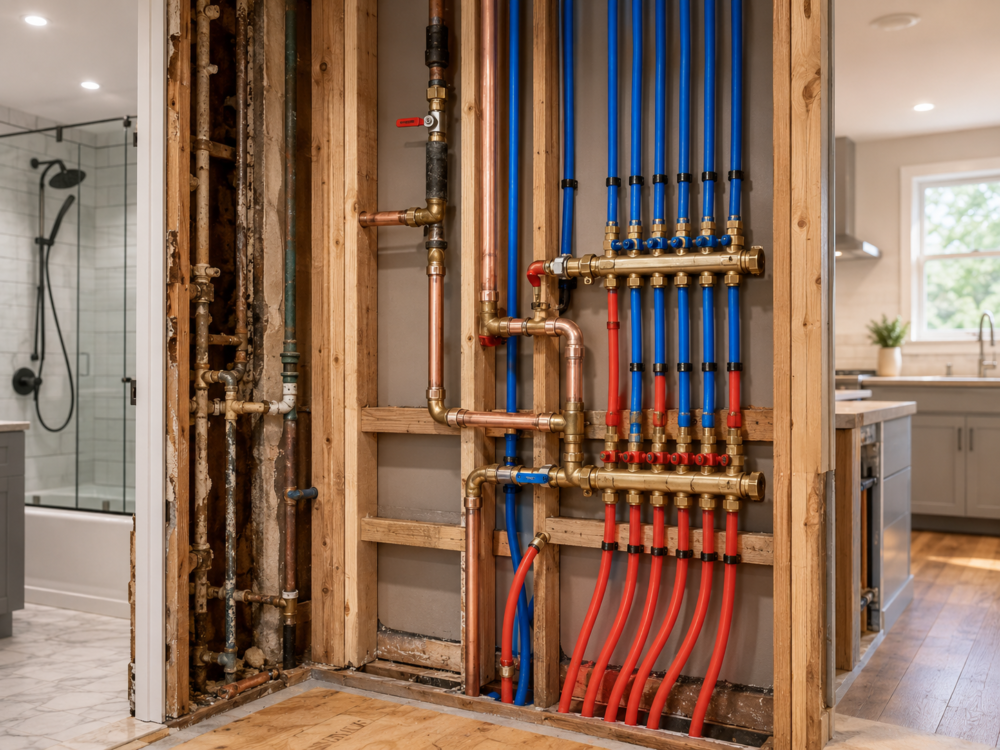
A line under a slab is in the worst possible place for a repair: encased in concrete, under whatever flooring you chose, and reachable only by removing both. Rerouting takes the problem out of that situation entirely.
| Situation | Better answer |
|---|---|
| Slab leak under tile or hardwood | Reroute: the flooring is the real cost |
| Second leak on the same run | Reroute: the run is failing, not the spot |
| Leak under a kitchen island or built-in | Reroute, almost always |
| Hot-water line under a slab | Reroute, hot lines fail again more often |
| Leak in an accessible wall | Spot repair, nothing to route around |
| First leak, clear physical cause | Spot repair |
| Leaks on several different runs | Repipe, rerouting one at a time gets expensive |
A reroute quote covers the route, the material, the tie-ins, testing and patching what we open. It does not cover finish work, and that is stated on the quote rather than left to be discovered. Everything we price is on the pricing page.
Two or more reroutes in the same house start to approach the cost of a repipe, and a repipe replaces everything rather than one run at a time. If you are on your second reroute, ask for both numbers. We would rather quote you a repipe you were expecting than a third reroute you resent.
This is the question everyone asks and few get a straight answer to.
| Opened | Not opened |
|---|---|
| Small access holes in drywall along the route | The slab |
| An attic hatch or ceiling access, where used | Finished flooring |
| Cabinet backs, occasionally | Anything outside the chosen route |
| The wall at each tie-in point | Rooms the route does not pass through |
Openings are sized for the work rather than for convenience, and we walk the route with you before anything is cut so there are no surprises about where holes appear. A reroute through an attic in a single-storey house often means very few openings at all.
Not every pipe in a house is a candidate. Rerouting works on pressurised supply lines, and the reason is gravity.
| Line | Can it be rerouted? |
|---|---|
| Hot water supply under a slab | Yes: the most common reroute we do |
| Cold water supply under a slab | Yes |
| A branch feeding one bathroom | Yes, and often the cheapest version of this job |
| The main from the meter to the house | Yes, though that is usually a replacement instead |
| A drain or waste line | No — drains need fall, so they cannot go up into an attic |
| A sewer lateral | No — same reason. That is a repair or a replacement |
| A gas line | Not by us. We detect gas leaks; we do not work on gas lines |
The drain rows catch people out. A supply line works under pressure and can be routed uphill without complaint; a drain relies on falling and cannot. If your problem is a drain under the slab, the honest answer is a different method. See sewer line repair.
A fair question, and one that deserves something better than a marketing number.
Nobody can tell you a number of years and mean it. What can be said honestly is that the specific conditions that caused this failure are no longer acting on the line that replaced it, and that if it ever does need attention, reaching it is a drywall job rather than a concrete one.
It is the most common worry about this method and the answer is no, with a reason rather than a reassurance.
The one thing worth doing is keeping the paperwork. A future plumber, inspector or buyer benefits enormously from knowing a reroute was done and which run it replaced, and that record is part of what you get.
We are licensed and insured plumbers, and this site is about leaks — finding the ones you cannot see and repairing them properly. Roughly half of what looks like a plumbing leak turns out not to be one, so the boundary is worth stating plainly.
Roof leaks are a roofer. Water under an air handler is an HVAC technician clearing a condensate drain. Water under an appliance is appliance repair. Drying, restoration and mold are separate trades again, and gas line repair is SoCalGas or a licensed gas fitter. We detect gas leaks, we do not repair gas lines.
The full list, with the trade to call for each, is on what we don’t do.
The longer comparison is on PEX vs copper.
Full terms on guarantees and warranties.

We locate the leak precisely, then price the reroute against the spot repair so you can compare.
(714) 386-7923Call or text, day or nightSchedule a VisitTypically $2,000 to $4,500 per line. Length of the route, how many openings it needs and how accessible the tie-in points are all move it within that. Your price is quoted in writing after we see the job.
Usually, when the leak is under finished flooring or the run has failed before. A spot repair fixes one inch of pipe and leaves the rest of the run exactly as old as it was; a reroute takes the whole run out of service.
No — avoiding that is the entire point of the method. The new line runs above slab level through walls, an attic or a ceiling, and the failing line is capped and left where it is.
No. Capped at both ends and not under pressure, it cannot leak, and copper in concrete is inert. Removing it would mean the excavation we are avoiding. It appears on the written record of the work, which is what matters for a future sale.
One to two days for a single line in most houses. Attic routes in single-storey homes tend toward the shorter end; a route that has to cross the house at ground level takes longer. The schedule is on the quote before we start.
For most of it, yes. Only the line being replaced comes out of service, and the tie-in points are the part that needs the water off. We tell you when and roughly for how long.
We patch what we opened. Texture matching, paint and tile are finish trades and are named as exclusions on the quote — stated up front rather than discovered at the end.
It should not, and it often improves it. A new line is a clean bore with no scale in it, which on an older house with hard-water buildup can be a noticeable difference in the fixtures it feeds.
For a reroute inside walls, in most respects it is better: it bends rather than needing fittings at corners, so there are fewer joints to fail, and it does not scale in hard water. Copper still wins on exposed runs.
Ask for the repipe number as well. Two reroutes start to approach it, and a repipe replaces everything instead of one run at a time. We would rather give you both figures than sell you the third reroute.