Mon–Sat 7am–6pm · 24/7 Emergency Line
Serving Santa Ana & Central OC

A pool that keeps dropping is losing water through the shell, the plumbing, or the equipment, and the three are repaired completely differently. Before any of that, there is a free test that tells you whether you have a leak at all, because in Southern California a good deal of “my pool is leaking” is evaporation.
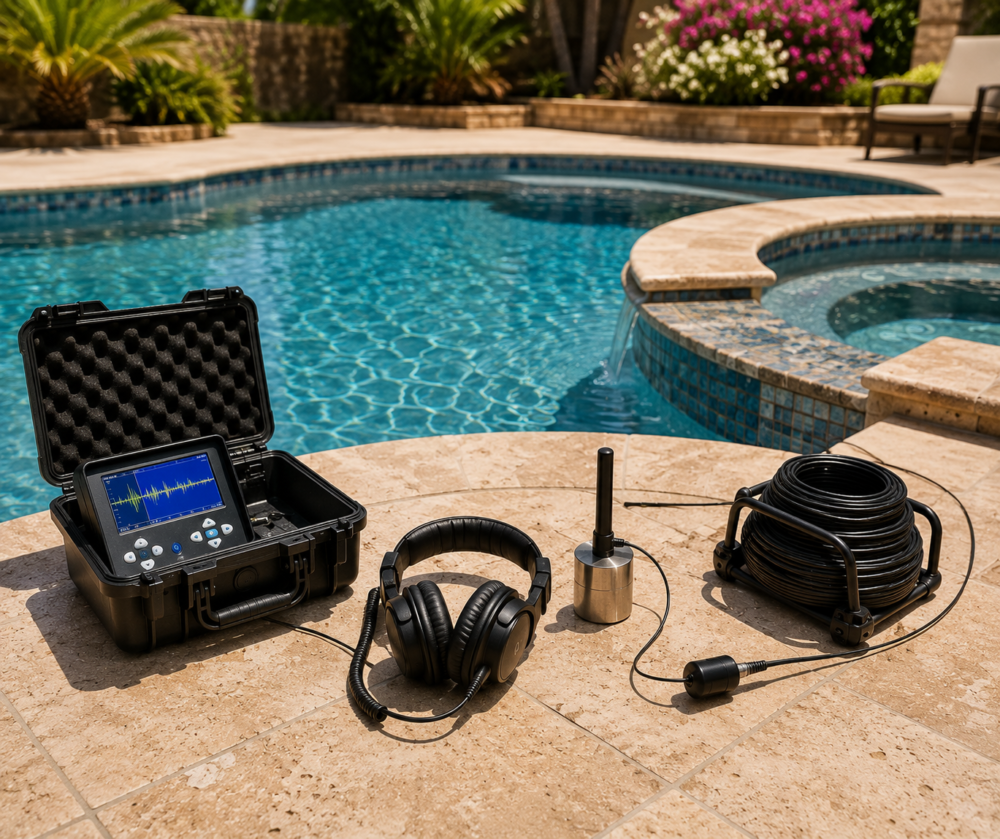
An uncovered pool in this climate loses roughly a quarter of an inch a day to evaporation. Over a week that is close to two inches, which is enough to convince anybody they have a problem. The bucket test separates the two, it costs nothing, and it takes a day.
| Location | How it behaves |
|---|---|
| Skimmer, at the joint to the shell | Loses down to just below the skimmer, then stops |
| Return fittings and light niche | Steady loss, often with wet ground nearby |
| Main drain | Loses continuously, down toward the drain level |
| Suction lines | Worse with the pump off |
| Pressure lines | Worse with the pump running |
| Shell cracks and plaster | Loss stops at the crack level, a very useful clue |
| Tile line and expansion joint | Loses to just below the tile |
| Equipment pad | Usually visible — look before assuming anything else |
Where the water stops falling is the strongest single piece of evidence you can gather. A pool that stabilises at a particular level is telling you the leak is at that level, and that alone eliminates most of the list.
Detection detail is on pool leak detection. This page is what happens after it.
On a pool, what sits above the pipe is the variable that matters. A line under a lawn and the same line under a stamped concrete deck are identical plumbing and very different jobs, and the difference is deck rather than pipe.
Everything we price is on the pricing page, and the detection side is broken down on pool leak detection cost.
That last one is the urgent item. A pump that loses prime and keeps running can be damaged in a single afternoon, and it turns a plumbing repair into a plumbing repair plus a pump. If the level is anywhere near the skimmer, turn the pump off.
A spa attached to a pool has its own plumbing, its own fittings and frequently its own heater, which means it can leak while the pool is sound.
| Symptom | Where to look |
|---|---|
| Spa drops, pool holds | Spa plumbing, spillway, or the spa shell |
| Both drop together | Shared plumbing, or the shared equipment pad |
| Spa drops only when it runs | Pressure side — jets, blower or return lines |
| Spa drops when it is off | Shell, spillway seal, or the suction side |
| Water feature drops, pool holds | The feature’s own plumbing or basin |
The pattern of when it loses water is doing most of the diagnostic work in that table. More on it in spa losing water.
We are licensed and insured plumbers, and this site is about leaks — finding the ones you cannot see and repairing them properly. Roughly half of what looks like a plumbing leak turns out not to be one, so the boundary is worth stating plainly.
Roof leaks are a roofer. Water under an air handler is an HVAC technician clearing a condensate drain. Water under an appliance is appliance repair. Drying, restoration and mold are separate trades again, and gas line repair is SoCalGas or a licensed gas fitter. We detect gas leaks, we do not repair gas lines.
The full list, with the trade to call for each, is on what we don’t do.
Worth stating plainly, because pool contracting covers a lot of ground and we do not cover all of it.
| Us | Not us |
|---|---|
| Finding the leak | Resurfacing and replastering |
| Pressure testing the lines | Tile and coping replacement |
| Repairing buried plumbing | Pool remodelling and new construction |
| Fitting and penetration repairs | Weekly pool service and chemistry |
| Equipment pad plumbing | Pump, heater and filter replacement |
| Structural crack sealing at a leak point | Structural assessment of the shell |
If the answer is resurfacing, you will be told that rather than sold a series of patches. A shell that has failed extensively is a plastering job and no amount of sealant changes it.
Run the bucket test first. If the pool is dropping faster, we will find out where.
(714) 386-7923Call or text, day or nightSchedule a VisitThe bucket test. An uncovered pool here loses roughly a quarter of an inch a day to evaporation. Put a weighted bucket on a step with the water inside level with the pool, mark both, and wait 24 hours. If both drop the same amount, it is evaporation.
Fitting and equipment repairs typically run $300 to $1,200. A buried line repair is $1,500 to $3,500, and a line replacement $2,000 to $4,500. What sits above the pipe — lawn or a concrete deck — moves it more than the plumbing does.
Skimmer joints, return fittings, the light niche, the main drain, the suction and pressure lines, and cracks in the shell. Where the water stops dropping is the best clue you can give us, the leak is generally at that level.
Usually not. Pressure testing the lines and dye testing the shell are both done with the pool full. Draining a pool has its own risks in saturated ground and it is a last resort rather than a starting point.
The loss is on the pressure side, the return lines that push water back into the pool. If it leaks more with the pump off, look at the suction side or the shell. Running the bucket test both ways is genuinely useful.
Only at the located point, if the leak is in a line buried under it. That is exactly why we locate before excavating — on a pool the deck is usually the larger part of the bill, and a search rather than a repair is what makes it expensive.
A small one at a leak point, yes. Extensive plaster failure is a resurfacing job and that is a pool plastering contractor rather than us. We will tell you which you have rather than selling you a series of patches.
Yes: an attached spa has its own plumbing, fittings and often its own heater. Whether it loses water while running or while off narrows it quickly. See spa losing water.
The water and chemicals are a running cost rather than an emergency. What is urgent is the level reaching the skimmer: a pump that loses prime and keeps running can be damaged in an afternoon. If the level is near the skimmer, turn the pump off.
No. We find and repair leaks — plumbing, fittings and penetrations. Weekly service, chemistry, resurfacing, tile, coping and remodelling are all separate pool trades, and we will point you at the right one rather than take the work on.