Mon–Sat 7am–6pm · 24/7 Emergency Line
Serving Santa Ana & Central OC

To find a leak under your slab without digging, we use acoustic listening equipment to pinpoint the sound of escaping water, then confirm the exact location with thermal imaging or tracer gas, before any repair begins. That’s the direct answer for a Santa Ana homeowner who suspects a slab leak, a break or slow failure in a water or drain line buried under your home’s concrete foundation, and wants to know how professional detection actually works, not just that it exists. Detection is a flat-rate $150 to $500 visit credited toward the repair; a spot repair is estimated at $1,500 to $3,500, and rerouting a single line at $2,000 to $4,500.

That sequence, listen, confirm, then repair, is why we can find a slab leak in an older Santa Ana home without opening a wall or a floor on a guess. If you're not sure whether what you're noticing even is a slab leak, our plain-language explanation of what a slab leak is is a good place to start.
Each method targets a different clue: acoustic equipment listens for the distinct sound of water escaping under pressure, thermal imaging reveals the temperature difference a leak creates in the slab, and tracer gas traces a scent through the pipe to its exit point. We use these together, not in isolation, because no single method catches every leak in every situation.
No single method finds every leak on its own. A slab leak in dense soil, near existing plumbing, or under tile versus hardwood can behave differently, which is why we combine methods rather than relying on one piece of equipment for every job. Our technicians train specifically on this equipment; running acoustic, thermal, and tracer-gas equipment accurately takes repetition, and it's genuinely most of what we do, not a side skill for a plumber who occasionally handles a leak call.
The goal throughout is precision: finding the leak's exact location before any concrete is cut, so the repair itself, not exploratory digging, is the only disruption to your home. See why this non-invasive approach beats jackhammering the floor →
¿Prefiere leer esto en español? Fugas bajo la losa en Santa Ana. Atendemos en español.
A general plumber can repair a slab leak once it's found. Finding it precisely, without opening a wall or a floor to look, is a different skill, one built by running acoustic, thermal, and tracer-gas equipment on leak after leak until reading the results correctly becomes routine rather than guesswork.
That's most of what we do here, not an occasional call squeezed between a water heater swap and a drain-cleaning job. The distinction matters directly to you: a plumber who mostly handles general repair work and only occasionally investigates a slab leak is more likely to fall back on an educated guess about where to open the concrete, because renting or maintaining dedicated detection equipment for one job rarely pencils out for a generalist.
We do the opposite: locate first, with the same equipment and the same technicians every time, then repair only what we actually found. It's also why one team, not a separate “detection company” handing off to a separate “repair company,” follows the job from the first listening pass through the finished repair. Nothing about the leak's exact location gets lost or re-explained in a hand-off, because there isn't one.
That is the whole of what a professional leak detection service does: it locates a leak before anything is opened, using equipment rather than exploratory demolition, and then repairs what it found. It is worth stating plainly because the phrase gets used loosely. The EPA's WaterSense program puts household leaks at nearly a trillion gallons of wasted water a year nationally, and the average household's own leaks at more than 9,300 gallons a year, which is the scale a single unfound slab leak contributes to.
A sudden jump in your water bill, a warm spot on the floor, or the sound of running water when everything is off are the most common signs of a possible slab leak. None of these signs confirms a slab leak on its own, but each one is worth having checked, especially in an older, slab-on-grade Santa Ana home.
Other signs to watch for include a wet or green patch in the yard with no obvious cause, unexpectedly low water pressure, and brown or rusty water from a tap that's usually clear. The same pattern shows up in older housing stock across Orange County, not just Santa Ana.
Any one of these could have another explanation, a running toilet, a sprinkler timer, hard water buildup, so the pattern across more than one sign is usually what points toward a slab leak specifically. See our full slab leak signs and symptoms checklist → for all seven signs and what each one can mean.
You tell us what you’ve noticed. We locate the leak with acoustic and thermal equipment before anything is opened up. We mark the exact spot and explain what we found in plain language. You get a written quote on site, and the same crew does the repair.
The detection visit is a flat $150 to $500, credited toward the repair if you go ahead. The full sequence — what helps before we arrive, what happens at each step, and the four things you get at the end — is on what happens on a leak detection visit.
If you're ready to get started, contact us to schedule a detection visit.
There's no fixed number of hours we can promise for either step, and we're not going to invent one just to give you a tidy answer. A detection visit's length depends on your home's layout, how accessible the suspected area is, and how many possible explanations need to be ruled out before the leak is pinpointed; a straightforward case with easy crawl-space or yard access typically moves faster than one where the signs are ambiguous or the slab is covered by finished flooring in multiple rooms.
Repair timelines vary the same way: a single spot repair or reroute is typically a shorter, more contained job than a whole-house repipe, which is a bigger undertaking by nature, more pipe, more fixtures, more of the home involved. We'll give you a specific timeline for your own job as part of the same written quote that covers cost, once we actually know what we're dealing with.
What we won't do is promise a leak found in a set number of hours; rushing that step is how a technician ends up cutting into the wrong section of concrete.
Slab leaks are mostly a function of how long a pipe has been in the ground and what it is made of. Older supply lines have simply had longer to corrode, and the two materials used through most of the twentieth century each fail in their own way.
Galvanized steel corrodes from the inside out along its whole length, narrowing the bore before it perforates. Copper is vulnerable to galvanic corrosion — an electrochemical reaction with dissimilar metals or with minerals in the water — which is why hard water shortens its life and why pinholes rarely arrive alone.
Ground movement adds to both. Where a slab sits on soil that swells when wet and shrinks when dry, buried joints take a mechanical stress each year that neither copper nor galvanized steel was built to absorb indefinitely. A joint set in concrete cannot flex with it.
We work across Santa Ana’s older neighbourhoods — Floral Park, Washington Square, Wilshire Square, Historic French Park and others — where slab-on-grade construction is common. What is actually under any given house, and what its supply lines are made of, is something we establish on the visit rather than assume from the street it is on. Read our full Santa Ana Slab Leak Guide →
Usually not an immediate emergency. A slab leak rarely gets better on its own, and the longer it runs, the more water damage and repair cost it can cause. Slow, quiet signs like a warm floor spot or a gradually rising water bill are worth scheduling a detection visit for soon, not necessarily calling in a panic over.
The exceptions are active water pooling inside or outside your home, a rapid, sudden spike in your water bill, or a noticeable drop in water pressure alongside any other sign; any of those combinations is worth a same-week call.
If you're dealing with active flooding or a burst pipe right now, call our 24/7 emergency line: it's answered day or night, in English or Spanish, and can get you talked through shutting off your water and dispatched to the on-call technician. Scheduled detection visits and quotes otherwise run Monday through Saturday, 7am to 6pm.
Once the leak is located, the repair is a spot repair, a reroute of the failed line, or a whole-house repipe where the system is failing rather than the pipe. A spot repair in an accessible area runs $1,500 to $2,500 and a single-line reroute $2,000 to $4,500. Detection is a flat $150 to $500, credited toward whichever it turns out to be.
The three options compared, and what decides between them, are on slab leak repair. The full breakdown, including what is and is not included, is on slab leak repair cost. Your price is quoted in writing after we see the job.
Whether insurance covers a slab leak repair depends on the specific cause and how the damage occurred, not a blanket yes or no. California homeowners insurance policies generally distinguish between sudden, accidental water damage, which is typically covered, and gradual, long-term leaks, which are typically excluded, a distinction the California Department of Insurance's residential insurance guide sets out.
The pipe itself is usually not covered even when the resulting water damage is. See our full guide on documenting a slab leak insurance claim → for what to document and how the process works; we don't promise a specific coverage outcome, because that call belongs to your policy and your carrier.
Four questions separate them: what will you do before opening anything, is the price fixed before you arrive, what happens if you find nothing, and who is actually doing the work. Ours are locate first and cut second, a flat $150 to $500 agreed when you book, no detection fee if we cannot find it, and our own crew rather than a subcontractor.
The full list, the red flags, and how to check a contractor’s licence yourself are on how to choose a leak detection company.
You don't pay the detection fee when our equipment can't locate your leak, and every repair we complete is backed by a 2-year workmanship warranty.
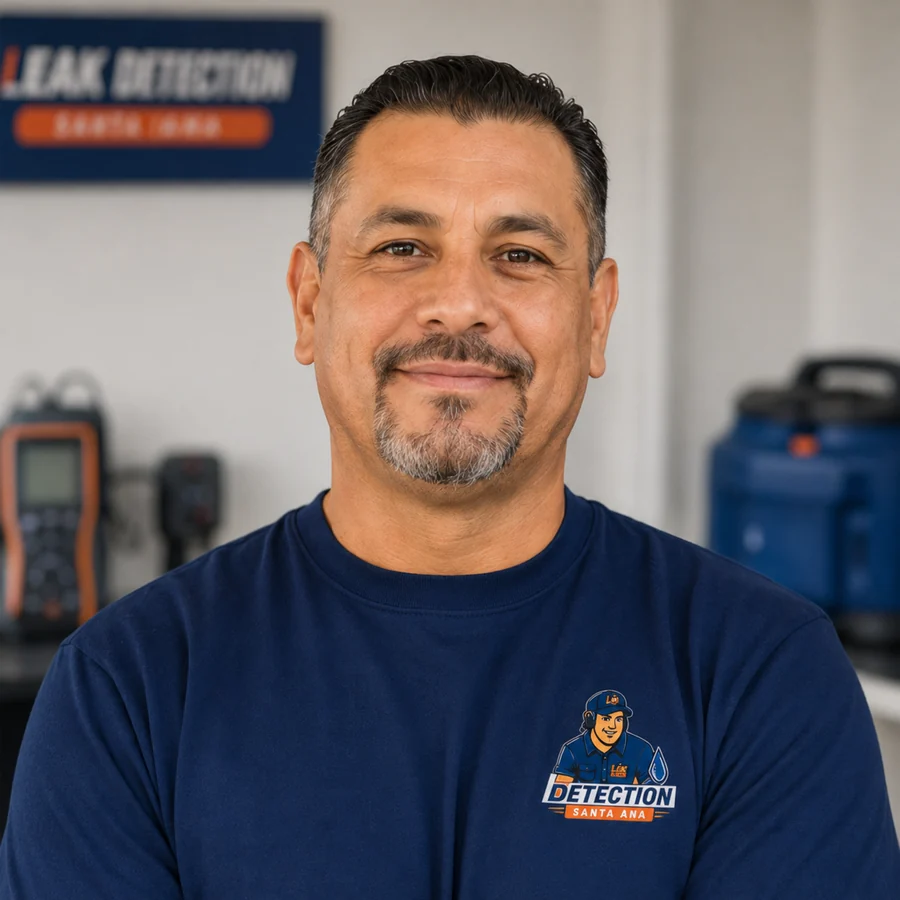
This page is written and led by David Herrera, founder of Leak Detection Santa Ana, who spent 15+ years working hands-on on homes across Orange County before starting this company as a specialist, not a general plumbing shop. He's not the only name behind the work.
Carlos Mendez leads much of the hands-on repair and repipe work and is fully bilingual in English and Spanish, part of why we're able to serve Santa Ana's Spanish-speaking households in their preferred language, from the first call through the finished repair; read more about our bilingual service.
Kevin Nguyen documents every repair the team completes, the kind of paperwork that matters if you need it later for a warranty claim or an insurance claim.
We're a new company, and we say so directly rather than pretending otherwise. What we can offer instead of a long review history is a named team, transparent published pricing, and the two guarantees above, stated in plain language rather than buried in fine print.
Suspect a slab leak? We locate it precisely first, then quote the repair in writing.
(714) 386-7923Call or text, day or night Schedule a VisitAcoustic listening equipment picks up the sound of water escaping a pressurized pipe under the slab, and thermal imaging or tracer gas testing then confirms the exact location before any repair begins. That’s the same sequence described above: listen, confirm, then repair.
A slow slab leak can run for weeks or months before it produces a sign a homeowner notices, which is part of why a sudden high water bill is often the first real clue. A faster, more active leak tends to show up sooner, through a warm floor spot, a sound of running water, or visible water.
Slab leaks are common enough in Santa Ana’s older, pre-1985 slab-on-grade homes that they’re one of the primary reasons the area has ongoing demand for non-invasive detection service, largely because of the galvanized and copper pipe materials and clay soil conditions described above. Newer homes with modern piping see them far less often.
Usually not an immediate emergency. It is not something to ignore either; the exceptions are active water pooling, a rapidly rising water bill, or a sudden pressure drop, any of which is worth a same-week call.
A slab leak is worth taking seriously because it doesn’t resolve on its own and can cause real water damage the longer it runs, even when it isn’t an emergency in the moment you first notice it.
It depends on whether the damage is considered sudden and accidental or gradual, a distinction that varies by policy and carrier. See our full insurance documentation guide for what to document for a claim; we don’t promise a specific coverage outcome.
A spot repair is estimated at $1,500 to $2,500 in an accessible area and $2,500 to $3,500 under tile or hardwood, rerouting a single line at $2,000 to $4,500, and a whole-house repipe at $6,000 to $15,000. Your price is quoted in writing after we see the job. See our full repair cost breakdown for what moves the price within that range.
It depends on your plumbing’s age and history: a single, isolated leak in an otherwise sound system usually calls for a spot repair, while a home that’s already had multiple, unrelated leaks is often a better candidate for a whole-house repipe. See our full repipe versus repair comparison for how we help you decide.
Detection itself doesn’t damage anything, because acoustic, thermal, and tracer-gas methods all work from the surface without cutting concrete or opening walls. Repair is different by necessity, since reaching the actual pipe means opening the specific section of slab or wall where the leak is. Because we locate that section precisely first, the repair stays confined to the leak’s actual location instead of an exploratory search across your floor.
You don’t pay the detection fee when our equipment genuinely can’t locate the leak during your paid detection visit. That’s the no-find-no-fee guarantee described above. In practice this is uncommon once we’ve worked through the full method sequence, but it’s a real guarantee, not a marketing line: no location, no charge for that visit.
A slab leak doesn’t fix itself, and left alone it typically gets worse: more water loss, more water damage to flooring and framing, and a bigger repair bill later. That doesn’t mean every slab leak is a same-day emergency (see above), but waiting and hoping it resolves on its own is rarely the cheaper path once you factor in the cost of the water damage a slow leak causes over months.
Have a slab leak you want looked at, or just want to talk through what you’re seeing before you commit to anything? Contact us to schedule a detection visit, Monday through Saturday, 7am to 6pm, or reach our 24/7 emergency line if you have active flooding right now.