Mon–Sat 7am–6pm · 24/7 Emergency Line
Serving Santa Ana & Central OC

A claim is decided on what you can show. The evidence exists for about an hour, between noticing the water and cleaning it up, and after that it is gone for good. This is what to capture, in what order, and what to keep.
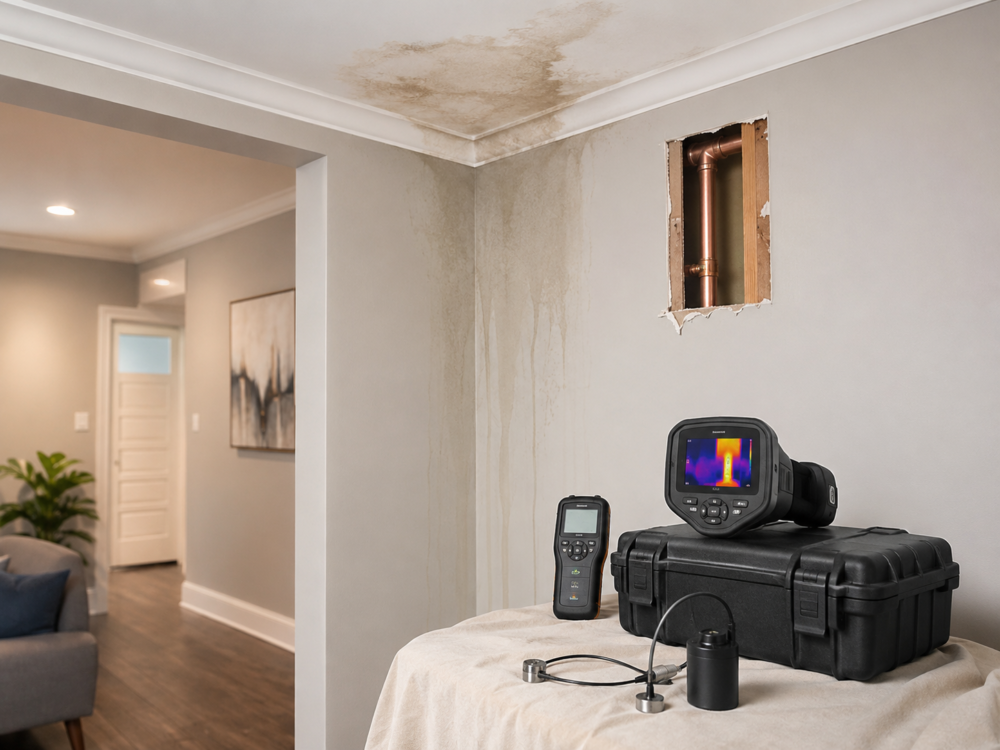
Photograph more than you think you need. Storage is free and the moment is not repeatable, which is a lopsided trade in one direction only.
The date you first noticed it turns up in every conversation that follows, so write it down while it is exact rather than reconstructing it later.
| Record | Why it matters |
|---|---|
| When you first noticed anything | Sudden and gradual are treated differently in most policies |
| What you noticed first | A stain, a sound, a bill. It establishes the sequence |
| When you shut the water off | Shows you acted to limit the damage |
| When you notified anyone | Landlord, association, insurer, with timestamps |
| When each contractor attended | And what each one said |
| What you spent, and when | Emergency purchases are often reimbursable — keep receipts |
A plain text note on your phone, updated as things happen, is enough. What you are building is a record made at the time rather than a recollection assembled afterwards.
An adjuster is trying to establish cause, and a homeowner’s description of a stain does not establish cause. A written technical report does.
| The report states | Why an adjuster wants it |
|---|---|
| Which line failed | Establishes cause rather than describing damage |
| Where, precisely | Ties the damage to a specific failure |
| By what mechanism | Corrosion, physical damage, a fitting. This matters |
| What method found it | Establishes it was diagnosed rather than guessed |
| What was ruled out | Pre-empts the question of whether it was something else |
| Dated photographs | Independent, contemporaneous record |
You get all six on every detection visit, whether or not you go ahead with the repair. See what happens on a visit.
Everything above produces a pile of material. Organising it into one place, once, at the start, saves an enormous amount of chasing later, because a claim usually runs longer than anyone expects.
| Section of the file | What goes in it |
|---|---|
| The timeline | One dated list: noticed, shut off, notified, each visit |
| Photographs and video | In dated folders, originals kept — never only the ones you sent |
| Technical reports | Detection report, camera footage, any engineer’s assessment |
| Quotes and invoices | Every trade, itemised, including the ones you did not use |
| Correspondence | Emails and texts with the landlord, association, insurer, contractors |
| Receipts | Emergency purchases, temporary accommodation, replacements |
| Physical evidence | The failed part, and samples of damaged material |
Two practical points. Keep the original photographs rather than only the compressed copies you emailed — metadata carries the date, and a resized copy may not. And keep the quotes you did not accept: a range of prices from several contractors is useful when a figure is being disputed.
We are licensed and insured plumbers, and this site is about leaks — finding the ones you cannot see and repairing them properly. Roughly half of what looks like a plumbing leak turns out not to be one, so the boundary is worth stating plainly.
Roof leaks are a roofer. Water under an air handler is an HVAC technician clearing a condensate drain. Water under an appliance is appliance repair. Drying, restoration and mold are separate trades again, and gas line repair is SoCalGas or a licensed gas fitter. We detect gas leaks, we do not repair gas lines.
The full list, with the trade to call for each, is on what we don’t do.
We are not going to tell you what your policy covers. We do not know your carrier, your endorsements or your deductible, and anybody who tells you otherwise on a website is guessing. What we can say is what to look for.
| Look for | Why |
|---|---|
| How sudden and gradual damage are treated | This distinction drives a great many outcomes |
| Whether the failed part itself is covered | Many policies cover damage rather than the pipe |
| Notification requirements and time limits | Missing one is an avoidable problem |
| Mitigation obligations | What you are expected to do to limit damage |
| Mold and remediation terms | Often separate, often limited |
| Your deductible | It decides whether claiming is worth it at all |
The general shape of it, without pretending to know yours, is on does insurance cover water leaks.
| Do | Why |
|---|---|
| Photograph your own possessions separately | Your renters policy covers them, not the landlord’s |
| Notify the landlord in writing | A logged, timestamped record — email or text |
| Shut the water off | You never need permission to stop damage |
| Keep receipts for anything you replace urgently | Often reimbursable |
| Photograph the building damage too | Even though it is not your claim. It establishes the event |
The building and the contents are two claims with two policies, and the split surprises people. Documenting both costs nothing extra at the time.
On every detection visit: a written report naming the cause and location, the method used, dated photographs, and an itemised quote. Whether or not you proceed with the repair, and whether or not the answer turns out to be plumbing. If a claim needs something specific from us, ask and we will provide it.
Written report, cause, location and dated photographs - on every visit, either way.
(714) 386-7923Call or text, day or nightSchedule a VisitWide shots of every affected room before anything is moved, then close shots of the detail, the source if you can see it, damaged possessions individually, and serial numbers on any damaged appliances. Include something for scale.
After. Cleanup destroys the evidence permanently, and the moment between noticing the water and mopping it is the only time the record exists. Shut the water off first, though — stopping the damage comes before documenting it.
Yes, and do not let any contractor take it away. A section of pipe with a hole in it is the most persuasive object in the whole file, and unlike a photograph it cannot be questioned.
A great deal. Most policies treat sudden damage differently from damage that developed gradually, and when you first noticed it is part of establishing which you had. Write it down while it is exact.
It helps considerably. An adjuster is trying to establish cause, and a written technical report naming which line failed, where and by what mechanism does that in a way a homeowner’s description of a stain cannot.
Yes: a written report with cause, location, method, what was ruled out, dated photographs and an itemised quote. On every visit, whether or not you go ahead with the repair.
Stop it. Most policies expect you to limit the damage, so leaving water running to build a better photograph would work against you. Shut the water off, then photograph, then start drying.
Document what is left, write down the timeline while you remember it accurately, and keep any damaged material and the failed part. A detection report establishing cause becomes more important, not less, when the scene has been disturbed.
We genuinely cannot tell you. We do not know your carrier, endorsements or deductible. Read your own policy, and look specifically at how it treats sudden versus gradual damage and whether it covers the failed part or only the resulting damage.
Your own possessions separately, because they are your renters policy rather than the landlord’s. Photograph the building damage too, notify the landlord in writing so there is a timestamp, and keep receipts for anything you replace urgently.