Mon–Sat 7am–6pm · 24/7 Emergency Line
Serving Santa Ana & Central OC

A wet ceiling has at least five plausible causes and they belong to four different trades. Calling the wrong one costs you a visit and a week. This page walks the decision the way we would walk it on the phone, including the outcomes where the answer is not us.
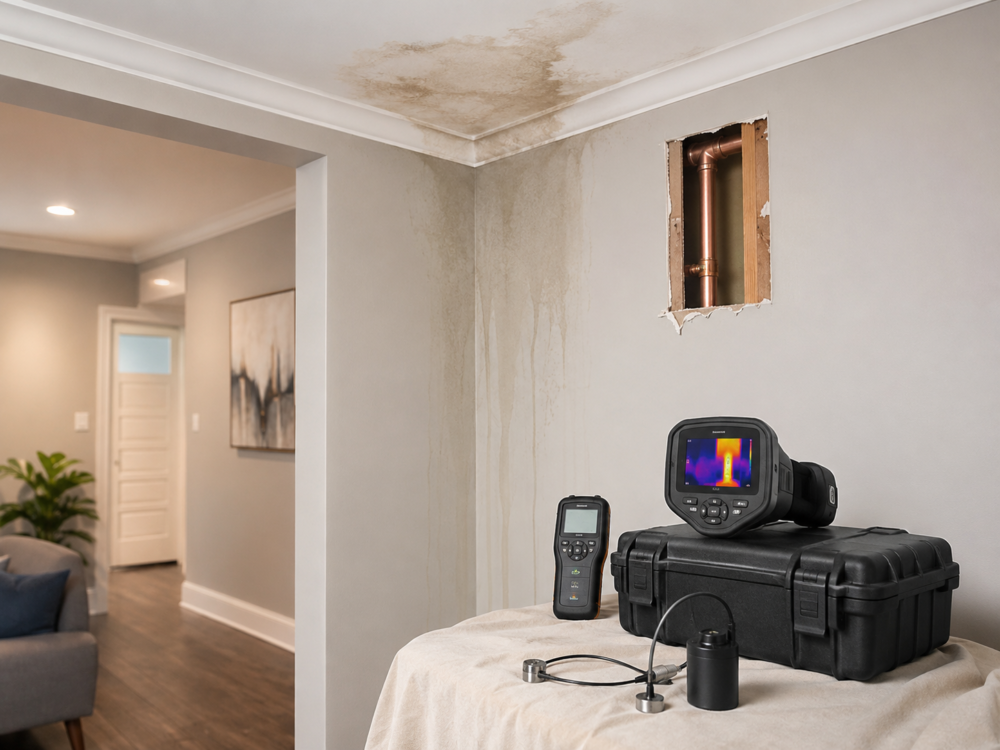
Before calling anybody. These three narrow it further than any amount of looking at the stain does.
| What you are seeing | Who to call |
|---|---|
| Wet after showers, dry in between | Plumber, supply line, shower pan or drain above |
| Wet all the time, nobody has used water | Plumber, supply line or valve |
| Wet after rain, top-floor ceiling | Roofer |
| Wet after rain, around a window | Window or siding contractor |
| Wet when the AC runs, worse in summer | HVAC technician, condensate line |
| Wet under or behind an appliance | Appliance repair |
| Wet at the base of an exterior wall after rain | Drainage and grading, landscaping |
| Wet with no pattern at all | Leak detection. That is what the equipment is for |
The last row is the honest place for a specialist. If the pattern is clear, call the trade the pattern points at. If it is not, that is exactly the case detection equipment was built for.
This is the single most expensive misunderstanding in this subject, and it is worth understanding before anybody opens anything.
Opening the ceiling directly under the stain is therefore a coin toss. Locating first, thermal, acoustic and moisture mapping, costs less than the second hole you would otherwise cut.
Once you have the timing, the stain adds a little more. None of this is conclusive on its own, but together with the pattern it usually settles which trade to call.
| What it looks like | What it suggests |
|---|---|
| Clean water, no smell, no colour | Supply line, or HVAC condensate |
| Brown or yellow ring with a defined edge | Water that has been through building material, older, slower |
| Growing ring with a darker centre | Still active right now |
| Ring that stays the same size for weeks | Historic, the leak may already be fixed |
| A smell to it | Drain or sewer water rather than supply |
| Bubbling or blistering paint | Water behind the surface, under some pressure |
| Sagging or bulging drywall | Water pooling above, drain it deliberately |
The historic-stain row saves people money regularly. A dry, stable ring with a hard edge in a house you have just bought may be the record of something already repaired. Photograph it, mark the edge in pencil, and see whether it moves before assuming you have an active leak.
| Trade | Handles | Does not handle |
|---|---|---|
| Leak detection / plumber | Supply lines, drains, fixtures, slab and wall leaks | Roofs, HVAC, appliances, drying |
| Roofer | Roof covering, flashing, penetrations, gutters | Anything inside the plumbing |
| HVAC technician | Condensate lines, pans, air handlers | Water that has nothing to do with the system |
| Appliance repair | Washers, dishwashers, refrigerators, ice makers | The plumbing behind them |
| Restoration contractor | Drying, dehumidification, damaged material removal | Finding or fixing the leak |
| Mold remediation | Testing and remediation, a licensed specialty | Everything else |
| General contractor | Rebuilding what came out | Diagnosis |
A bad water event frequently needs three of these in sequence: find it, fix it, dry it, rebuild it. Knowing that in advance is what stops the second and third from feeling like somebody is adding scope.
If you land on the specialist row, this is what the visit is actually for, and notice that half the possible outcomes are not plumbing work.
Detection is flat, credited toward the repair, and there is no detection fee if we cannot locate it during your paid visit.
We are licensed and insured plumbers, and this site is about leaks — finding the ones you cannot see and repairing them properly. Roughly half of what looks like a plumbing leak turns out not to be one, so the boundary is worth stating plainly.
Roof leaks are a roofer. Water under an air handler is an HVAC technician clearing a condensate drain. Water under an appliance is appliance repair. Drying, restoration and mold are separate trades again, and gas line repair is SoCalGas or a licensed gas fitter. We detect gas leaks, we do not repair gas lines.
The full list, with the trade to call for each, is on what we don’t do.
More on both in documenting a leak for an insurance claim and does insurance cover water leaks.
Different question, and the answer is simpler than people fear.
| You are | What to do |
|---|---|
| The tenant | Shut the water off — no permission needed to stop damage |
| The tenant | Then notify the landlord in writing, not only by phone |
| The tenant | Photograph your own possessions as well as the building |
| The landlord | Authorise detection before repair — guessing costs more |
| The property manager | Say on the call who approves spend and to what limit |
The written notice matters more than it sounds. A phone call that nobody logged is not much use three weeks later when the question is who knew what and when.
Calls answered 24/7, technicians dispatched 24/7, English and Spanish. Tell us the answers to the three questions at the top of this page when you call. It genuinely changes what we bring and how long the visit takes.

No clear pattern? We locate it and tell you in writing if it turns out not to be plumbing.
(714) 386-7923Call or text, day or nightSchedule a VisitIt depends on the pattern. Worse after somebody showers means a plumber. Worse after rain means a roofer. Worse when the air conditioning runs means an HVAC technician. No pattern at all is what leak detection equipment exists for.
No — roughly half of what looks like a plumbing leak turns out not to be. Roofs, HVAC condensate lines, appliances and water coming in from outside all produce the same stain, which is why the timing pattern is worth establishing first.
Because water runs along joists, ducts and wiring until it finds a gap, then comes down there. The stain marks where it escaped, not where it started, which is why opening the ceiling under the stain is so often the wrong hole.
Yes, at the lowest point, with a bucket underneath. A ceiling holding water will come down eventually and it is far better that it drains where you chose than that it collapses somewhere you did not.
Shut the main off if water is actively coming through, cut power to the wet area at the breaker, contain what you can, and photograph everything before you clean up. Those four take a few minutes and matter more than anything that happens afterwards.
Yes, in writing, with what was tested and ruled out and which trade to call next. That is a real result. It stops you paying three trades to guess in turn.
If you know where the leak is, a plumber can repair it. If you do not, detection is the part worth paying for, and the two being the same crew avoids a location being described rather than handed over.
A flat $150 to $500, credited toward the repair, with no detection fee if we cannot locate it during your paid visit. Set that against the cost of opening the wrong section of ceiling.
A restoration contractor, a separate trade with its own equipment. A bad water event often needs three trades in sequence: find it, fix it, dry it. Knowing that in advance stops it feeling like scope creep.
If water is actively coming through, yes — shut the water off now. If it is a stain that appears occasionally, it is urgent in the sense that the damage is a function of how long rather than how fast. It will not resolve itself.