Mon–Sat 7am–6pm · 24/7 Emergency Line
Serving Santa Ana & Central OC

A camera on a flexible rod goes down the line and shows you the inside of your sewer as it is right now, roots, cracks, bellies, offsets, or nothing wrong at all. You keep the footage. It is the difference between being told your line needs replacing and seeing why.
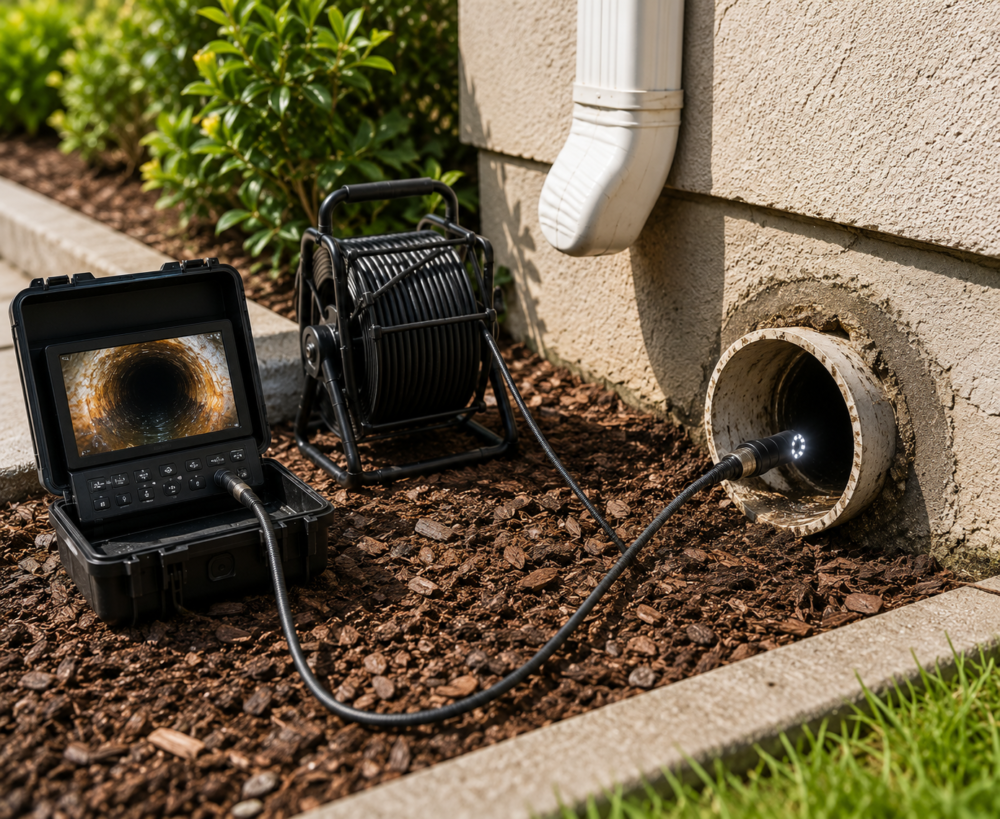
Not every slow drain needs one. These are the situations where the footage genuinely changes what you do next.
| What we see | What it means |
|---|---|
| Roots at a joint | Roots found moisture and are now growing into the line |
| A crack or fracture | The pipe wall has failed, how badly decides the repair |
| An offset joint | Two sections no longer line up; solids catch on the step |
| A belly | A dip holding standing water; waste settles instead of flowing |
| Scale or heavy buildup | The bore has narrowed, common in cast iron |
| A collapsed section | The pipe is no longer round; this is a replacement conversation |
| Grease | Usually a habits problem rather than a pipe problem |
| A clean, round line | Genuinely good news, and worth having on file |
That last row matters more than it looks. A recorded, dated inspection showing a sound line is a document, for a sale, for a dispute with a neighbour, or for the next person who tries to sell you a replacement.
| Material | Typical era | How it fails |
|---|---|---|
| Clay | Pre-1970s | Roots at every joint; sections crack |
| Cast iron | 1950s–1970s | Corrodes and scales from the inside |
| ABS plastic | 1970s onward | Generally sound; joints and crushing are the risks |
| Orangeburg | Occasionally, mid-century | Deforms into an oval and collapses |
Knowing the material before anyone quotes you is useful, and it is visible on the footage in the first few feet.
The inspection fee is charged either way, and that is deliberate rather than an exception to our no-find-no-fee guarantee. On a leak detection call you are paying us to answer a question. On a camera inspection you are buying the inspection itself and the recording, a clean line is a result you asked for and received.
Full pricing on the pricing page, and the cost breakdown for this specific service is on sewer camera inspection cost.
A sewer line does not stop at the property line, and neither does the bill, which surprises people the first time it comes up. The section from the house out to the public main is the sewer lateral, and in most arrangements the property owner owns more of it than they expect.
Because that boundary decides who pays, it is worth settling before a repair is agreed rather than after. The camera helps: it tells you how far along the run the fault is, which is the first thing anyone will ask. The subject in full is on what is a sewer lateral.
If someone has already inspected your line and quoted a replacement, these are the questions worth asking before you sign.
Getting a second inspection is normal and nobody should make you feel awkward about it. More on that in how to choose a company.
We are licensed and insured plumbers, and this site is about leaks — finding the ones you cannot see and repairing them properly. Roughly half of what looks like a plumbing leak turns out not to be one, so the boundary is worth stating plainly.
Roof leaks are a roofer. Water under an air handler is an HVAC technician clearing a condensate drain. Water under an appliance is appliance repair. Drying, restoration and mold are separate trades again, and gas line repair is SoCalGas or a licensed gas fitter. We detect gas leaks, we do not repair gas lines.
The full list, with the trade to call for each, is on what we don’t do.
Most of what shortens a sewer line’s life is not dramatic. It is a few habits and one tree, repeated for twenty years.
None of that is a maintenance contract pitch. On a sound line with no tree over it, a camera every several years is plenty, and on a line that has already shown roots once, more often is genuinely cheaper than the alternative.
Finding it is the easy part. What follows depends entirely on what the footage showed, and there are fewer options than people expect.
| Finding | Usual answer |
|---|---|
| Roots, pipe otherwise sound | Clear the roots, then treat the joint they came in at |
| Single cracked section | Spot repair — excavate at the located point |
| Offset joint | Spot repair, or lining if the run has other issues |
| Belly | Excavate and re-lay to grade — lining will not fix a dip |
| Multiple faults along the run | Trenchless lining or replacement |
| Collapse | Replacement of that section at minimum |
| Heavy scale in cast iron | Descaling, then a second look at what is underneath |
Lining is the option people ask about most, so it is worth being straight: it works well on cracks and root intrusion in a line that still holds its shape, and it does nothing at all for a belly. See trenchless vs traditional.
See the inside of your sewer line before anyone quotes you a repair.
(714) 386-7923Call or text, day or nightSchedule a Visit$250 to $500, charged whether or not a fault is found. You are buying the inspection and the recording rather than a result, a clean line is a legitimate outcome and it is one worth having on file.
Yes, always, and it is yours to do what you like with — including showing it to another contractor for a second opinion. Any company that hesitates on this question is telling you something.
On anything built before roughly 1980, yes. A standard home inspection does not include the sewer line, and a failed line is one of the few property problems that reaches five figures with no warning at all.
It finds faults you can see — cracks, roots, offsets, collapses. It does not confirm whether the line holds, because a drain is not under pressure. That question is answered by a hydrostatic test.
A cleanout is easiest. Without one, access is usually through a pulled toilet or a roof vent. We tell you which access we need before we start, and pulling and resetting a toilet is a normal part of the job rather than an extra.
Most residential inspections run under an hour. Locating and marking a fault adds a little; a line that has to be cleared before the camera can pass adds more, and we tell you before doing it rather than after.
The camera cannot pass a full blockage, so the line has to be cleared first. That is a separate step with its own price, and you get told what it will be before we do it — never discovered at the end.
It depends how deep it is. A shallow dip that holds a little water is common and often lived with for years. A deep one causes repeated backups, and no lining product will fix it — correcting a belly means digging and re-laying to grade.
Not exactly. The material narrows it a long way. Clay and cast iron point at a mid-century line, ABS at 1970s or later, and Orangeburg at a narrow mid-century window. That is usually enough to know what you are dealing with.
Yes. Larger diameters and longer runs, same method. See commercial leak detection.