Mon–Sat 7am–6pm · 24/7 Emergency Line
Serving Santa Ana & Central OC

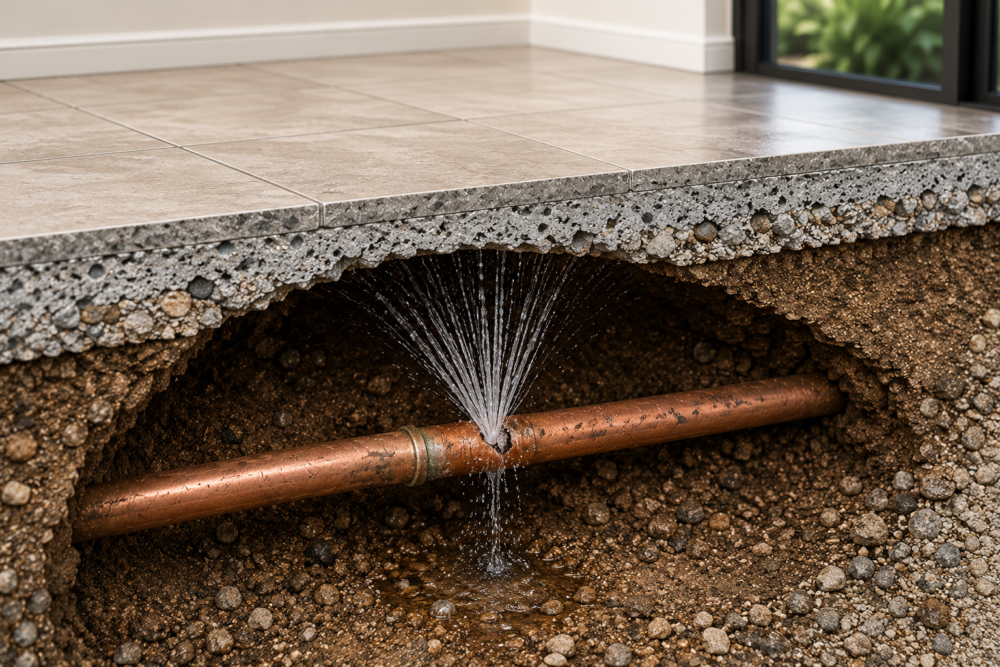
Cracks in a floor, a door that stops closing, a floor that is no longer level. Those are foundation symptoms, and a slab leak is one of the things that can cause them — by washing the soil out from under the concrete. Establishing whether a leak is present is plumbing. Assessing the foundation is not, and this page is careful about the difference.
| Question | Who answers it |
|---|---|
| Is a plumbing line under the slab leaking? | Leak detection — us |
| Has the foundation moved, and how much? | A licensed structural engineer |
| Is the movement getting worse? | A structural engineer, over time |
| Does the slab need repair or underpinning? | A structural engineer, then a foundation contractor |
| Is the soil moving for other reasons? | A geotechnical or structural engineer |
| What caused the movement? | Usually a combination, and that is their call |
The important feature of that sequence is that it is localised. Damage concentrated in one area of a house, rather than distributed, is more consistent with a leak than with general soil movement — though it is not proof of one.
A leak is one cause among several, and Southern California supplies most of the rest.
Which is why an engineer’s assessment is worth having rather than an opinion. Several of those can be acting at once, and correcting a leak does not undo movement caused by something else.
| Sign | Why it points at plumbing |
|---|---|
| A warm patch on the floor | Close to diagnostic for a hot-water slab leak |
| The meter turning with the house isolated | Water is leaving the supply, definitively |
| A water bill that jumped and stayed up | Something is consuming water continuously |
| The sound of running water with everything off | A pressurised leak |
| Damage concentrated in one area | Localised loss of support |
| Flooring cupping or lifting over one spot | Moisture from below |
| It all started fairly suddenly | Soil movement is usually slower |
The meter test is the decisive one and it costs nothing. See the water meter leak test. A still meter does not rule out an under-slab drain leak, though, and that is what a hydrostatic test is for.
| Sign | Why |
|---|---|
| Movement across the whole house | Soil, not a single leak |
| It correlates with the seasons | Expansive clay wetting and drying |
| The meter is completely still | No pressurised line is losing water |
| Cracks in exterior walls and stucco too | Structural movement rather than local settlement |
| It has been happening slowly for years | A leak large enough to move a slab does not take years to show |
| A large tree very close to the affected side | Moisture withdrawal by the root system |
If most of your situation is in this table, the useful next call is a structural engineer rather than a plumber, and we would tell you that on the phone rather than after taking your money.
Not a diagnosis, an engineer reads cracks properly and this is not that. But there are patterns worth noticing before you decide who to call first.
| What you see | More consistent with |
|---|---|
| One crack, one area, floor only | Localised settlement, a leak is plausible |
| Cracks in several rooms across the house | Whole-slab movement |
| Hairline cracks in a new slab | Shrinkage during curing, often normal |
| Cracks that widen and narrow with the seasons | Expansive clay responding to moisture |
| A crack that has grown noticeably in months | Something active — worth acting on |
| Stucco and exterior wall cracks as well | Structural movement rather than local settlement |
| A floor that is visibly sloped in one area | Loss of support underneath that area |
Two practical things you can do for nothing. Mark each crack’s ends with a pencil and date it, so you find out whether it is moving. And put a marble or a level on the floor in the affected area, a slope you can measure is far more useful to an engineer than a description of one.
We are licensed and insured plumbers, and this site is about leaks — finding the ones you cannot see and repairing them properly. Roughly half of what looks like a plumbing leak turns out not to be one, so the boundary is worth stating plainly.
Roof leaks are a roofer. Water under an air handler is an HVAC technician clearing a condensate drain. Water under an appliance is appliance repair. Drying, restoration and mold are separate trades again, and gas line repair is SoCalGas or a licensed gas fitter. We detect gas leaks, we do not repair gas lines.
The full list, with the trade to call for each, is on what we don’t do.
| Doing it this way | Doing it the other way |
|---|---|
| Plumbing checked first, a few hundred dollars | Foundation work quoted on incomplete information |
| Leak found and fixed | Foundation repaired over a still-leaking line |
| Ground allowed to stabilise | Movement continues after the repair |
| Engineer specifies what is genuinely needed | Contractor scopes their own work |
| Structural work, if any, is correctly sized | Work redone, or a dispute |
Foundation repair is expensive and largely irreversible. Spending a few hundred dollars first to establish whether water is involved is one of the better-value decisions available in that situation, whichever way the answer goes.
The written report is designed to be useful to whoever looks at the structural question next, which is the most valuable thing a plumber can contribute here.
Detection is flat, credited toward the repair, and there is no detection fee if we cannot locate a leak during your paid visit. If the answer is that your plumbing is sound, you get that in writing, which is exactly what an engineer wants to see before assessing anything.

We establish whether a line is leaking. The structural question belongs to an engineer.
(714) 386-7923Call or text, day or nightSchedule a VisitYes. Water escaping under a slab washes fine material out of the soil supporting it, so the concrete loses support in that area and settles unevenly. Cracks, sticking doors and sloping floors follow from that.
Run the water meter test — if the meter turns with everything shut off, a pressurised line is losing water. Damage concentrated in one area, a warm patch on the floor, or a bill that jumped all point at plumbing. Movement across the whole house points elsewhere.
No. Assessing structural movement is a licensed structural engineer’s work and it is not something a plumber is qualified to do. We establish whether a leak is present, where, and by what mechanism, which is a useful input to their question.
Get the plumbing checked first. It is the cheaper investigation and it removes a variable before the engineer looks. Repairing a foundation over a still-leaking line is money spent twice.
Expansive clay soil swelling and shrinking with moisture, drought and irrigation cycles, large trees drawing moisture from near the house, drainage against one side, and how the ground was prepared originally. Several can act at once.
No pressurised line is losing water. That does not rule out an under-slab drain leak, which does not register on a meter, a hydrostatic test answers that. If both come back clean, the question is structural.
It stops the cause if the leak was the cause. Whether the movement that already happened needs correcting is an engineer’s call, and they frequently want a period of monitoring after a leak is fixed because some movement stabilises on its own.
Read your policy. Water damage and earth movement are usually treated very differently, and which category a claim falls into can depend on establishing the cause, which is another reason to have the plumbing question answered in writing.
A flat $150 to $500, credited toward any repair, with no detection fee if we cannot locate one. Against the cost of foundation work, establishing whether water is involved is inexpensive whichever way it goes.
Get it verified independently. A leak is a specific, testable claim — the meter either moves or it does not, and detection either finds a leak or does not. Anybody quoting structural work on the basis of a suspected leak should be able to point at a leak.