Mon–Sat 7am–6pm · 24/7 Emergency Line
Serving Santa Ana & Central OC

CORE SERVICE · SANTA ANA & CENTRAL ORANGE COUNTY

Water Leak Repair in Santa Ana, CA

Once a leak is located precisely, repairing it is a decision rather than an emergency: open and repair the one spot, reroute the line around it, or replace the run. We locate first, then quote all the options that genuinely apply in writing, and we say which one we would choose and why.

Water Leak Repair in Santa Ana, CA

Three Ways to Repair a Water Leak

Almost every hidden water leak comes down to one of three, and the right answer depends on where the leak is, what the rest of the pipe looks like, and how many times this house has been here before.

Spot repair
Open at the marked location, cut out the failed section, replace it, test and close up. Cheapest and quickest. It is the right call when the pipe is otherwise sound and the leak is a one-off: a nail through a line, a single joint, physical damage.
Reroute
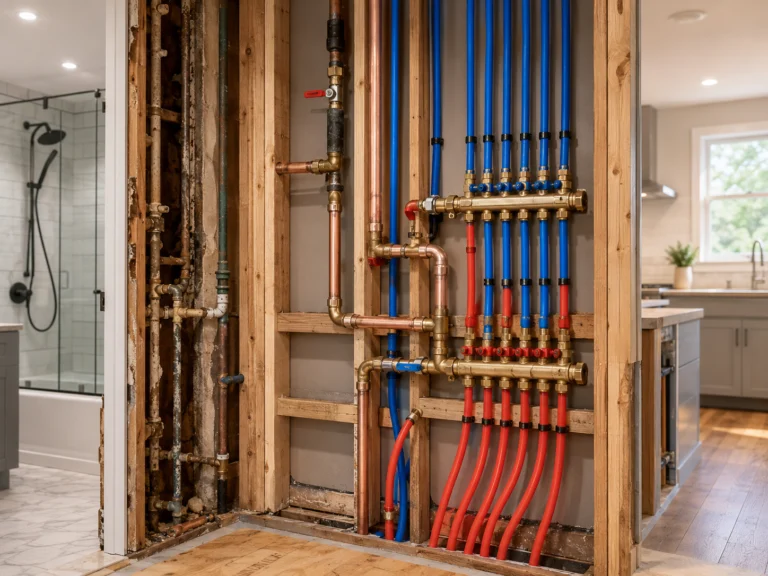
Abandon the failing run in place and route a new line above ground level through walls, an attic or a ceiling. Nothing gets opened in the slab. It is the usual answer for a slab leak on a line that has already failed once.
Repipe
Replace all the supply lines in the house. This is what a third leak in two years is telling you: the pipe is at the end of its service life and you are paying to find out where next. See whole house repipe.
Worth knowing There is a fourth option nobody advertises, and it is worth naming: on some leaks the honest recommendation is to repair the cheap way now and plan the repipe for a year you choose. That is a real answer, and you should get it in writing rather than as a hint.

How We Choose Between Them

SituationWhat we usually recommend
First leak, pipe otherwise soundSpot repair
Slab leak, accessible from aboveReroute, keeps the slab closed
Second leak on the same runReroute that run
Third leak anywhere in two yearsRepipe: the pipe is telling you
Leak under finished tile or hardwoodReroute, almost always
Leak in an accessible wall or cabinetSpot repair
Galvanised supply lines still in placeRepipe, the material is the problem

The pattern behind the table is simple. One leak is an event. Two on the same run is a condition. Three is a decision you have already made and are paying for one leak at a time. We will tell you which of the three you are in before you spend money on the wrong one.

What Water Leak Repair Costs

Detection visit
$150 – $500
Flat, credited toward the repair
Spot repair
$1,500 – $3,500
Accessible, or under finished floor
Reroute
$2,000 – $4,500
Per line
Whole-house repipe
$6,000 – $15,000
PEX or copper

Ranges, not quotes. What moves a job inside its range is access more than anything else: a line under a cabinet and a line under a tiled entry are the same repair and very different jobs. Your price is quoted in writing after we see it.

What the quote includes, and what it does not

IncludedNot included
Locating the leakReplacing flooring we did not open
Cutting access where neededPainting and finish work
The pipe repair itselfDrying and mold remediation
Pressure testing afterDamage that existed before we arrived
Patching what we openedAnything on the utility’s side of the meter

Restoration is the line people are most often surprised by, so it is stated on the quote rather than left to be discovered. Everything we price is on the pricing page.

Already know where it is? Send us the report and we will quote the repair.
Get a written quote

What the Repair Day Looks Like

1
Confirm the location
Even with a report in hand, we re-confirm before opening anything. Marks move, and concrete is not forgiving of an approximate one.
2
Protect the space
Floor coverings, dust containment where we are cutting, and the water off at the point that isolates the least of your house.
3
Open the access
As small as the repair allows. On a slab that means a controlled cut, not a trench.
4
Make the repair
Cut out the failed section and replace it, or run the new line if it is a reroute.
5
Pressure test
Before anything closes. A repair that has not been tested is not finished.
6
Close up and photograph
We patch what we opened, clean the area, and you get photographs of the completed work for your records.

Most single repairs are a same-day job. A reroute usually runs one to two days, a repipe longer, and you get the schedule in writing before the first cut.

Where the Leak Is Changes Everything About the Repair

The same failed inch of copper is a ninety-minute job in one place and a two-day job in another. It is worth knowing which one you are looking at before the number lands.

LocationWhat the repair involves
Under a cabinet or in an accessible wallOpen, replace, test, patch, usually same day
Inside a finished wallSmall controlled opening; drywall patch, finish work separate
In a ceiling below a bathroomAccess from below; the ceiling is the restoration cost
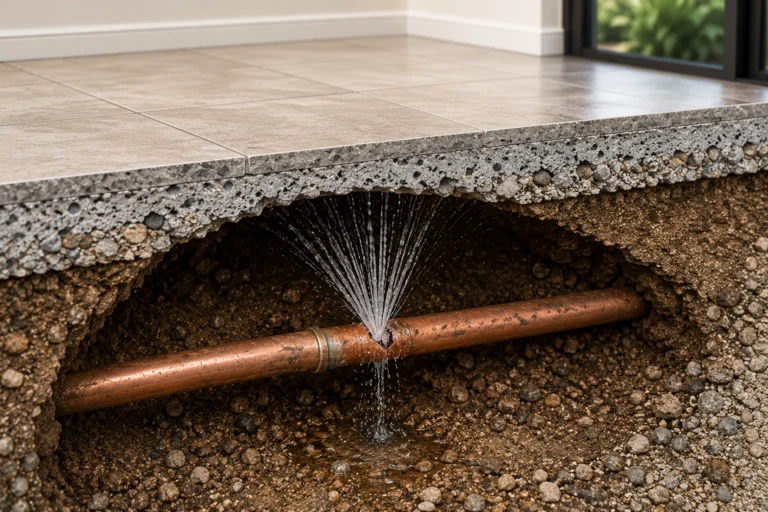
Under a concrete slabSpot repair means cutting concrete, reroute usually wins
Under a raised floorAccess through the crawl space; often the easiest of the set
Buried in the yardExcavation at the located point; restoration depends on what is above
Under a driveway or patioReroute or trenchless if the route allows, concrete is the expense

Read that table sideways and it says one thing: the pipe is rarely the expensive part. What is on top of the pipe is. That is also why locating precisely is worth paying for, an approximate location on a tiled floor is an expensive approximation.

Why a reroute is not a compromise

People sometimes hear “reroute” as the cheaper, lesser option, and it is not. It leaves the slab intact, it puts the new line somewhere it can be reached again, and it takes the failing run out of service permanently rather than repairing one point on it. On an older slab home it is frequently the better engineering answer as well as the cheaper one.

Materials, and Why We Use What We Use

Two materials cover almost all residential supply work here, and the choice is a real one rather than a preference.

PEX
Flexible, fast to run through walls and attics, fewer joints, and it does not corrode or scale the way copper does in hard water. It is what makes a reroute practical without opening every wall in the path.
Copper
Rigid, long-established, and the material most Santa Ana homes were built with. Still the right answer in some situations — exposed runs, certain repairs where matching the existing material is cleaner.
What we will not do
We do not patch a pressurised line with a clamp and call it a repair. A clamp is a way to get through a night, not a way to finish a job, and we are not going to hand you one on a two-year warranty.

The comparison in full is on PEX vs copper. Whatever goes in, it is named on the quote — material should never be a surprise you find out about later.

Repair or Replace, the Question Behind the Question

People ask what a repair costs when the thing they actually want to know is whether they are about to do this again. That is a fair question and it has a fairly honest answer.

How old is the plumbing?
Copper installed in the 1960s has had a long life. Copper installed in 2010 that is leaking has a cause worth finding — pressure, water chemistry, or how it was installed.
Has it leaked before?
The single most useful predictor. Same run, twice, means the run rather than the spot.
What is the water pressure?
Anything much over 80 psi is working every joint in the house harder than it was designed for. A regulator is cheap next to a repipe.
How long are you staying?
Nobody else will say this out loud: if you are selling in a year, the calculus is genuinely different, and disclosure obligations are part of it.

Worked through properly on repipe vs slab leak repair.

What This Site Is About, and What Belongs to Another Trade

We are licensed and insured plumbers, and this site is about leaks — finding the ones you cannot see and repairing them properly. Roughly half of what looks like a plumbing leak turns out not to be one, so the boundary is worth stating plainly.

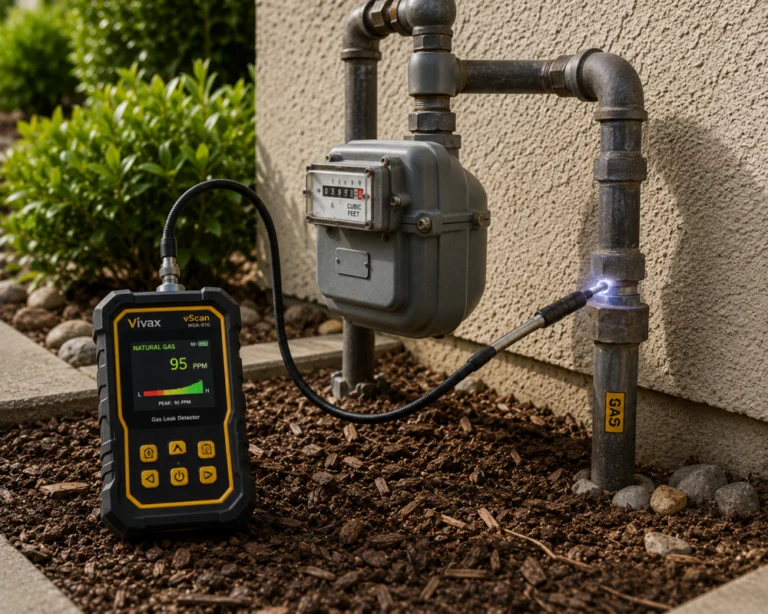
Roof leaks are a roofer. Water under an air handler is an HVAC technician clearing a condensate drain. Water under an appliance is appliance repair. Drying, restoration and mold are separate trades again, and gas line repair is SoCalGas or a licensed gas fitter. We detect gas leaks, we do not repair gas lines.

The full list, with the trade to call for each, is on what we don’t do.

The Warranty, in Plain Terms

Repairs carry a two-year workmanship warranty. That covers our work: the joint we made, the line we ran, the connection we cut in. If it fails because of how we did it, we come back and it costs you nothing.

  • It covers the repair we performed, for two years
  • It does not cover a different leak elsewhere on old pipe. That is a new event, and pretending otherwise would just mean pricing it into every job
  • It does not cover damage from something outside the plumbing
  • It transfers with the property, which matters if you sell

Full terms on guarantees and warranties. It is worth reading the exclusions on any warranty you are offered — ours included.

David Herrera, Founder & Lead Leak Detection Technician
About the Author
David Herrera, Founder & Lead Leak Detection Technician
David founded Leak Detection Santa Ana in 2026 after more than 15 years finding and repairing leaks across Orange County. He leads the crew that does the work, and the judgement calls on this page are the ones he uses in the field. Meet the team.

Get a Free On-Site Quote

We locate the leak precisely first, then quote every repair option that genuinely applies.

(714) 386-7923Call or text, day or nightSchedule a Visit

What’s Included

  • Written, itemised quote before we start
  • Repair options explained, not just one
  • Two-year workmanship warranty
  • Photographs of the completed work

Frequently Asked Questions

A spot repair typically runs $1,500 to $3,500, a reroute $2,000 to $4,500 per line, and a whole-house repipe $6,000 to $15,000. Access moves a job within its range more than anything else. Your price is quoted in writing after we see it.

Usually not. Most leaks are a spot repair or a single reroute. A repipe is the answer when the pipe itself has reached the end of its life, typically after repeated leaks on different runs rather than after one.

Only if a spot repair under the slab is the option you choose. A reroute exists precisely to avoid it: the failing line is abandoned in place and a new one runs overhead. On finished tile or hardwood that is almost always the better trade.

Often, yes: the crew that detects is the crew that repairs, and the van carries materials for common repairs. A reroute or a repipe gets scheduled, because doing those properly takes more than an afternoon.

We patch what we opened and we clean up. Finish work — matching tile, refinishing hardwood, painting — is a separate trade, and it is named as an exclusion on the quote rather than left for you to discover afterwards.

Two-year workmanship warranty on the repair we performed, and it transfers with the property. It does not cover a new leak elsewhere on old pipe. That is a different event, and full terms are on the guarantees page.

Read your own policy, because they differ. The general pattern is that policies treat sudden damage more favourably than damage that developed slowly, and that many cover the damage rather than the pipe. Our written report and photographs are what a claim rests on, and you get both either way.

Then we tell you before we cut, not after. We re-confirm the location on arrival even when a report already exists. That is a few minutes against the cost of opening the wrong square foot of concrete.

Only as far as the repair requires. Part of arriving is finding the isolation point that takes the least of your house out of service, and telling you roughly how long it will be off.

Yes. See commercial leak detection. The repair methods are the same; scheduling around occupancy is what changes.