A pipe that has actually ruptured is a different problem from a leak: water is arriving faster than the building can shed it, and every minute is measurable damage. Shut the main off first. That single action does more than anything else on this page. Calls are answered 24/7.
If you read nothing else here, read this. A ruptured supply line delivers water at household pressure until somebody closes a valve, and no amount of towels changes that equation.
Search this subject nationally and almost everything you find is about freezing. Santa Ana does not freeze, so none of that applies, and the real causes are different enough to matter.
| Cause | What is happening |
|---|---|
| Corrosion in old copper | Decades of flow thin the wall until it opens |
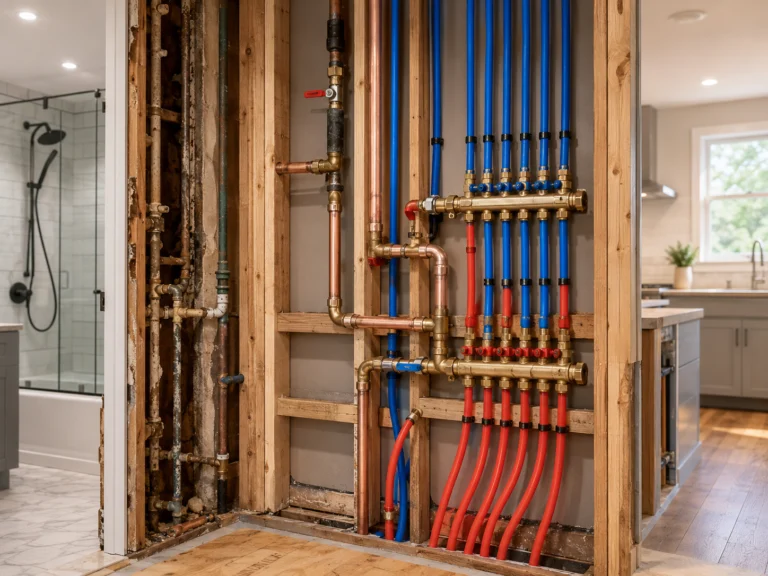
| Galvanised steel | Rusts from the inside; failures come in groups |
| Excess water pressure | Anything much over 80 psi stresses every joint continuously |
| Water hammer | Pressure spikes when a valve slams shut, repeated for years |
| Physical damage | A nail or screw through a line, often years before it opens |
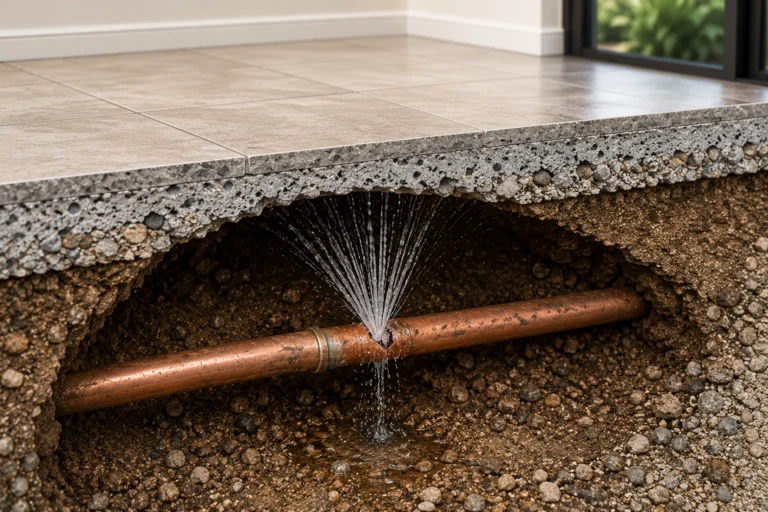
| Soil movement | Clay soil shifts and a buried or slab line takes the strain |
| Bad original workmanship | A joint that was marginal from the day it went in |
Pressure is the one worth checking on any older house, because it is cheap to measure and cheap to fix. See high water pressure in the house and pressure regulator installation.
After-hours pricing is given on the call, before dispatch. What moves the number is access and what the rest of the pipe looks like: a rupture in accessible copper is a straightforward repair, and a rupture in galvanised steel is usually the start of a larger conversation, because galvanised does not fail once.
Full pricing on the pricing page.
| Location | Why there | What it damages first |
|---|---|---|
| Inside a wall | Old copper, or a fastener driven through years ago | Drywall, then flooring |
| Under the slab | Abrasion against concrete, soil movement | Flooring, then the subgrade |
| In the attic | Fittings, and heat cycling | The ceiling below, quickly |
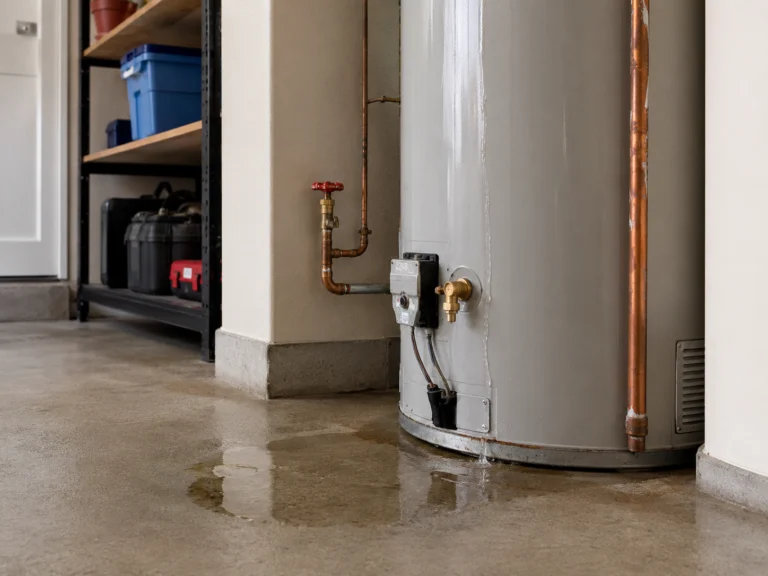
| At the water heater | The tank, a fitting, or the relief valve | The garage, or worse if it is indoors |
| Under a sink | Supply connectors, braided lines have a service life | The cabinet and the floor |
| Outside at the hose bib | Age and exposure | Often little: the good case |
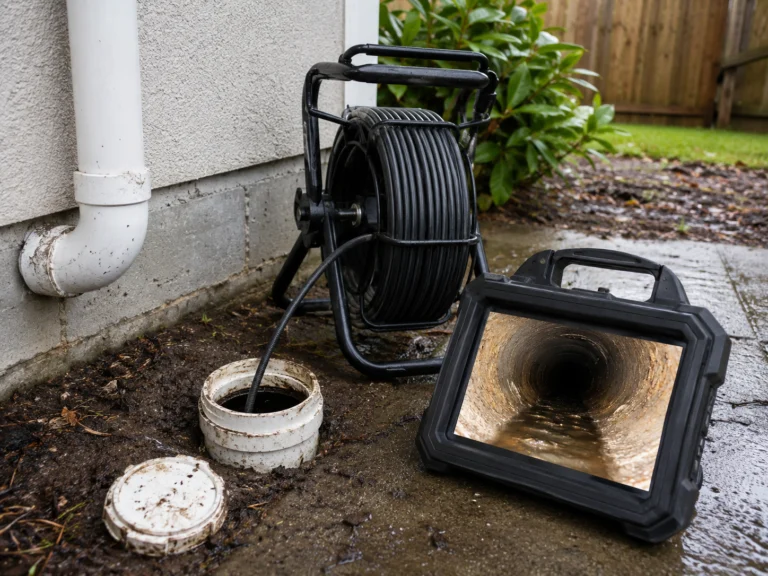
| The main from the meter | Corrosion, roots, soil movement | The yard, and the bill |
Attic ruptures do the most damage the fastest, because water arrives at the ceiling with nothing to slow it. Under-sink connectors are the most common and the most preventable: a braided supply line is a wear item, and replacing them is a small job that nobody thinks about until one lets go.
Nobody wants to think about paperwork with water on the floor. But the difference between a claim that goes smoothly and one that does not is almost entirely made in the first hour, and it is made by you rather than by us.
More on it in documenting a leak for an insurance claim, and on the general shape of cover in does insurance cover water leaks.
We are licensed and insured plumbers, and this site is about leaks — finding the ones you cannot see and repairing them properly. Roughly half of what looks like a plumbing leak turns out not to be one, so the boundary is worth stating plainly.
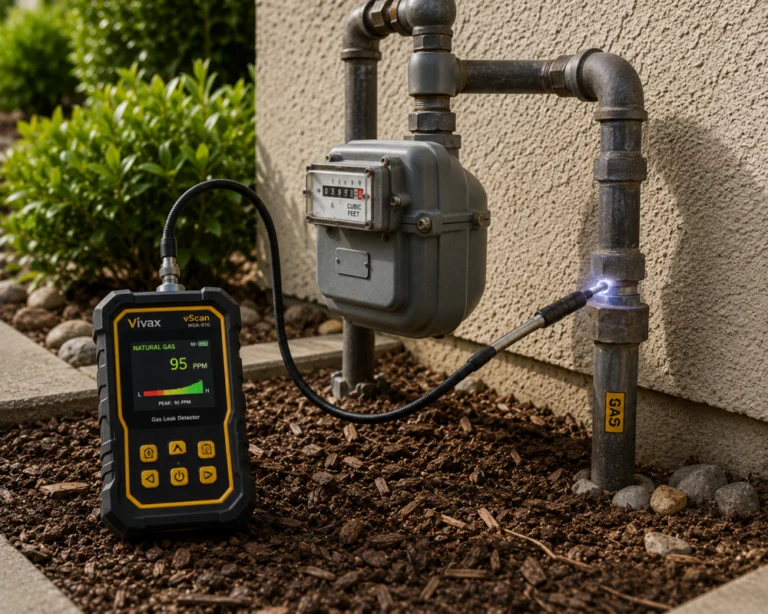
Roof leaks are a roofer. Water under an air handler is an HVAC technician clearing a condensate drain. Water under an appliance is appliance repair. Drying, restoration and mold are separate trades again, and gas line repair is SoCalGas or a licensed gas fitter. We detect gas leaks, we do not repair gas lines.
The full list, with the trade to call for each, is on what we don’t do.
This is the question worth asking before you agree to a repair, because the answer changes what you should spend.
| What is true | What it usually means |
|---|---|
| Copper, first failure, clear cause | A one-off. Repair it and move on |
| Copper, second failure in two years | The run is at the end of its life |
| Galvanised steel anywhere in the house | Plan the repipe. It will not stop |
| High pressure never corrected | It will happen again wherever the next weak joint is |
| Failure at a fitting a plumber recently made | Workmanship. Ask who is covering it |
| Pinhole leaks, several, over time | Water chemistry and age — repipe territory |
We will tell you which row you are in. It is not always the row that produces the bigger invoice today, and saying so is the whole reason a repeat customer exists.
A rupture is worth treating as information as well as an emergency. Three checks cover most of what causes them here, and all three are cheap next to the thing they prevent.
None of that is a service contract. It is three things you can check yourself this weekend, and two of them cost nothing.

Shut the water off at the main first. Then call and we will take it from there.
(714) 386-7923Call or text, day or nightSchedule a VisitShut the water off at the main — clockwise until it stops — then cut power to any wet area at the breaker, open a low tap to drain the lines, and photograph everything before you clean up. Then call. Those steps take a few minutes and they matter more than anything that happens afterwards.
No, the climate does not get there. Ruptures here come from corrosion in old copper, galvanised steel rusting through, excess water pressure, water hammer, physical damage from a nail or screw, and soil movement.
Shut the water off instead. Clamps and tape are a way to get through a night on a line that has already been depressurised, not a way to hold household pressure, and a temporary fix that holds for a week is how a small repair turns into a ceiling.
A spot repair typically runs $1,500 to $3,500, and a reroute $2,000 to $4,500 per line if the run needs taking out of service. After-hours pricing is given on the call before anyone is dispatched.
Read your policy. The common pattern is that policies treat sudden damage more favourably than gradual damage, and that many cover the resulting damage rather than the pipe itself. Photographs taken before cleanup, and the failed section of pipe, are what a claim rests on.
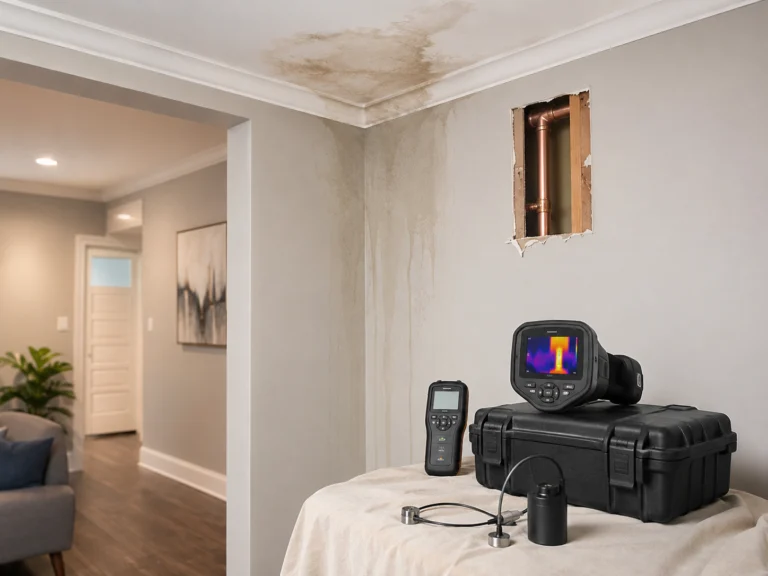
Because water runs along framing and floor structure until it finds a way down. The wet spot is where it escaped, not where it started, which is exactly why opening the ceiling under the stain is such a common and expensive mistake.
Do not force an old gate valve — snapping the stem makes it worse. Use the valve in the meter box at the street instead; it shuts everything. Tell us on the call and we will bring what is needed to replace the house valve while we are there.
Not usually, on copper with a clear one-off cause. On galvanised steel, or after a second failure in a couple of years, the pipe itself is what is failing and repairing one point at a time gets expensive quickly.
A restoration company. That is a separate trade with separate equipment and it is not something we do. We stop the water and repair the plumbing, and we will tell you plainly when drying is needed rather than leaving you to find out from a smell in a month.
Calls are answered 24/7 and a technician is dispatched 24/7, in English and Spanish. We do not publish a response-time window because we have not established an honest one. You get a real estimate on the phone.