If your house sits on a raised foundation rather than a slab, the plumbing under it is reachable, which is genuinely good news. A leak down there is usually visible once somebody goes and looks, and repairing it costs a fraction of the same failure under concrete. The problem is that nobody goes and looks until something smells.
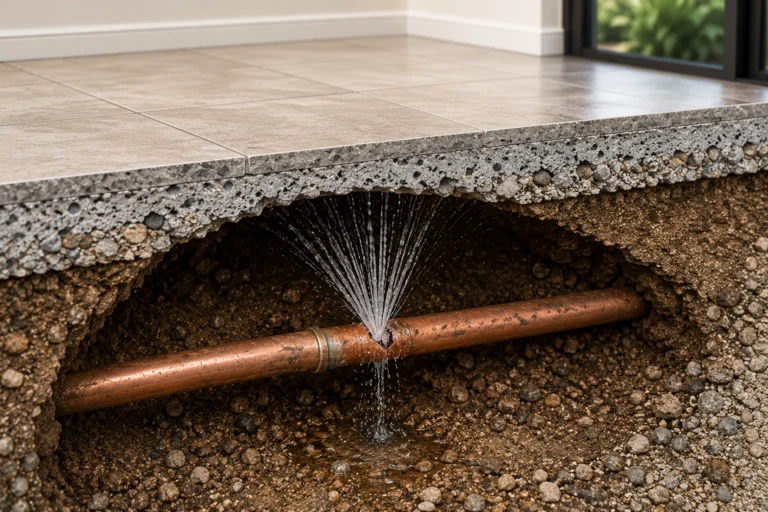
A crawl space leak announces itself indirectly, because the water never reaches your floor. It goes into the ground and into the air instead.
This is the one piece of good news in this whole subject, and it is worth stating plainly.
| Under a slab | Under a raised floor |
|---|---|
| Encased in concrete | Exposed, on hangers |
| Located acoustically through concrete | Frequently visible once somebody looks |
| Repair means cutting the floor, or a reroute | Repair means replacing a section in place |
| Flooring is often the largest single cost | No flooring is disturbed at all |
| Nothing can be inspected without opening it | Inspectable any time, for free |
Put together: the same failed fitting is a major job in one house and a straightforward one in another. If you have a crawl space, you can simply go and look.
That last one changes who you should be paying. If the water is coming in from outside, the fix is grading and drainage rather than plumbing, and we will say so in writing.
Crawl space repairs tend to sit at the lower end of these ranges, for the reason the comparison table gives: nothing has to be cut open to reach the pipe. What raises a price is access: a low clearance, a tight hatch, or standing water that has to be dealt with before anyone can work.
Everything we price is on the pricing page.
The reason this matters is not the crawl space. Nobody lives down there. It matters because a raised foundation is not sealed off from the rooms above it — air moves upward through the floor, and whatever is in that air comes with it.
| What gets wet | What follows |
|---|---|
| The soil | Humidity rises through the floor into the living space |
| Floor joists and subfloor | Wood softens; floors above start to feel spongy |
| Insulation | Falls, compacts, and stops insulating — heating and cooling cost more |
| Ductwork sitting in the space | Damp air distributed to every room by design |
| Hardwood above | Cups and warps from the underside, where nobody looks |
| Anything organic | Mold gets the conditions it needs: moisture, dark, no airflow |
None of that happens quickly, which is exactly the problem. It happens over months while the only symptom is a smell you get used to. A leak under a slab announces itself with a bill; a leak in a crawl space frequently does not announce itself at all until the floor tells you.
A crawl space with standing water in it has two problems and they belong to two different trades. Being clear about which is which saves you paying the wrong one.
| The problem | Whose job |
|---|---|
| Finding why water is arriving | Us |
| Repairing the failed pipe | Us |
| Correcting grading or a downspout | Landscaping or drainage contractor |
| Drying the space out | Restoration contractor |
| Testing for and removing mold | Mold remediation, a licensed specialty |
| Replacing damaged insulation | Insulation contractor |
| Repairing damaged framing | General contractor |
We stop the water and we tell you plainly when the rest is needed. What we will not do is take on the drying and remediation work to keep the invoice in one place. Those are specialties, and doing them badly is worse than not doing them.
We are licensed and insured plumbers, and this site is about leaks — finding the ones you cannot see and repairing them properly. Roughly half of what looks like a plumbing leak turns out not to be one, so the boundary is worth stating plainly.
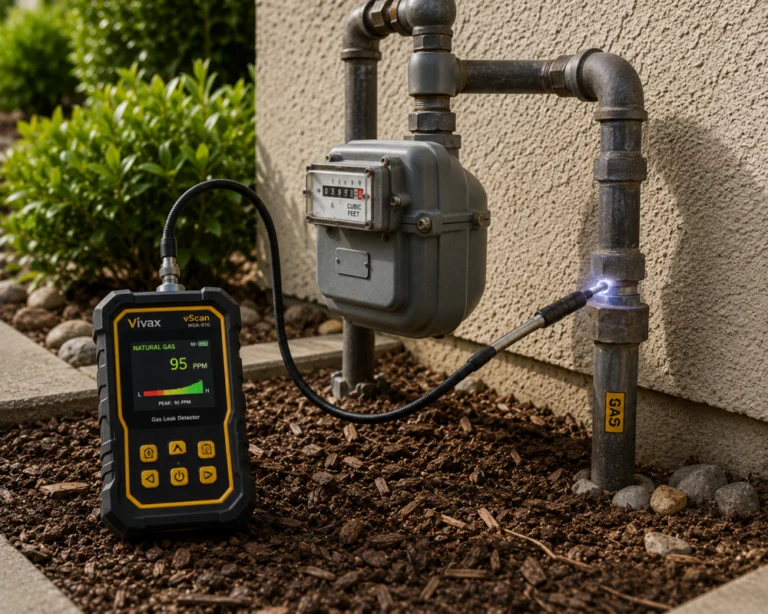
Roof leaks are a roofer. Water under an air handler is an HVAC technician clearing a condensate drain. Water under an appliance is appliance repair. Drying, restoration and mold are separate trades again, and gas line repair is SoCalGas or a licensed gas fitter. We detect gas leaks, we do not repair gas lines.
The full list, with the trade to call for each, is on what we don’t do.
Most Santa Ana houses do not. The bulk of the local housing stock is slab-on-grade, particularly everything built from the 1950s onward, and that is the more common call by a wide margin.
If it turns out you are on a slab, the relevant pages are slab leak detection and slab leak repair. The symptoms overlap considerably; the repair does not.
Full terms on guarantees and warranties.

Musty smell, high bill, or soft floors? We look under the house and photograph what we find.
(714) 386-7923Call or text, day or nightSchedule a VisitThe usual signs are a musty smell, a water bill that climbed with no change in usage, floors that feel soft or cool in one area, and indoor humidity that will not settle. The meter test tells you whether a supply line is involved before anyone goes under the house.
Usually, and often by a lot. The pipe is exposed rather than encased in concrete, so the repair does not involve cutting a floor or rerouting around one. Nothing you can see gets disturbed.
You can, with a good light, but be careful. Low clearance, standing water, damaged framing, wiring and pests are all real hazards, and a crawl space with standing water and electricity in it is not a place to be exploring. If you would rather not, that is entirely reasonable.
Then it is not a plumbing repair and you get that in writing. Grading, a downspout discharging at the foundation, or irrigation soaking in are all common, and the fix belongs to a drainage or landscaping contractor rather than to us.
No. Drying is a restoration contractor and mold is a licensed remediation specialty. We stop the water and tell you plainly when the rest is needed — keeping the whole invoice in one place is not worth doing those badly.
Yes: the majority of Santa Ana’s housing stock is slab-on-grade, especially anything built from the 1950s onward. Raised foundations are more common in the older neighbourhoods. A low vent or hatch on an exterior wall is the easiest tell.
Usually an hour or two, depending on the size of the house and how easy the space is to move through. Low clearance and standing water both slow it down, and we say so before starting rather than after.
Always, and you keep them. You are not going to be down there, so a photographic record of your own subfloor is the only way you will ever actually see what was found.
Yes, and it is one of the more common causes of a smell nobody can place. A drain leaks only when something drains, so it is intermittent, and cast iron corroding through at the bottom of the pipe is a classic in mid-century houses.
No. Groundwater, poor grading, a downspout in the wrong place and irrigation are all possible, and after heavy rain some seasonal moisture is normal in a raised foundation. Which one it is decides who you should be paying, so it is worth testing rather than assuming.