Mon–Sat 7am–6pm · 24/7 Emergency Line
Serving Santa Ana & Central OC

CORE SERVICE · SANTA ANA & CENTRAL ORANGE COUNTY

Pipe and Line Locating in Santa Ana, CA

Before anyone digs, trenches, drills or drives a post, it is worth knowing what is down there. We trace and mark buried water, sewer and irrigation lines on your property, including the private lines a free 811 mark-out does not cover, which is most of what people actually hit.

Pipe and Line Locating in Santa Ana, CA

What 811 Covers, and What It Does Not

This is the single most useful thing on this page, and it is the thing most people get wrong. California 811 — DigAlert — is free, it is the law before you excavate, and it is not a survey of your property.

LineMarked by 811?
The public water main in the streetYes
The utility service line up to your meterYes
The gas service line up to your meterYes
Electric, telecom and cable in the public right of wayYes
Your water line from the meter to the houseNo — private
Your sewer lateralNo — private
Irrigation and sprinkler linesNo — private
Pool plumbing and equipment linesNo — private
Power to a detached garage, shed or gateNo — private
Worth knowing 811’s own response codes tell you this: on private lines, the instruction is to contact a private locator. Call 811 first — always, it is required and it is free — and then understand that everything on your side of the meter is still unmarked, which is where the majority of residential strikes happen.

When You Need Lines Located

Before landscaping or hardscape
New planting, a retaining wall, a patio, pavers. Trenching for drainage is the classic one, the new drain and the old irrigation line want the same route for the same reason.
Before a fence, gate or post
Post holes go deeper than people expect and land exactly where a line runs along a property boundary. This is one of the more common ways an irrigation main dies.
Before a pool, spa or outbuilding
Excavation on that scale near existing services is where a locate pays for itself in one avoided strike.
Before a repair, so you dig once
Knowing the route and the depth before excavating turns an exploratory trench into a hole at one point.

There is also the quieter case: you have just bought the house and nobody can tell you where anything runs. A locate with photographs is a document you keep.

How Locating Works

1
Establish access
A cleanout, a meter box, a valve, a hose bib, the locate needs somewhere to introduce a signal or a camera.
2
Trace the line
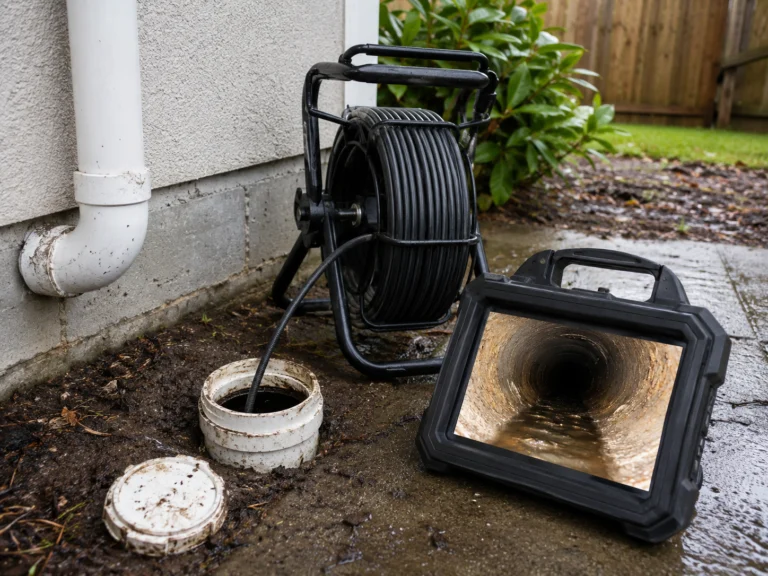
Either by energising a metal line directly, or by pushing a transmitting sonde through a non-metallic one. Plastic lines cannot be found magnetically, which is why the sonde method exists.
3
Follow the signal on the surface
A receiver walks the route above ground, and the path gets marked as it goes.
4
Read the depth
At marked points along the run. Depth is half the useful information, a line at eight inches and the same line at four feet are very different risks to a trencher.
5
Mark it
Paint or flags on the surface, following standard colour convention where it applies.
6
Photograph and write it up
Marks wash off. A photographed, dimensioned record does not, and it is what you hand the next contractor.

What Can and Cannot Be Located

LineLocatable?How
Metal water lineYesDirect connection, traced from the surface
Plastic water lineYesSonde, or by tracing an accessible run
Sewer lateralYesCamera with a transmitting head
Cast iron or clay drainYesCamera and sonde
Irrigation mainsUsuallyDepends on material and access to a valve
Individual sprinkler lateralsSometimesSmall, shallow, often unmarked
A capped line with no access at either endOften notNothing to introduce a signal into

The last row is the honest limit. If a line is sealed at both ends with no cleanout, no valve and no metal in it, there may be no way to trace it without exposing it, and we would rather tell you that at the quoting stage than after taking your money.

What It Costs

Line locating
$150 – $500
Depends on how much is being traced
Camera inspection
$250 – $500
If the sewer is being located and inspected
Spot repair
$1,500 – $3,500
If a fault is found and you want it fixed
Main line replacement
$2,000 – $4,500
Typical residential run

Set that against the cost of a strike. Hitting a sewer lateral with a trencher means an emergency repair, an excavation you did not plan, and a contractor standing idle while it is sorted out. Locating first is one of the few genuinely cheap decisions in construction.

Everything we price is on the pricing page.

Digging next week? Call 811 first, then have the private lines marked.
Book a locate

Locating Is Also How a Repair Gets Cheap

Most people find this page because they are about to dig. But the same equipment does something else worth knowing about: it turns a repair from a search into a job at one point.

Without locatingWith locating
Exploratory trench along the suspected routeOne hole at the marked point
Landscaping disturbed the length of the runLandscaping disturbed at one spot
Depth unknown until the machine finds outDepth known before anyone starts
Quote is a range because the work is unknownQuote is firm because the job is defined
Restoration cost is whatever it turns out to beRestoration is a known area

On a buried water or sewer line the restoration is frequently larger than the plumbing. That is the whole argument for locating first: it does not make the pipe cheaper, it makes everything on top of the pipe cheaper. The same logic runs through finding an underground leak.

Reading the Marks

Colour convention is standard across the industry, and it is worth knowing what is on your lawn before somebody starts a machine.

ColourWhat it marks
BluePotable water
GreenSewer and drain
PurpleReclaimed water and irrigation
YellowGas, oil, steam
RedElectric
OrangeTelecom, cable, fibre
WhiteProposed excavation, where you intend to dig
PinkTemporary survey markings

White paint before the locate is worth doing yourself: marking out where you actually intend to dig means the locate focuses there rather than covering the whole property, which usually costs less.

What This Site Is About, and What Belongs to Another Trade

We are licensed and insured plumbers, and this site is about leaks, finding the ones you cannot see and repairing them properly. Roughly half of what looks like a plumbing leak turns out not to be one, so the boundary is worth stating plainly.

Roof leaks are a roofer. Water under an air handler is an HVAC technician clearing a condensate drain. Water under an appliance is appliance repair. Drying, restoration and mold are separate trades again, and gas line repair is SoCalGas or a licensed gas fitter. We detect gas leaks, we do not repair gas lines.

The full list, with the trade to call for each, is on what we don’t do.

What Happens If a Line Gets Hit

Worth knowing in advance, because the answer is different depending on what was struck and who struck it.

  • Gas, stop, leave the area, and call SoCalGas on 1-800-427-2200, answered 24 hours. Do not attempt to assess it
  • Electric, stop, keep everyone clear, and call the utility. Do not touch the machine if it is in contact
  • Water, shut off at the meter, then call. Damage scales with how long it runs
  • Sewer, stop using water in the house immediately, then call. It is a health issue as much as a plumbing one
  • Photograph the strike before anything is moved, liability for an unmarked private line is a real dispute, and photographs are what settles it

The liability point is why the written locate record matters as much as the paint. If a contractor damages a line that was marked, that is a different conversation from one that was never marked at all.

What You Get, Every Time

The route marked on the ground
Paint or flags, in standard colours, along the actual path.
Depths at marked points
Because a line at eight inches and one at four feet are different problems.
Photographs
Marks wash away. A photographed record survives the next rain and the next contractor.
A written summary
What was traced, what could not be, and why, stated rather than implied.
David Herrera, Founder & Lead Leak Detection Technician
About the Author
David Herrera, Founder & Lead Leak Detection Technician
David founded Leak Detection Santa Ana in 2026 after more than 15 years finding and repairing leaks across Orange County. He leads the crew that does the work, and the judgement calls on this page are the ones he uses in the field. Meet the team.

Book a Locate Before You Dig

Call 811 first. Then have the private lines on your side of the meter marked.

(714) 386-7923Call or text, day or nightSchedule a Visit

What’s Included

  • Lines traced and marked on the ground
  • Depth read at marked points
  • Photographed record of the marks
  • Written summary of what was found

Frequently Asked Questions

811 is free, it is required before you excavate, and it marks utility-owned lines up to your meter. Everything past the meter, your water line, sewer lateral, irrigation, pool plumbing, power to a detached structure, is private and is not marked. That is where most residential strikes happen.

Yes. Always call 811 first. It is the law before excavating in California, it is free, and it covers the lines that are most dangerous to hit. A private locate is what you add on top, not a replacement for it.

Yes. Plastic cannot be traced magnetically, so it is located either with a transmitting sonde pushed through the line or by tracing from an accessible point. It needs access at one end, which is the practical limit rather than the material.

$150 to $500 depending on how much is being traced and how accessible it is. Marking out the area you actually intend to dig in white paint beforehand usually brings it down, because the locate focuses there rather than covering the property.

Good enough to dig to confidently, and it is not surveying. Standard practice is to hand dig within a margin either side of a mark rather than trenching straight down the line, and any competent excavator will do that as a matter of course.

Yes, at the marked points. Depth is half the value of a locate: a shallow line changes what equipment is safe to use, and a deep one changes what the repair would cost if it were struck.

No. Gas is 811 and SoCalGas, and it stays that way. We detect gas leaks; locating and working on gas lines is not something this site does.

Days to a couple of weeks, depending on weather and surface. Rain and irrigation take them off faster than anything. That is exactly why photographs are part of what you get: the paint is temporary, the record is not.

Mains, usually. Individual laterals are small, shallow and often unmarked, and honesty is the right approach: we will tell you at the quoting stage what is realistically traceable on your system rather than after.

That is one of the better reasons to book a locate. You get the routes marked, the depths, photographs and a written summary, a document you keep and hand to every contractor who works on the property afterwards.