This is the test that settles whether you have a leak at all. It costs nothing, it takes about twenty minutes, and it turns “something seems wrong” into a fact. Run it before you call anybody, including us.
| What you saw | What it means |
|---|---|
| Indicator spinning steadily | A significant leak, act on this now |
| Indicator moving slowly or intermittently | A small or intermittent leak |
| Indicator still, reading changed after 2 hours | A slow leak, real but small |
| Indicator still, reading unchanged | The supply is not losing water |
That last row is the one worth dwelling on. If the supply is not losing water and you still have a wet patch or a smell, the water is coming from somewhere that is not your pressurised plumbing: a drain, a roof, an air conditioner, an appliance, or from outside. That is genuinely useful to know before you pay anyone.
If the meter is moving, one more step splits the problem in half and takes five minutes.
Those two answers point at completely different services and completely different costs, which is why the five minutes is worth spending. See main water line repair for the first and slab leak detection for the second.
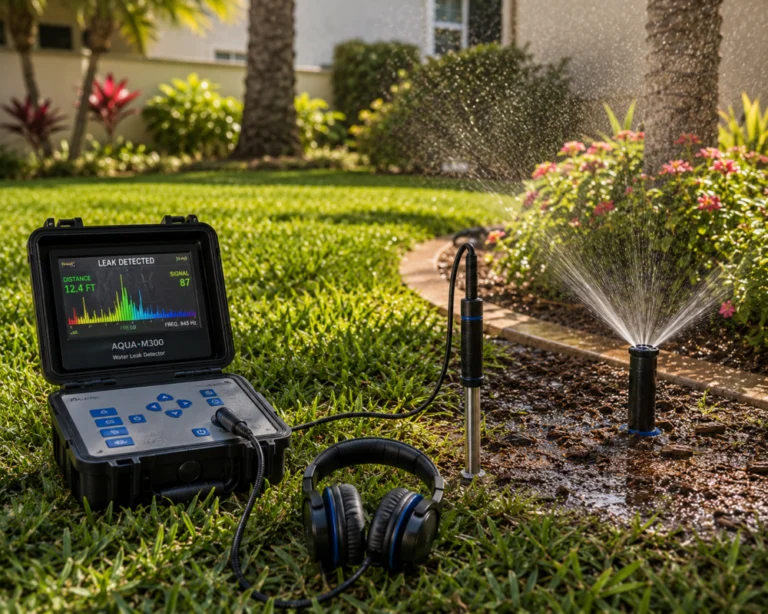
Irrigation is the single most common answer to “the meter moves and nothing inside is wet”, and it is free to eliminate.
A leaking irrigation valve wastes water continuously and produces no symptom at all except the bill, because it drains straight into the soil. See irrigation and sprinkler leak detection.
A running toilet is the cheapest leak to fix and one of the more common causes of a bill that jumped. It is also easy to miss, because a slow flapper leak is silent.
A flapper is a few dollars and a ten-minute job. Doing this before calling anybody is worth it purely on the odds.
Meters vary, and the dial you are looking for has different names depending on who made it. These are the parts worth recognising.
| What you see | What it is |
|---|---|
| A small triangle, star or red dial | The leak indicator — spins on tiny flow |
| A large sweep hand | One full turn is a fixed volume — useful for measuring |
| A row of digits, some on a black field | The totaliser — your cumulative reading |
| A digit on a white or red field | Usually a fraction of a unit, not billed separately |
| A flow arrow on a digital display | The digital equivalent of the leak indicator |
| A display that is asleep | Many digital meters wake when you shine a light on them |
If yours has no leak indicator at all, the two-readings-two-hours-apart method does the same job. Photograph the face rather than trying to remember it, and if you cannot make sense of what you are looking at, photograph it and bring it to the call.
| It answers | It does not answer |
|---|---|
| Whether the supply is losing water | Where the leak is |
| Roughly inside or outside the house | Which line, or how deep |
| Whether irrigation is involved | Whether a drain or sewer line is leaking |
| Whether a toilet is running | Whether a roof, AC or appliance is the source |
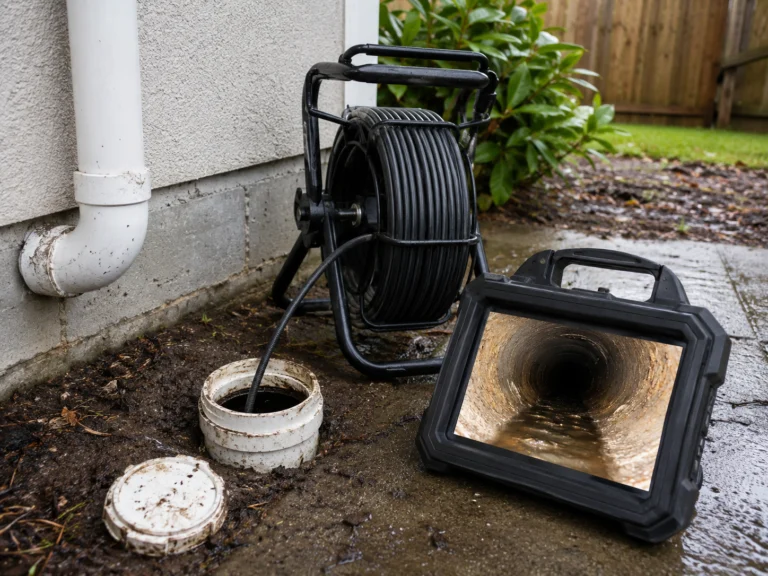
Drains are the important gap. They are not pressurised, so a leaking drain or sewer line does not move the meter at all, the water was going down the pipe anyway. That is what a hydrostatic test is for.
We are licensed and insured plumbers, and this site is about leaks — finding the ones you cannot see and repairing them properly. Roughly half of what looks like a plumbing leak turns out not to be one, so the boundary is worth stating plainly.
Roof leaks are a roofer. Water under an air handler is an HVAC technician clearing a condensate drain. Water under an appliance is appliance repair. Drying, restoration and mold are separate trades again, and gas line repair is SoCalGas or a licensed gas fitter. We detect gas leaks, we do not repair gas lines.
The full list, with the trade to call for each, is on what we don’t do.
Detection is flat rather than hourly, credited toward the repair, and if we cannot locate the leak during your paid visit there is no detection fee. Bringing your meter test result to the call genuinely shortens the visit. You have already done the first two steps we would have done.

Meter still turning after the test? We locate the leak precisely and quote in writing.
(714) 386-7923Call or text, day or nightSchedule a VisitTurn off every fixture in the house including irrigation, open the meter box, and watch the small triangle or star on the meter face. With nothing running it should be perfectly still. If it turns at all, water is leaving your system.
Usually in a covered box in the ground near the street or sidewalk, with a concrete or plastic lid often marked WATER. It lifts with a screwdriver in the notch. Open it carefully — insects like meter boxes.
Irrigation first — turn it off at the controller for a day and retest. Then the toilets, with the dye test. Those two account for most cases of a moving meter with no visible water anywhere.
Yes, and it is useful information. Your pressurised supply is not losing water, so the source is something else: a drain, a roof, an air conditioner condensate line, an appliance, or water coming in from outside.
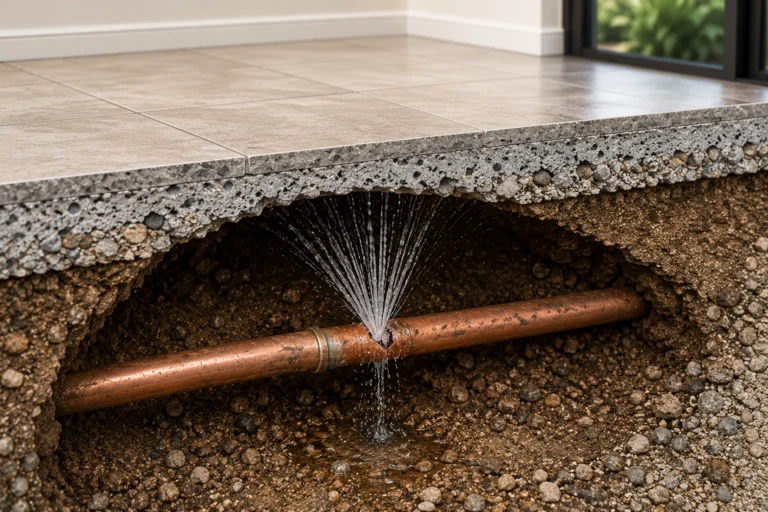
Close the main shut-off valve where the supply enters the house, then check the meter again. Still turning means the leak is between the meter and that valve, so it is the buried main line. Stopped means the leak is inside.
The leak indicator picks up surprisingly little flow, but not everything. If it is still, photograph the reading and check again after one to two hours with nothing used, a changed reading catches leaks too slow to spin the dial.
Easily, and it is one of the more common causes. A flapper that passes water does so continuously and silently. Put dye in the tank, wait twenty minutes, and look in the bowl — colour there means it is leaking.
No. Drains are not pressurised, so a leaking drain does not register, the water was going down the pipe anyway. A hydrostatic test is what proves a drain system holds.
Enough to be obvious on a bill, which is usually how people find out. Rather than quote a figure we have not verified for your meter, take two readings a day apart with nothing used, the difference is your actual answer.
Yes, and any honest company will tell you the same. It is free, it takes twenty minutes, and it either saves you a service call or tells us where to start. Bring the result to the conversation.