Every hidden leak announces itself somehow: a bill, a sound, a smell, a warm patch, a crack in a floor. This page takes the symptoms one at a time and says what each usually points at, what it rules out, and what to check before spending anything.
| Symptom | Most likely cause |
|---|---|
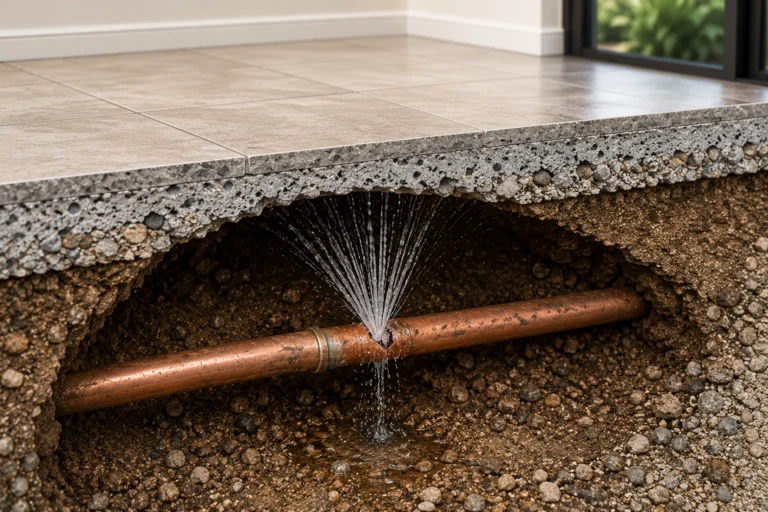
| A warm patch on the floor | Hot-water slab leak |
| Running water sound with everything off | A pressurised leak |
| Water bill jumped, nothing visible | Irrigation, a toilet, or a hidden leak |
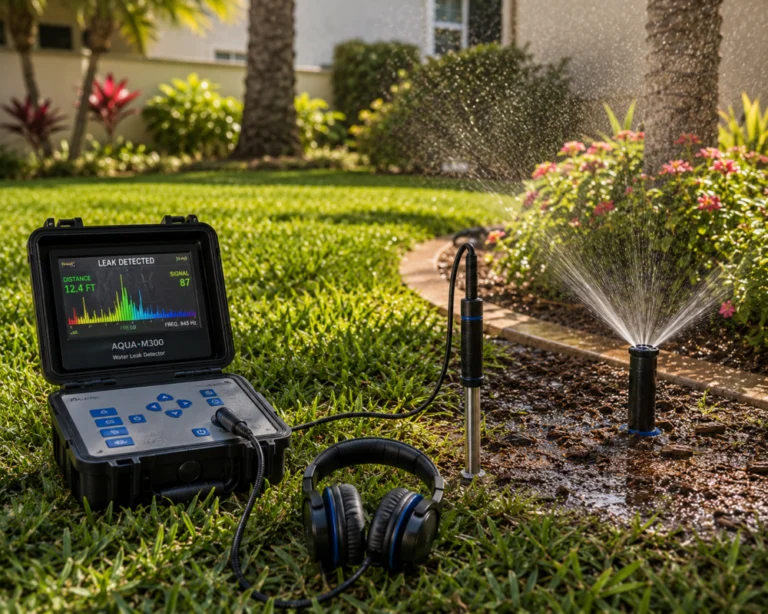
| Wet patch in the yard that will not dry | Main line, irrigation or drainage |
| Low pressure through the whole house | Supply leak, regulator or corrosion |
| Pressure that is uncomfortably high | Failed or absent regulator |
| Brown or rusty water | Corroding pipe or a disturbed main |
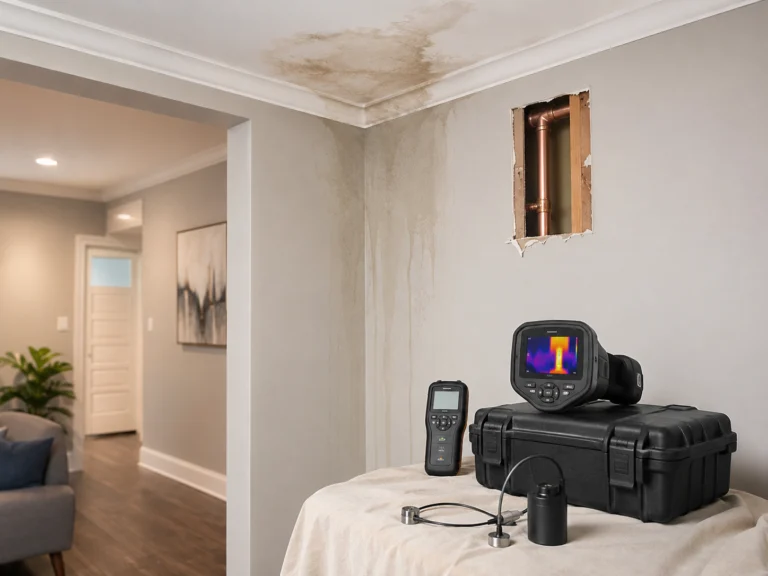
| Ceiling wet under a bathroom | Shower pan, supply line or drain |
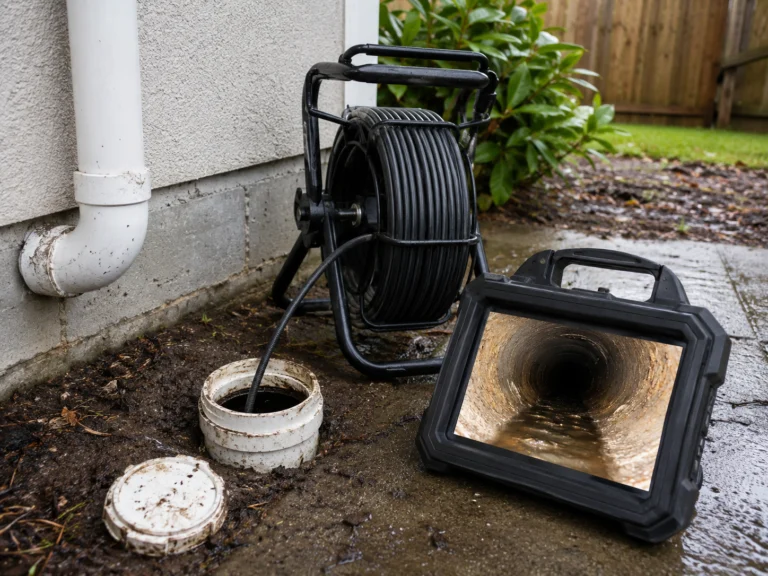
| A drain that clogs again after snaking | Roots, a belly, or a failing line |
| Damp that might just be condensation | Often exactly that |
| A pool or spa losing water | Evaporation, plumbing or the shell |
Most leaks are urgent in the sense that damage accumulates. A few are urgent in the sense that something is happening right now.
Everything else on this page can wait until morning, and morning is usually a calmer and cheaper conversation than midnight.
When a symptom appears narrows the cause faster than what it looks like.
| When it happens | What that points at |
|---|---|
| Constantly, day and night | A pressurised supply line. It never stops |
| Only when water is being used | A drain, a shower pan, or a fixture |
| Only after rain | Roof, flashing, window, or grading against the house |
| Only when the AC runs | HVAC condensate, not plumbing at all |
| Only in summer | Condensation, or the same condensate line |
| Only when the irrigation runs | Irrigation, obviously, and easily eliminated |
| It comes and goes with no pattern | Intermittent — keep notes, they are the key |
If nothing in that table matches, write down when it happens for a week before calling anybody. Ten minutes of notes routinely beats an hour of searching, and the notes cost nothing.
Half of what gets reported as a plumbing leak is not one. These are the recurring impostors, and recognising your situation here saves a service call.
The instinct is to rank leaks by how dramatic they look. It is the wrong ranking, and it is why people leave the expensive ones and panic about the cheap ones.
| Symptom | Feels | Actually |
|---|---|---|
| Water pouring through a ceiling | Catastrophic | Contained the moment you shut the main |
| A drip under a sink | Trivial | Trivial — genuinely, if you catch it |
| A warm patch on the floor | Mild | A pressurised leak running 24 hours a day |
| A bill up by a third | Annoying | Water leaving the system continuously |
| A musty smell | Mild | Moisture that has been there for months |
| A drain that clogs again | Routine | Often a failing line rather than a blockage |
| Nothing visible at all | Fine | The under-slab drain leak nobody finds for years |
The pattern in the right-hand column is that the leaks with the quietest symptoms have usually been running the longest, and damage is a function of duration. A dramatic leak you stop in ten minutes may cost less than a quiet one nobody noticed for a year.
| What you notice | Why it can be a leak |
|---|---|
| Hardwood cupping in one area | Moisture from below, through the subfloor |
| A crack appearing across a tiled floor | Soil washing out under the slab |
| A door that suddenly will not close | The slab has moved slightly |
| Ants or roaches in one room | They are following moisture |
| A musty smell nobody can place | Long-running moisture in a wall or under a floor |
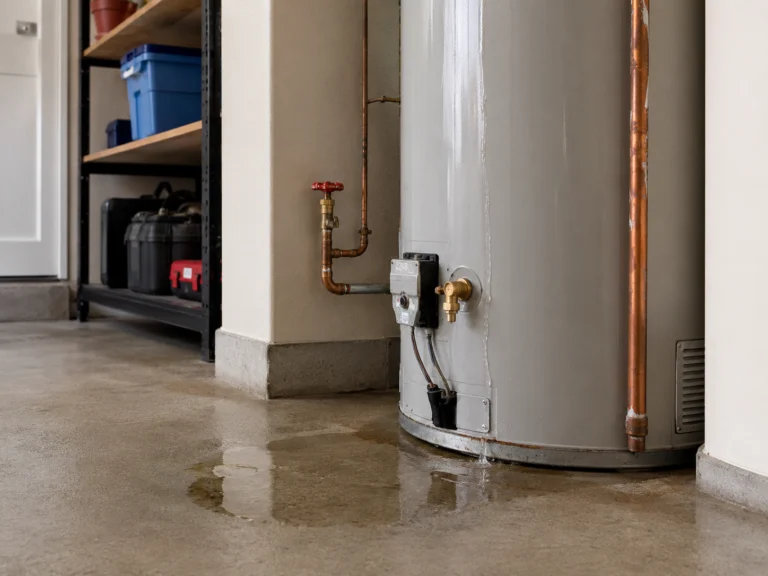
| The water heater running more than it used to | A hot-water leak means constant reheating |
| Grass greener in a strip across the lawn | The main line runs under it |
The greener strip is the most literal signal in this trade, and the door that stops closing is the one people find hardest to believe. Both are worth acting on.
We are licensed and insured plumbers, and this site is about leaks — finding the ones you cannot see and repairing them properly. Roughly half of what looks like a plumbing leak turns out not to be one, so the boundary is worth stating plainly.
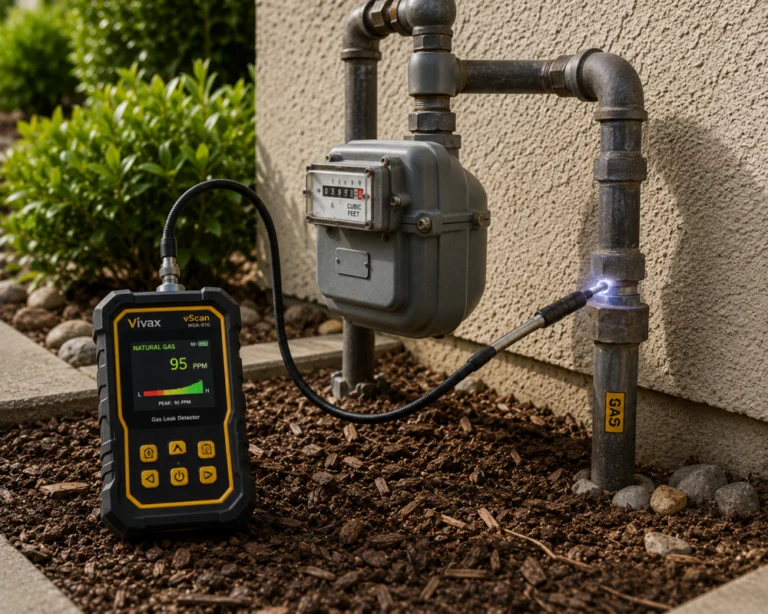
Roof leaks are a roofer. Water under an air handler is an HVAC technician clearing a condensate drain. Water under an appliance is appliance repair. Drying, restoration and mold are separate trades again, and gas line repair is SoCalGas or a licensed gas fitter. We detect gas leaks, we do not repair gas lines.
The full list, with the trade to call for each, is on what we don’t do.
Because they produce the most distinctive symptom set and the most expensive mistakes.
Detail on all of it is at slab leak signs and symptoms and what is a slab leak. The repair side is slab leak repair.
Detection is flat rather than hourly and credited toward the repair, with no detection fee if we cannot locate the leak during your paid visit. Bring your meter test result and your notes — both shorten the visit.

Run the meter test first. If it is moving, we will find out where the water is going.
(714) 386-7923Call or text, day or nightSchedule a VisitMost commonly a water bill that jumped with no change in usage, the meter turning with everything shut off, the sound of running water when nothing is running, or a warm patch on the floor. The bill and the meter together are the strongest pair.
Not always. It is one of the more reliable signs. A hot-water line leaking under a slab warms the concrete above it. Radiant heating and a sun-warmed floor can both mimic it, which is why the meter test is worth running alongside.
Usually irrigation, a running toilet, or a leak that drains away without ever surfacing. Turn the irrigation off for a day and retest the meter, then dye-test the toilets. Those two cover most cases.
Yes. Water under a slab washes fines out of the soil beneath it, and the slab settles unevenly where the support has gone. A new crack across a tiled floor, or a door that suddenly will not close, is worth taking seriously.
No. Condensation forms on the outside of a cold pipe or tank when warm humid air reaches it. It is worst in summer, the water is on the pipe rather than under it, and no repair is needed — though insulation helps.
Long-running moisture somewhere you cannot see — inside a wall, under a floor, or in a crawl space. By the time something smells it has usually been damp for a while, which is why a smell with no source is worth investigating rather than airing out.
Because a water line runs under it and has been watering it. A green or soft strip in the shape of a trench is one of the more reliable outdoor signs of a main line leak, and it usually appears before any pooling does.
Water coming through a ceiling, any gas smell, sewage backing up, water near an electrical panel, a pool level near the skimmer, and a floor that is sinking or newly cracked. Everything else can wait until morning.
Yes, particularly an under-slab drain leak. Drains are not pressurised, so nothing shows on the meter and the water was going down the pipe anyway. That is what a hydrostatic test exists to prove.
The leak itself is usually the cheap part. Flooring, subfloor, soil under the slab, drying and mold all scale with how long the water ran, not how fast. A meter test today beats another month of wondering.