Mon–Sat 7am–6pm · 24/7 Emergency Line
Serving Santa Ana & Central OC

LEAK GUIDE · SANTA ANA & CENTRAL ORANGE COUNTY

How to Choose a Leak Detection Company

You are about to let somebody into your house to tell you something expensive, and you have no way to check their work. These are the questions that actually separate companies, useful whether you hire us or somebody else.

How to Choose a Leak Detection Company

Verify the Licence Yourself

Not “are you licensed” on the phone. Look it up. It takes a minute and it is the one check nobody can talk you out of.

1
Ask for the licence number
Any legitimate contractor gives it without hesitation. Hesitation is the answer.
2
Look it up at cslb.ca.gov
The California State License Board’s site. Search by number or by business name.
3
Check it is active and current
Not expired, not suspended. The status is shown plainly.
4
Check the classification
Plumbing work should be held by somebody classified for plumbing.
5
Check the bond and workers’ compensation
Both are shown. Missing workers’ comp on a company with employees is a meaningful risk to you, not only to them.
6
Ask for the insurance certificate
General liability, issued by the insurer, current. Reluctance here is worth noticing.
Worth knowing A licence does not make somebody good. What it does is establish that somebody is accountable to a body that can act on a complaint, and that there is money behind a mistake in your house. Both matter more than they feel like they do until the day they matter enormously.

The Pricing Questions

AskWhat a good answer sounds like
Is detection flat or hourly?Flat, hourly charges most for the hardest search
What is the flat fee?A number, on the phone, before dispatch
Is it credited toward the repair?Yes, and stated without being pushed
What if you cannot find it?No detection fee, specific, not vague
What are the after-hours rates?Given on the call, before anybody is sent
Will I get a written quote?Itemised, with exclusions, before work starts
Are there trip or diagnostic add-ons?Ideally none, and named if there are

A company that will not give a detection price on the phone is asking you to let somebody into your house before you know what it costs. That is a choice they have made, and you can make one too.

The Method Questions

These are the ones that separate a specialist from a general plumber with a moisture meter.

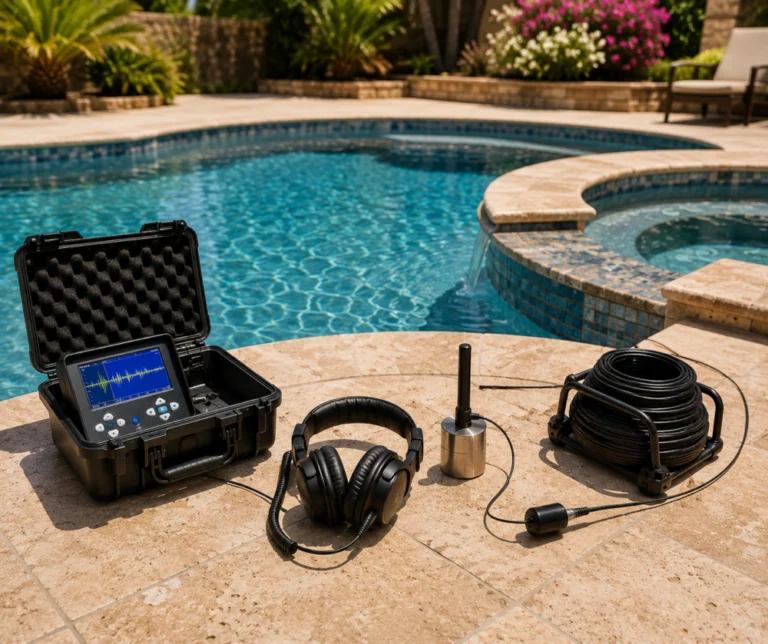
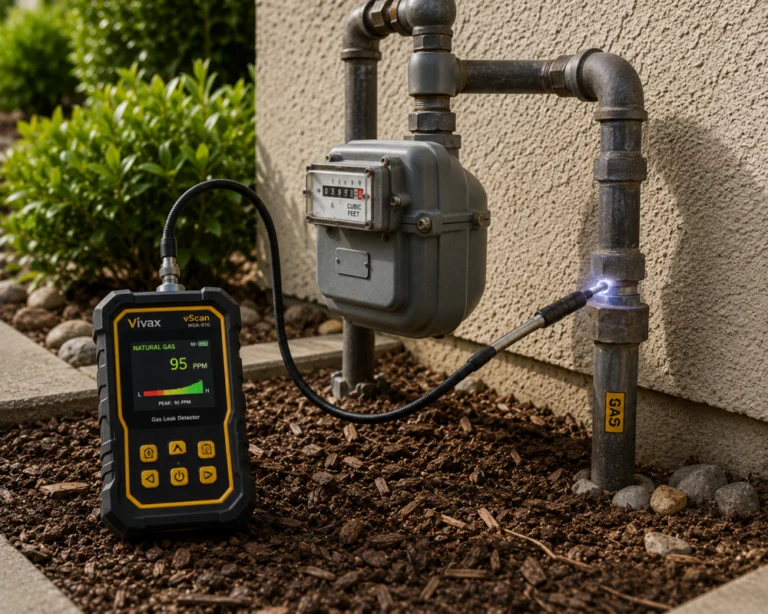
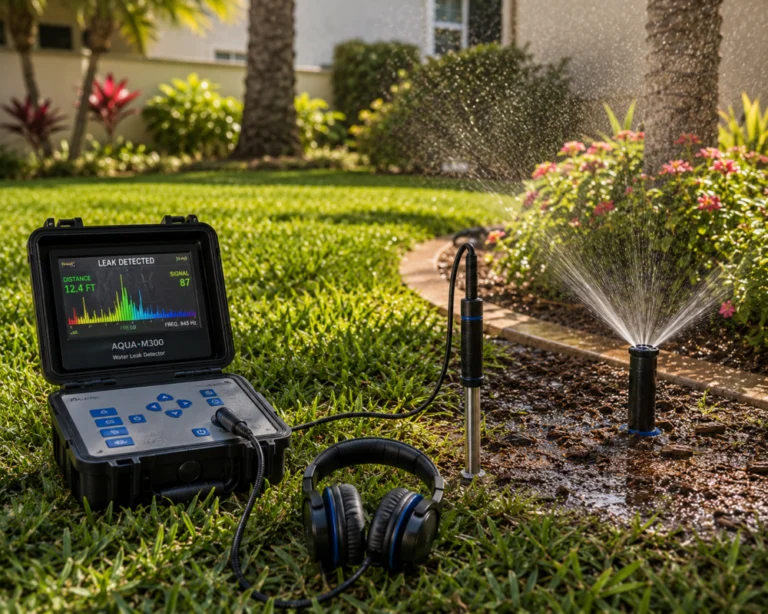
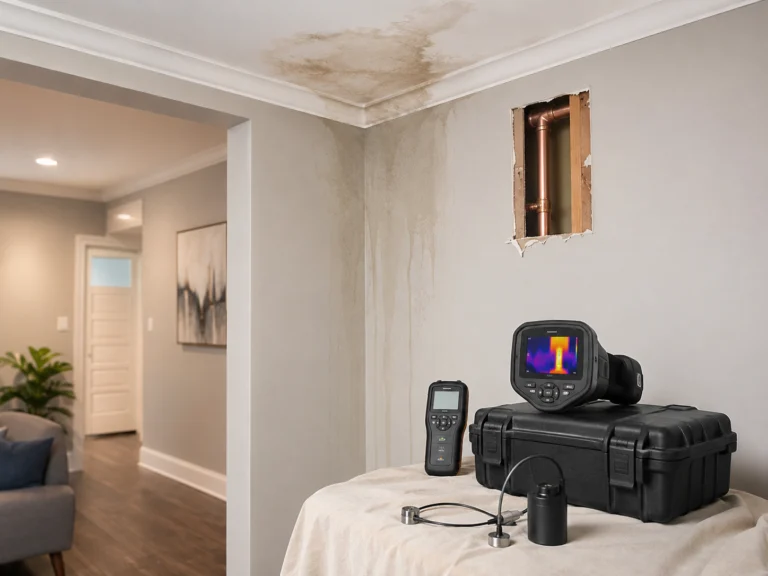
  • What equipment do you use? You want to hear acoustic, thermal and tracer gas, not one of the three
  • Will you need to cut into anything to find it? The answer should be no. Opening a building is a repair step, never a search step
  • Do you locate before you quote a repair? A price given before the leak is found is a guess
  • Do you repair what you find? When detection and repair are separate companies, the location gets described rather than handed over
  • Do I get a written report and photographs? Regardless of whether you proceed
  • Will you tell me if it is not plumbing? Half of what looks like a plumbing leak is not

Red Flags

A repair quoted before the leak is located
There is no honest way to price a repair for a leak nobody has found yet. A number given at that stage is either padded to cover the unknown or is going to change.
Pressure to decide today
Urgency applied to your decision rather than to the water is a sales technique. A genuine emergency is about stopping the water, not about signing this afternoon.
Repipe recommended without a diagnosis
A repipe is sometimes exactly right. Recommended before anybody has established what failed and why, it is a product being sold rather than a problem being solved.
Reluctance to hand over footage or reports
It is your line and your house. Any hesitation about giving you the video or the written findings tells you what those documents would show.

None of these is proof of bad faith on its own. Two of them together in the same conversation is a reason to get another quote.

Reading Reviews Usefully

Look forDiscount
Reviews describing the diagnosis, not just politeness“Great service, highly recommend”
Reviews from people who were told it was not plumbingReviews with no detail at all
How the company answered a critical reviewThe existence of a critical review
Repeat customers mentioning a second jobA cluster of five-star reviews in one week
Specifics: what was found, where, what it costAnything that reads like a template

The most useful review on any contractor’s profile is a two- or three-star one with detail, and the reply underneath it. That tells you how the company behaves when something goes wrong, which is the only time any of this matters.

Getting a Second Opinion

It is normal, it is reasonable, and nobody should make you feel awkward about it.

  • On anything over a few thousand dollars, a second quote is ordinary prudence
  • Give the second company the symptoms, not the first company’s conclusion. You want an independent read, not a confirmation
  • Do share the video or report afterwards, once you have their own finding, and compare
  • If two companies disagree about the location, that is worth resolving before anybody digs
  • If two companies agree on the location but differ wildly on price, the difference is usually scope, ask what each quote includes

We take second-opinion calls routinely and we start from zero on them by policy. See mystery leak detection.

Questions About the Warranty

What exactly does it cover?
The work performed, or the whole system? Those are very different promises and the difference is where disputes start.
For how long?
And is it in writing, in the quote, rather than said on a doorstep.
Does it transfer if I sell?
Worth knowing, and worth having in writing if the answer is yes.
What voids it?
Every warranty has exclusions. A company that says there are none has not written one down.

Ours is two years on workmanship, transferable, with the exclusions stated, full terms on guarantees and warranties. Read anybody else’s the same way you would read ours.

What This Site Is About, and What Belongs to Another Trade

We are licensed and insured plumbers, and this site is about leaks, finding the ones you cannot see and repairing them properly. Roughly half of what looks like a plumbing leak turns out not to be one, so the boundary is worth stating plainly.

Roof leaks are a roofer. Water under an air handler is an HVAC technician clearing a condensate drain. Water under an appliance is appliance repair. Drying, restoration and mold are separate trades again, and gas line repair is SoCalGas or a licensed gas fitter. We detect gas leaks, we do not repair gas lines.

The full list, with the trade to call for each, is on what we don’t do.

Specialist or General Plumber?

Both are legitimate. The question is which one your situation calls for.

Your situationWho fits
You know exactly where the leak isEither, a general plumber can repair it
You have no idea where it isA specialist. That is the equipment-heavy part
Somebody has already looked and failedA specialist, and one who starts from zero
It is under a slabA specialist, the cost of guessing is very high
It is a poolA specialist — pool plumbing is its own diagnostic
It is a visible drip at a fixtureA general plumber, and probably cheaper

If your leak is on the last row, we would tell you the same thing on the phone. There is no sense paying detection rates for a problem you can already point at.

How We Answer Our Own Questions

Detection visit
$150 – $500
Flat, credited toward the repair
Spot repair
$1,500 – $3,500
Accessible, or under finished floor
Reroute
$2,000 – $4,500
Per line
Whole-house repipe
$6,000 – $15,000
PEX or copper
  • Licensed and insured, verifiable at cslb.ca.gov — ask and you get the number
  • Detection is flat, $150 to $500, credited toward the repair
  • No detection fee if we cannot locate it during your paid visit
  • Non-invasive first, always. Nothing is opened to search
  • Written report, photographs and an itemised quote — whether or not you proceed
  • Two-year workmanship warranty, transferable
  • We tell you when it is not plumbing, and which trade it is
Comparing quotes? Ask us the same questions you asked them.
Get a written quote
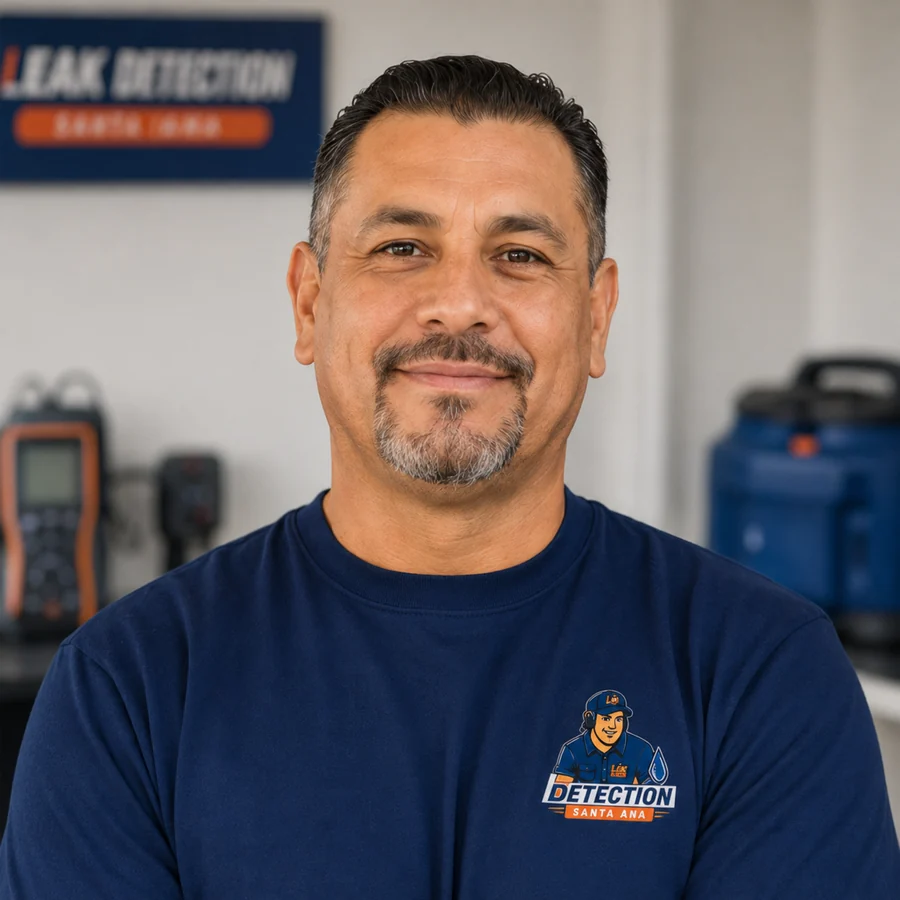
David Herrera, Founder & Lead Leak Detection Technician
About the Author
David Herrera, Founder & Lead Leak Detection Technician
David founded Leak Detection Santa Ana in 2026 after more than 15 years finding and repairing leaks across Orange County. He leads the crew that does the work, and the judgement calls on this page are the ones he uses in the field. Meet the team.

Get a Free On-Site Quote

Ask us the same questions you ask everybody else. We would rather you did.

(714) 386-7923Call or text, day or nightSchedule a Visit

What’s Included

  • Acoustic, thermal & tracer-gas location
  • Plain-language explanation of what we found
  • Firm written quote, on-site
  • No-find-no-fee guarantee

Frequently Asked Questions

Go to cslb.ca.gov and search by licence number or business name. Check that it is active and current, that the classification covers plumbing, and that the bond and workers’ compensation are in place. It takes a minute.

Flat is better for you. Hourly charges the most precisely when the leak is hardest to find, which is the situation you are most likely in if you have called a specialist rather than a general plumber.

It should mean that if the company cannot locate a leak during your paid detection visit, you do not pay the detection fee. Ask them to state it plainly — vagueness here, or “we always find it”, is worth noticing.

No, it is ordinary prudence on anything over a few thousand dollars. Give the second company the symptoms rather than the first company’s conclusion. You want an independent read, and comparing afterwards is where the value is.

A repair quoted before the leak is located, pressure to decide today, a repipe recommended without any diagnosis, and reluctance to hand over footage or written findings. Any two of those together is a reason to get another quote.

If you know where the leak is, a general plumber can repair it and may be cheaper. If you do not know where it is — particularly under a slab — the detection is the part worth paying a specialist for.

Look for reviews that describe what was actually found rather than how polite everyone was. The most useful thing on any profile is a critical review with detail and the company’s reply underneath it. That is how they behave when something goes wrong.

The scope, the material, the price, what is excluded, and the schedule. Restoration and finish work are the exclusions people are most often surprised by, so they should be named rather than left to be discovered.

You should be. You paid for the diagnosis; the report is what you bought. A company that withholds findings from somebody who declined the repair is telling you what those findings are worth to them.

Sometimes, but compare what each includes before deciding. Two quotes that differ by thousands on the same leak usually differ on scope: restoration, permits, material, or whether the failing run is being replaced or one point on it repaired.