Excess water pressure is the quietest cause of plumbing failure there is. It does not announce itself, it works every joint and every appliance in the house continuously, and it costs very little to measure and correct. If your house has had more than one leak, this is the first thing worth ruling out.
| What it affects | How |
|---|---|
| Pipe joints | Constant stress at every fitting, day and night, for years |
| Supply connectors | Braided lines under sinks and toilets fail sooner |
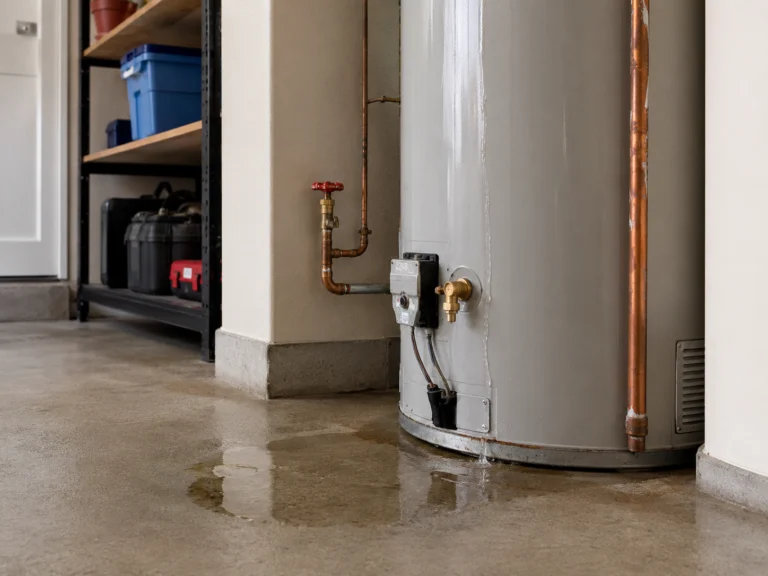
| The water heater | Its relief valve weeps or discharges; the tank works harder |
| Appliance valves | Dishwashers and washing machines have inlet valves rated for a range |
| Taps and cartridges | Drip sooner, wear faster |
| Toilet fill valves | Run on, or fail to seal |
| The whole system | Water hammer hits harder, which is its own repeated stress |
None of that is dramatic on any given day. It is a background load that shortens the life of everything simultaneously, which is why a house with excess pressure tends to produce a run of unrelated failures rather than one obvious problem.
The last one is the reason this page sits on a leak detection site. When a house produces a second leak in a short span, pressure is the first thing worth measuring, because if it is the cause, repairing the leak solves this week’s problem and nothing else.
A brass, bell-shaped fitting where the supply enters the house, usually with an adjustment screw on top. Its entire purpose is to hold the house below the street.
| Question | Answer |
|---|---|
| Do I have one? | Most houses do. Look near where the main enters, often by the meter or a front wall |
| How long do they last? | They wear out. A house that has never had one replaced may be on its original |
| How do they fail? | Either direction, stuck open gives excess pressure, stuck closed gives low |
| Can I adjust it myself? | Only with a gauge on the system. Adjusting blind is guessing |
| Is replacing one expensive? | Modest, relative to almost anything else in this trade |
| Does it need anything else? | On a closed system, an expansion tank, ask when it is fitted |
The expansion tank point is worth raising with whoever fits one. A regulator makes the system closed, and heated water in a closed system has to expand somewhere. See pressure regulator installation.
Related, frequently confused with it, and worth separating.
If you have banging pipes and a gauge reading well over 80 psi, fix the pressure first. It frequently reduces the hammer as a side effect, and it is the more consequential of the two problems.
Worth understanding, because it explains a symptom that otherwise makes no sense: pressure that is fine most of the time and spikes after somebody showers.
| What happens | Why |
|---|---|
| Water is heated in the tank | It expands — water always does |
| In an open system it pushes back into the main | Nothing to stop it, so pressure stays level |
| A regulator makes the system closed | The expanding water has nowhere to go |
| Pressure spikes after every heating cycle | Sometimes far above the regulated setting |
| The relief valve weeps or discharges | It is doing exactly what it was built to do |
| An expansion tank absorbs it | A small air-charged vessel that gives the water somewhere |
This is why a relief valve that drips should not simply be replaced. Replacing it treats the symptom of a system with nowhere to put expanding water, and the new one will do the same thing. It is also why fitting a regulator without considering an expansion tank can create a problem that was not there before.
| Reading | What to do |
|---|---|
| Comfortably in the normal range | Nothing. Note it and move on |
| Toward the upper end | Recheck overnight before deciding anything |
| Above 80 psi | Worth correcting — check whether you have a regulator |
| Well above 80 psi | Correct it. Everything in the house is being worked hard |
| Varies wildly through the day | A failing regulator is the usual explanation |
| Low instead | Different page — low water pressure |
There is no drama here and there does not need to be. A gauge, a reading, and where necessary a regulator, is one of the cheapest pieces of prevention available in a house.
We are licensed and insured plumbers, and this site is about leaks — finding the ones you cannot see and repairing them properly. Roughly half of what looks like a plumbing leak turns out not to be one, so the boundary is worth stating plainly.
Roof leaks are a roofer. Water under an air handler is an HVAC technician clearing a condensate drain. Water under an appliance is appliance repair. Drying, restoration and mold are separate trades again, and gas line repair is SoCalGas or a licensed gas fitter. We detect gas leaks, we do not repair gas lines.
The full list, with the trade to call for each, is on what we don’t do.
Excess pressure does not create a leak out of nothing. What it does is find every weak point sooner than it otherwise would.
| Without excess pressure | With it |
|---|---|
| An aging joint fails eventually | It fails sooner |
| A marginal original fitting holds for decades | It does not |
| A thinning copper wall opens late in life | It opens earlier |
| A braided connector reaches its service life | It reaches it faster |
| One leak is one event | One leak is often the first of several |
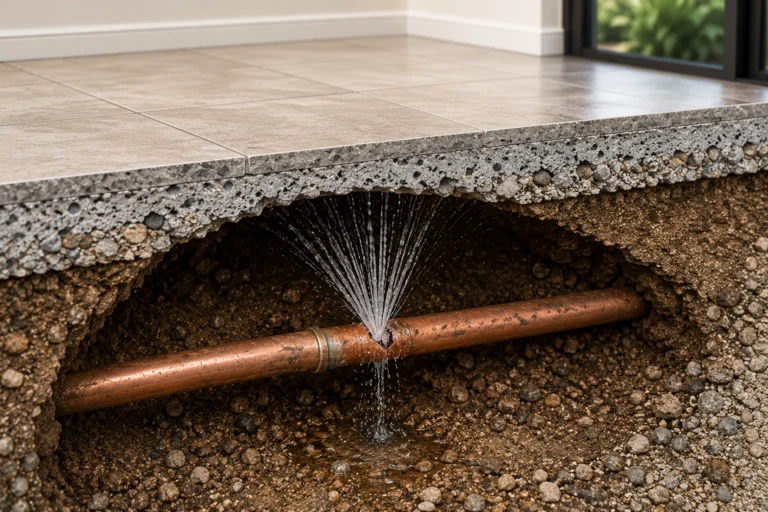
Which is why, after a slab leak or a pinhole in copper, a pressure reading is worth taking before anybody decides between a repair and a repipe. If the pressure is the underlying cause and nobody corrects it, the next failure is only a question of where. See copper pinhole leak repair.
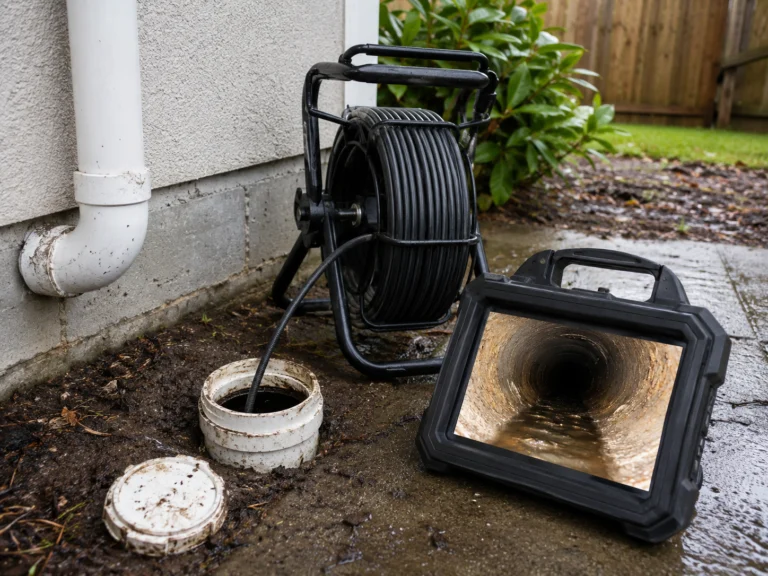
A pressure test at multiple points, the regulator inspected, and a meter test to confirm nothing is leaking are all part of a normal detection visit. Where a regulator is the answer, that is a modest job and you will be told so rather than sold something larger.

After a leak, measure the pressure before deciding between a repair and a repipe.
(714) 386-7923Call or text, day or nightSchedule a VisitAround 50 to 60 psi is comfortable and typical. Much above 80 psi is where damage accumulates. Not suddenly. It is a constant background load on every joint, connector and appliance valve in the house.
A gauge that screws onto a hose bib costs very little. Screw it on, open the tap fully with nothing else running, and read it. Then check again at night — municipal pressure often rises overnight and that is the reading that matters.
It does not create a leak from nothing. What it does is find every weak point sooner. A marginal joint that would have held for decades fails earlier, and a house with excess pressure tends to produce a run of unrelated failures rather than one.
A brass, bell-shaped fitting where the supply enters the house, with an adjustment screw on top. Its job is to hold your house below whatever the street is delivering. They wear out, and they can fail in either direction.
Only with a gauge on the system, otherwise you are guessing. Turning the screw without measuring is how a house ends up at the other extreme, and the point of the exercise is a known number rather than a different unknown one.
Water hammer — moving water stopping abruptly when a valve closes fast. Washing machines and dishwashers cause it most. High static pressure makes it worse, so correcting the pressure often reduces it as a side effect.
Frequently excess pressure, sometimes thermal expansion in a closed system. It is a genuine warning rather than a nuisance — measure the pressure before replacing the valve, or you will be replacing it again.
Yes. Dishwasher and washing machine inlet valves are built for a range, and running them above it shortens their life. Supply connectors, tap cartridges and toilet fill valves all wear faster too.
Not necessarily. What arrives at a property depends on elevation and distance from the supply, so a house lower than the surrounding network sees more. Neighbours a street away can read quite differently.
Yes, and ideally before deciding between a repair and a repipe. If excess pressure is the underlying cause and nobody corrects it, the repair solves this week’s problem and the next failure is only a question of where.