Mon–Sat 7am–6pm · 24/7 Emergency Line
Serving Santa Ana & Central OC

LEAK GUIDE · SANTA ANA & CENTRAL ORANGE COUNTY

Tree Roots in a Sewer Line

Roots do not break into a sound pipe. They find a joint or a crack that is already weeping, follow the moisture in, and then grow to fill the space. Which means roots in your line are two problems: the roots, and the defect that let them in, and clearing only the first is why the clog keeps coming back.

Tree Roots in a Sewer Line

How Roots Get Into a Pipe

1
A joint or a crack starts weeping
Clay pipe joints, an offset, a hairline crack, a failed connection. The pipe is not pressurised, so this leaks nothing dramatic. It just dampens the soil around it.
2
Roots find the moisture
Roots grow toward water and nutrients. A damp patch beside a sewer line in dry Southern California soil is a strong signal.
3
A fine root enters the gap
It only needs a hairline. What goes in is thread-thin.
4
It thickens inside the pipe
In there it has water, nutrients and no competition. It grows into a mass, and the root that entered as a thread ends up as thick as a finger.
5
The mass catches solids
Paper, grease and waste snag on it. That is what produces the backup: the roots are the net, not the blockage.
6
It widens the original defect
As the root thickens it levers the joint further open, which lets more roots in. That is the loop.
Worth knowing This is why a clean-out alone is temporary. Cutting the roots removes the mass and leaves the crack, and the crack is still weeping into soil full of roots that now know exactly where to go.

Signs You Have Them

  • A drain that clears after snaking and clogs again within months
  • Gurgling from a toilet or a floor drain when something else drains
  • More than one fixture slow at the same time. That points at the main line
  • A toilet that bubbles when the washing machine empties
  • Sewage odour outside near the line’s route
  • Grass unusually lush along a line from the house toward the street
  • Ground settling above the line

The repeat-clog pattern is the strongest single sign. A one-off blockage happens; the same drain clogging again a few months after it was cleared is telling you something structural. See why a drain keeps clogging.

Which Lines Are Vulnerable

Pipe materialEraRoot risk
ClayPre-1970sHighest, short sections, a joint every few feet
Cast iron1950s–1970sModerate, joints and corrosion holes
OrangeburgMid-century, occasionalHigh once it deforms
ABS plastic1970s onwardLow, solvent-welded joints, fewer of them
Lined pipeAfter a CIPP repairLow — continuous, no joints to enter

A mid-century Santa Ana house on original clay has a joint every few feet along its lateral, and every one of them is a potential entry point. That is not alarmism, it is just what clay pipe is.

Confirming It: the Camera

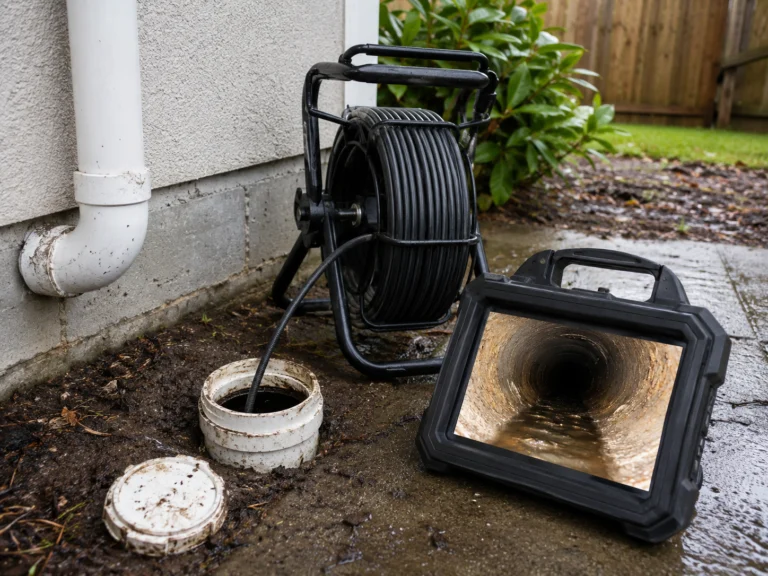
There is no way to know what is in a sewer line without looking, and guessing is expensive in both directions.

What the camera shows
Whether it is roots at all, which joints they are entering at, how far along the run, how deep, and what condition the surrounding pipe is in. All four matter to the repair.
Why it happens after clearing
A line full of roots cannot be inspected. Clearing first, then camera, is the right order, and a second look after clearing frequently reveals defects the mass was hiding.
What you get
The recorded run, yours to keep, with any fault located and marked on the surface. That footage is what a second opinion rests on.

Full detail on sewer camera inspection.

The Options, and What Each Actually Achieves

OptionWhat it doesHow long it lasts
Mechanical cuttingCuts the mass out with a rotating headMonths to a couple of years
Hydro jettingCuts and scours the pipe wall cleanSimilar, but a cleaner starting point
Root-killing treatmentsKills roots in contact with itDoes not repair the defect
Spot repair at the jointReplaces the section they enter atPermanent, for that joint
Lining (CIPP)Seals the run continuously — no jointsThe durable answer on a sound line
Pipe burstingReplaces the line entirelyNew pipe
Removing the treeRemoves the sourceRarely the proportionate answer

The honest summary: clearing buys time, and sealing the entry point ends it. Which of the sealing options fits depends on whether the roots are at one joint or all of them, and that is a camera question rather than an opinion.

What It Costs

Camera inspection
$250 – $500
Charged whether or not a fault is found
Spot repair
$1,500 – $3,500
Depends on depth and access
Trenchless sewer repair
$4,000 – $12,000
Lining or pipe bursting
Full sewer replacement
$6,000 – $20,000
Open trench, by length

Clearing is the cheapest thing on this page and it is also the thing you will be paying for repeatedly. The arithmetic worth doing is the cost of clearing every eighteen months against the cost of sealing the joint once — over any horizon longer than a few years it is not close.

Everything we price is on the pricing page.

Same drain clogging again? Put a camera in it before paying for another clearing.
Book a camera inspection

Cutting Versus Jetting

Both clear a line and they are not the same operation, which matters when you are comparing two quotes.

Mechanical cuttingHydro jetting
How it worksA rotating cutting head on a cableHigh-pressure water through a nozzle
What it leavesThe mass cut back, wall still coatedThe pipe wall scoured clean
Best onHeavy root mass, first passGrease, scale, and finishing after cutting
RiskCan catch on a badly damaged pipeCan worsen an already fragile line
Camera afterwardsAdvisableAdvisable, and much more readable
CostLowerHigher

On a heavy root mass the usual sequence is cut first, then jet, then camera — each step makes the next more effective, and the camera is only worth doing once the pipe wall is visible. A quote that includes jetting on a line nobody has looked at yet is worth questioning, because a fragile clay line is not always a good candidate for it.

About the Tree

The question everybody asks, and the answer is usually not what people expect.

  • Removing the tree does not remove the defect. The joint is still open, and other roots will find it
  • Roots travel considerably further than the canopy suggests, so the tree responsible may not be the nearest one, or yours
  • A mature tree is worth real money in shade, in property value and in the time it took to grow
  • Sealing the pipe solves the problem regardless of which tree it was
  • Where a tree is genuinely the wrong tree in the wrong place, that is an arborist conversation rather than a plumbing one

Our position is straightforward: fix the pipe, keep the tree. It is almost always both cheaper and better, and a lined or replaced line is not vulnerable to roots at all.

What This Site Is About, and What Belongs to Another Trade

We are licensed and insured plumbers, and this site is about leaks — finding the ones you cannot see and repairing them properly. Roughly half of what looks like a plumbing leak turns out not to be one, so the boundary is worth stating plainly.

Roof leaks are a roofer. Water under an air handler is an HVAC technician clearing a condensate drain. Water under an appliance is appliance repair. Drying, restoration and mold are separate trades again, and gas line repair is SoCalGas or a licensed gas fitter. We detect gas leaks, we do not repair gas lines.

The full list, with the trade to call for each, is on what we don’t do.

Whose Line Is It?

Worth settling before agreeing to a repair, because the lateral does not stop at the property line.

SectionGenerally
Inside the house to the building edgeYours, unambiguously
Across your property to the connectionNormally yours
Between the property line and the mainVaries — confirm with the City for your address
The public main in the streetThe City’s

The camera answers the first question anybody will ask: how far along the run the problem is. More on the boundary at what is a sewer lateral, and on responsibility generally at who is responsible.

Keeping It From Coming Back

Seal the entry point
Spot repair or lining. Everything else on this page is maintenance rather than a solution.
Camera it every few years
On a clay line with a tree over it, that is proportionate. On a lined or plastic line it is not necessary.
Do not wait for the second backup
The first can be a one-off. The second in a year is a specific message, and roots widen the defect while you decide.
Keep the footage
Comparing this year’s run against the last one tells you whether it is progressing or stable, which is genuinely useful.
David Herrera, Founder & Lead Leak Detection Technician
About the Author
David Herrera, Founder & Lead Leak Detection Technician
David founded Leak Detection Santa Ana in 2026 after more than 15 years finding and repairing leaks across Orange County. He leads the crew that does the work, and the judgement calls on this page are the ones he uses in the field. Meet the team.

Book a Camera Inspection

See which joint the roots are entering at before paying for another clearing.

(714) 386-7923Call or text, day or nightSchedule a Visit

What’s Included

  • Acoustic, thermal & tracer-gas location
  • Plain-language explanation of what we found
  • Firm written quote, on-site
  • No-find-no-fee guarantee

Frequently Asked Questions

Through a defect that already exists: a leaking joint, a crack, an offset. The pipe dampens the soil, roots grow toward the moisture, and a thread-thin root enters the gap and thickens inside. Roots do not break into sound pipe.

Because clearing removes the root mass and leaves the crack it grew through. The joint is still weeping into soil full of roots that now know exactly where to go, so they come back, typically within months to a couple of years.

Usually not, and it rarely solves anything on its own. The defect stays open and other roots find it. Sealing the pipe fixes the problem regardless of which tree was responsible, and roots travel much further than the canopy suggests.

A camera is the only way to know. The pattern that points at roots is a drain that clears and then clogs again, gurgling from other fixtures, and more than one fixture slow at once, which means the main line rather than one trap.

They kill roots in contact with them, which buys some time. What they do not do is repair the crack the roots came through, so the problem returns. They are maintenance rather than a solution.

Sealing the entry point: a spot repair at the joint if it is one place, or lining the run if it is several. A lined pipe has no joints to enter, which is why it is the durable answer on a line that is otherwise sound.

Clearing is the cheapest and you will pay for it repeatedly. A spot repair typically runs $1,500 to $3,500, trenchless work $4,000 to $12,000, and a full replacement $6,000 to $20,000. Compare against clearing every eighteen months.

Clay, by a distance — short sections mean a joint every few feet, and every joint is an entry point. Cast iron is moderate. ABS plastic and lined pipe are low risk because they have few or no joints to grow through.

Far less often. A pressurised water line pushes water out rather than letting roots in, so roots tend to wrap around it rather than enter it. Roots in pipes are overwhelmingly a sewer and drain problem.

On a clay lateral with a tree over it, every few years is proportionate, and comparing this year’s footage against the last tells you whether it is progressing. On a lined or plastic line it is not necessary.