Mon–Sat 7am–6pm · 24/7 Emergency Line
Serving Santa Ana & Central OC

LEAK GUIDE · SANTA ANA & CENTRAL ORANGE COUNTY

What Is a Sewer Lateral?

The sewer lateral is the single buried pipe that carries everything from your house to the public sewer main in the street. It is the most expensive pipe on most properties, almost nobody knows where theirs runs, and a large part of it is the property owner’s responsibility rather than the City’s.

What Is a Sewer Lateral?

Where It Runs and What It Does

Everything that drains in your house, sinks, showers, toilets, the washing machine, joins into one line that leaves the building and runs underground to the public main. That single line is the lateral.

  • It leaves the house at one point, usually the side nearest the street
  • It runs at a shallow fall, sewer lines work by gravity, not pressure
  • It is typically buried a few feet down, deeper as it runs toward the main
  • There is normally a cleanout: a capped vertical access point near the building or at the property line
  • It connects to the public main under the street, at a connection made when the house was built
Worth knowing Because it works by gravity rather than pressure, a leaking lateral does not show up on your water meter and does not raise your bill. The water went down the drain either way. That is why lateral problems run for years before anybody notices.

Where Your Responsibility Ends

SectionGenerally
Fixtures and drains inside the houseProperty owner
The line from the house to the property edgeProperty owner
The lateral across your propertyProperty owner
Between the property line and the mainVaries, confirm with the City
The public sewer main in the streetCity of Santa Ana

That fourth row is the one to settle before agreeing to any repair. Where a jurisdiction draws the line between the property boundary and the main differs, and it is worth confirming for your specific address rather than accepting a contractor’s general statement. The City is the authority on it, and the answer can be worth thousands.

What It Is Made Of, and When That Matters

MaterialEraWhat to expect
ClayPre-1970sA joint every few feet; roots at any of them
Cast iron1950s–1970sCorrodes and scales; the bore narrows
OrangeburgMid-century, occasionalDeforms into an oval, then collapses
ABS plastic1970s onwardGenerally sound; look for crushing or a belly
PVCLaterSound; joints and grade are the variables

On a mid-century Santa Ana house, clay is the likely answer, and clay with a mature tree nearby is the single most common lateral problem there is. See tree roots in a sewer line.

How Laterals Fail

Roots at a joint
The most common by a distance. A joint weeps, roots follow the moisture in, and they thicken inside the pipe until solids catch on them.
Bellies and settlement
The line sags where the soil under it moved or was never properly bedded. Standing water collects, solids settle, and it clogs repeatedly.
Offsets and cracks
Sections shift out of alignment or fracture. Waste catches on the step, and soil starts washing in through the gap.
Corrosion and collapse
Cast iron thins from the inside; clay and Orangeburg lose their shape. At that point the pipe is no longer round and the conversation is replacement.

Why Fall Matters More Than Anything Else

A supply line works because it is pressurised, so it can run uphill, round corners and through an attic without complaint. A lateral has none of that. It works because it slopes, and everything that goes wrong with one comes back to that.

What happens to the fallWhat follows
Correct, consistent slopeLiquid carries solids along; the pipe stays clear
Too shallowLiquid moves, solids do not. They accumulate
Too steepLiquid runs away from the solids, leaving them behind
A dip, a bellyStanding water permanently; solids settle in it
A step at an offset jointSolids catch on the edge every time
A section that has settledLocal fall is wrong even though the run looks fine

This is why lining does not fix a belly, why a snake never permanently cures a recurring clog in a sagged line, and why a lateral laid slightly wrong in 1962 has been quietly collecting material ever since. It is also why a camera operator will comment on standing water: on a gravity line, water that is not moving is a finding in its own right rather than a detail.

Signs Yours Has a Problem

  • A drain that clears after snaking and clogs again within months
  • More than one fixture slow at the same time. That points at the main line
  • Gurgling from a toilet or a floor drain when something else drains
  • Sewage odour outside along the line’s route
  • Grass unusually lush in a strip from the house toward the street
  • Ground settling or sinking above the line
  • Sewage backing up into a tub or shower, stop using water and call

More on the recurring-clog pattern at why a drain keeps clogging.

Finding Out What Condition Yours Is In

1
Locate the cleanout
A capped pipe near the building or at the property line. If there is not one, access is usually through a pulled toilet.
2
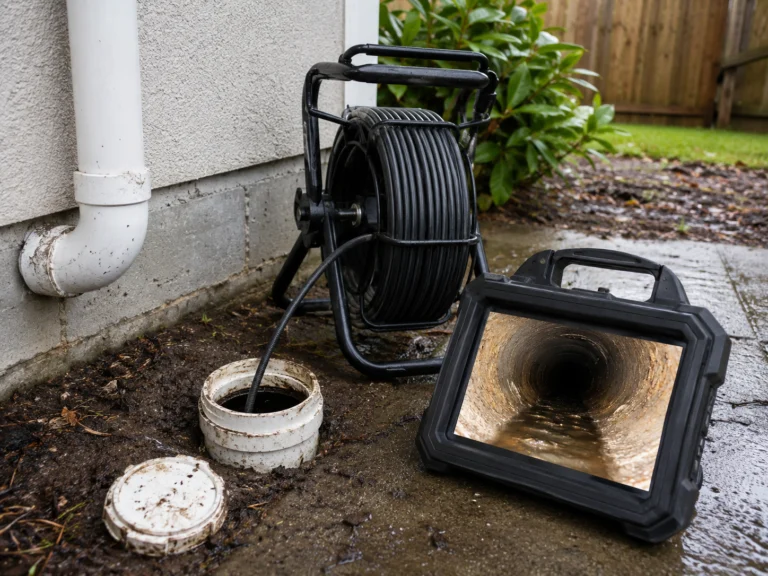
Run a camera the full length
Out to the connection, not to the first thing worth mentioning, a second fault past the first changes the repair.
3
Locate and mark anything found
Position on the ground and depth, which is what makes a repair a spot repair rather than a search.
4
Keep the footage
Yours, and yours to show to anybody else, particularly useful before agreeing to a replacement.
5
Consider a hydrostatic test as well
The camera shows condition; the test proves whether the system holds. See hydrostatic testing.

What Repairs Cost

Camera inspection
$250 – $500
Charged whether or not a fault is found
Spot repair
$1,500 – $3,500
Depends on depth and access
Trenchless sewer repair
$4,000 – $12,000
Lining or pipe bursting
Full sewer replacement
$6,000 – $20,000
Open trench, by length

What sits above the line moves these numbers more than the pipe does. A lateral under lawn and the same lateral under a stamped concrete driveway are identical plumbing and very different jobs, which is the whole argument for trenchless methods where the route allows. See trenchless vs traditional.

Buying a house with an old lateral? Inspect it before the contingency closes.
Book a camera inspection

What This Site Is About, and What Belongs to Another Trade

We are licensed and insured plumbers, and this site is about leaks — finding the ones you cannot see and repairing them properly. Roughly half of what looks like a plumbing leak turns out not to be one, so the boundary is worth stating plainly.

Roof leaks are a roofer. Water under an air handler is an HVAC technician clearing a condensate drain. Water under an appliance is appliance repair. Drying, restoration and mold are separate trades again, and gas line repair is SoCalGas or a licensed gas fitter. We detect gas leaks, we do not repair gas lines.

The full list, with the trade to call for each, is on what we don’t do.

Before You Buy a House

A standard home inspection does not include the sewer lateral, and a failed lateral is one of the few property problems that reaches five figures with no warning at all.

Age of houseWorth inspecting?
Pre-1970sYes — clay is likely, and roots are likely with it
1970s to 1990sYes on anything with mature trees
NewerLower risk, but a belly from settlement is still possible
Any house with big trees near the runYes
Any house where the seller mentions past backupsYes, and get the footage

Book it inside the inspection contingency, while the result can still change the deal. A problem discovered three days before closing is a very different conversation.

Keeping One in Good Condition

Grease goes in the trash
Not down the drain. Hot water only moves the problem further along the line, where it cools and sticks anyway.
“Flushable” wipes are not
They do not break down like paper, whatever the packet says, and they are a common find on camera.
Know where your trees are
A tree over the line is not a reason to remove it. It is a reason to look at the line every few years.
Act on the second backup
The first can be a one-off. The second in a year is structural, and clearing it again is treating a symptom.
David Herrera, Founder & Lead Leak Detection Technician
About the Author
David Herrera, Founder & Lead Leak Detection Technician
David founded Leak Detection Santa Ana in 2026 after more than 15 years finding and repairing leaks across Orange County. He leads the crew that does the work, and the judgement calls on this page are the ones he uses in the field. Meet the team.

Book a Camera Inspection

See the condition of your lateral, and keep the footage.

(714) 386-7923Call or text, day or nightSchedule a Visit

What’s Included

  • Acoustic, thermal & tracer-gas location
  • Plain-language explanation of what we found
  • Firm written quote, on-site
  • No-find-no-fee guarantee

Frequently Asked Questions

The single buried pipe carrying everything that drains in your house out to the public sewer main in the street. It works by gravity rather than pressure, which is why a leak in one never shows on your water meter.

From your fixtures to the building edge and across your property, normally yes. Where responsibility ends between the property line and the public main varies by jurisdiction — confirm it with the City for your specific address rather than assuming.

Because the water already went down the drain and was already billed. A drain is not pressurised, so nothing extra leaves your supply. That is exactly why lateral problems run for years before anybody notices them.

A camera with a transmitting head traces and marks it on the surface, with depths. Failing that, the cleanout location and the line from the house to the street is a reasonable first guess, but it is a guess.

A capped vertical access point into the lateral, usually near the building or at the property line. It is what a camera or a cable goes in through. Without one, access is usually through a pulled toilet, which takes longer.

It depends far more on material and what is growing near it than on years. Clay with a mature tree over it can be a problem in decades; ABS in open ground can be fine indefinitely. The camera is the only honest answer for your line.

On anything pre-1980, yes. A standard home inspection does not include the sewer lateral, and a failed one is among the few property problems that reaches five figures with no warning. Book it inside the contingency.

Trenchless work typically runs $4,000 to $12,000 and a full open-trench replacement $6,000 to $20,000 depending on length. What sits above the line — lawn, pavers, driveway — moves it more than the pipe does.

Roots at a joint, by a distance, particularly on clay pipe. They enter through a defect that already exists, thicken inside, and catch solids. Clearing them removes the mass and leaves the crack, which is why it recurs.

Often, where the line still holds its shape — lining seals cracks and joints continuously, and pipe bursting replaces the run through two pits. Neither corrects a belly, because a liner follows the shape of the pipe it forms in.