Sewer repairs run from about fifteen hundred dollars to twenty thousand, and the pipe is rarely what decides where you land. Depth, length, what is on top of the line and which method the fault allows do almost all of it, and every one of those is knowable before you commit.
Those are ranges rather than quotes, and a quote requires seeing the line. Anybody who gives you a firm sewer repair price without camera footage is pricing a guess, which usually means padding it, and occasionally means it changes halfway through the job.
Everything we price is on the pricing page.
| Factor | Effect |
|---|---|
| What is on top of the line | The largest single variable, lawn versus a stamped driveway |
| Depth | Deeper means more excavation, shoring, and time |
| Length of the affected run | Trenchless is priced by the foot |
| One fault or several | One is a spot repair; several is a whole-run conversation |
| Pipe diameter | Larger lines cost more to line or replace |
| Access for equipment | A narrow side gate genuinely changes the method available |
| Whether a permit is required | Pulled where it applies, and shown on the quote |
| Restoration | Frequently more than the plumbing on a hardscaped property |
Read that list and the pattern is clear: this is an excavation and restoration price with some plumbing in it, not the other way round. That is also the whole argument for trenchless methods where the fault allows one.
| Method | Roughly | Fits when |
|---|---|---|
| Spot repair | $1,500 – $3,500 | One fault, sound pipe either side of it |
| Lining (CIPP) | Within $4,000 – $12,000 | Cracks and roots along a run that still holds its shape |
| Pipe bursting | Within $4,000 – $12,000 | The line needs replacing but the route allows a pull |
| Open trench replacement | $6,000 – $20,000 | Collapse, a belly, or a route trenchless cannot take |
| Clearing only | Lowest | A genuine one-off blockage, and only that |
The bottom row is worth being blunt about. Clearing is the cheapest line on the page and it is not a repair. If the same drain has clogged twice, you are buying time rather than a solution. See why a drain keeps clogging.
The plumbing is more expensive per foot. It wins or loses on what it does not have to dig up.
| Surface above the line | Trenchless usually |
|---|---|
| Open lawn, shallow, short run | Loses: an open trench is cheaper all in |
| Mature landscaping | Wins |
| A concrete or paver driveway | Wins, often decisively |
| Stamped or coloured concrete | Wins, matching it afterwards is close to impossible |
| Under a structure or an addition | Wins, and may be the only option |
| A route with sharp bends or obstructions | Ruled out, the method has real limits |
Which is why any honest comparison has to include restoration. Comparing the plumbing lines alone will tell you open trench is cheaper almost every time, and on a hardscaped property that conclusion is simply wrong. See trenchless vs traditional.
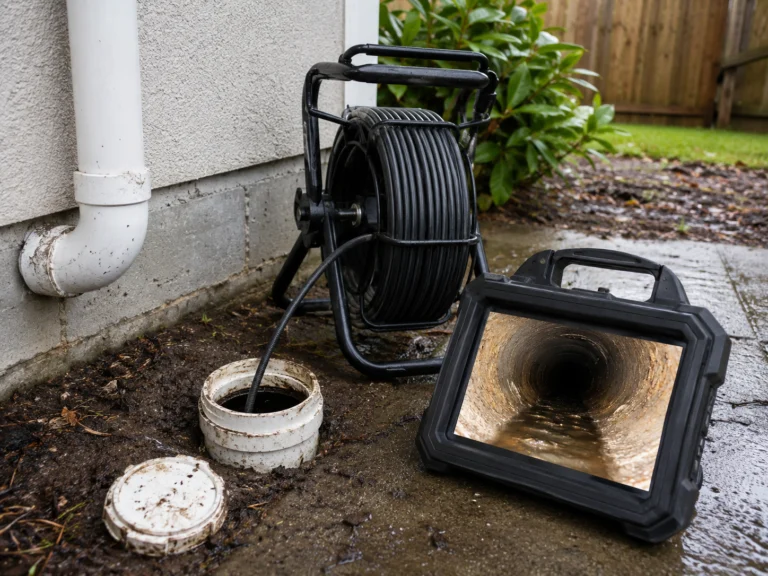
Before any of the site conditions matter, what the camera found sets the floor. Some findings have one sensible answer and some have three, and knowing which you have is what stops you comparing quotes for different jobs.
| What the camera shows | Realistic options | Cost band |
|---|---|---|
| Roots at one joint, pipe sound | Clear, then spot repair or line | Lower |
| Roots at many joints | Line the run | Middle |
| A single cracked section | Spot repair | Lower |
| Offset joint | Spot repair, or line if the run has other faults | Lower to middle |
| A belly | Excavate and re-lay to grade, nothing else works | Middle to high |
| Collapse | Replace that section at minimum | High |
| Heavy scale in cast iron | Descale, then look again before deciding | Unknown until you look twice |
The belly row is the one to watch on a quote. It is the finding most often quoted for lining by somebody who either has not looked properly or is hoping you will not ask: a liner forms against the pipe it is installed in, so lining a dip produces a lined dip. The last row is honest rather than evasive: a cast iron line thick with scale genuinely cannot be assessed until the wall is visible, and a quote given before that is a number attached to a guess.
We are licensed and insured plumbers, and this site is about leaks — finding the ones you cannot see and repairing them properly. Roughly half of what looks like a plumbing leak turns out not to be one, so the boundary is worth stating plainly.
Roof leaks are a roofer. Water under an air handler is an HVAC technician clearing a condensate drain. Water under an appliance is appliance repair. Drying, restoration and mold are separate trades again, and gas line repair is SoCalGas or a licensed gas fitter. We detect gas leaks, we do not repair gas lines.
The full list, with the trade to call for each, is on what we don’t do.
Worth settling before agreeing to anything, because a lateral does not stop at the property line.
| Section | Generally |
|---|---|
| Inside the house to the building edge | Property owner |
| The lateral across your property | Property owner |
| Between the property line and the main | Varies — confirm with the City |
| The public main in the street | City of Santa Ana |
The camera tells you how far along the run the fault sits, which is the first thing anybody will ask. More at what is a sewer lateral and who is responsible.
Every number on this page depends on what the line actually looks like. The inspection is $250 to $500, you keep the footage, and it converts a range into a quote.

Every number here depends on what the line looks like. The inspection turns a range into a quote.
(714) 386-7923Call or text, day or nightSchedule a VisitA spot repair typically runs $1,500 to $3,500, trenchless work $4,000 to $12,000, and a full open-trench replacement $6,000 to $20,000. What sits above the line moves it more than the pipe itself does.
Usually scope and restoration. One quote repairs a fault, another replaces the run, and one includes putting the driveway back while another does not. Compare totals and exclusions rather than headline prices.
The plumbing costs more per foot; the restoration costs far less. On open lawn an open trench usually wins all in. Under a driveway or mature landscaping, trenchless usually wins decisively.
Yes, and no honest quote exists without one. It determines which methods are even possible: a belly rules out lining entirely, and it costs $250 to $500, charged whether or not a fault is found.
Yes. You are buying the inspection and the recording rather than a result, and a clean line is a legitimate outcome worth having on file — particularly before agreeing to anything somebody else has quoted.
Usually not the pipe. Excavation and restoration dominate on a hardscaped property, which is why the same fault under a lawn and under a stamped concrete driveway are the same plumbing and very different invoices.
Concrete gets patched, not matched. Matching aged concrete is a specialist job and genuinely difficult, and we say so rather than promising it. It is one reason trenchless wins so often under hardscape.
Plumbing work regulated by code requires one from the City of Santa Ana. Where it applies we pull it and it shows on the quote as its own line. The Permit Counter is (714) 647-5800 if you want to confirm independently.
Some people do. It is the cheapest line on this page and it is not a repair — roots widen the defect they grow through, so the interval between clearings tends to shorten while the repair gets larger.
Read your policy. Sewer backup in particular is frequently an optional endorsement rather than standard cover, and it is worth knowing which you have before a lateral fails rather than during.