A post-tension slab has steel cables running through it under enormous tension. They are what holds the floor together, and cutting one is not a mistake you can patch afterwards. The leak is found the same way as on any slab; what changes completely is what happens before anybody touches the concrete.
Most homeowners genuinely do not know, and it is worth establishing before anyone quotes you a slab repair. These are the checks, easiest first.
| Conventional slab | Post-tension slab |
|---|---|
| Rebar in a grid, not tensioned | Steel cables under high tension |
| Cutting through rebar is undesirable | Cutting a cable is a structural failure |
| Locate the leak, then cut | Locate the leak, then locate the cables, then decide |
| Spot repair is routine | Spot repair is possible but conditional |
| No engineer normally involved | An engineer may need to be |
| Risk of a mistake: cost | Risk of a mistake: cost and safety |
A tensioned cable that is cut releases that energy. That is the entire reason for the extra care, and it is why a contractor who shrugs at the question is telling you something important about how they work.
On a conventional slab, reroute versus spot repair is mostly an argument about flooring and about how old the pipe is. On a post-tension slab there is a third factor, and it tends to decide it.
The method itself is the same one used on any slab home. See pipe rerouting. What changes on a post-tension slab is how often it is the obvious choice rather than a preference.
Cable scanning adds a step and a cost to any job that involves cutting. A structural engineer, where one is needed, is engaged directly by you rather than marked up through us, their independence is the point of having them.
Everything we price is on the pricing page.
It is worth understanding, because “we will scan first” is only reassuring if you know what is being scanned for.
The limit is worth stating: scanning reads what is there, it does not guarantee what is not. That is precisely why a reroute, which requires no cut at all, is the option that removes the uncertainty instead of narrowing it.
The slab type changes the repair, not the symptoms. These are the same signals you would look for on any concrete floor.
| Sign | What it points at |
|---|---|
| A warm patch on the floor | A hot-water line under the slab |
| The sound of running water with everything off | A pressurised leak |
| The meter turning with the house isolated | Water leaving the supply somewhere |
| A water bill that jumped and stayed up | A leak that has been running a while |
| Cracked, lifting or cupping flooring | Moisture from below |
| Low pressure through the whole house | A supply leak, or a failed regulator |
| A musty smell with nothing visible | Long-running moisture in the structure |
Detail on each of those is on slab leak signs and symptoms, and the meter test that settles the question is on the water meter leak test.
We are licensed and insured plumbers, and this site is about leaks — finding the ones you cannot see and repairing them properly. Roughly half of what looks like a plumbing leak turns out not to be one, so the boundary is worth stating plainly.
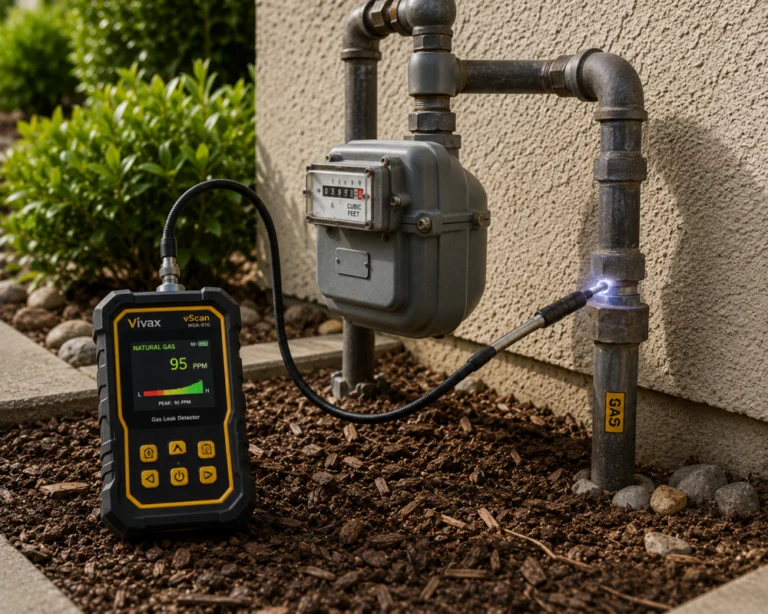
Roof leaks are a roofer. Water under an air handler is an HVAC technician clearing a condensate drain. Water under an appliance is appliance repair. Drying, restoration and mold are separate trades again, and gas line repair is SoCalGas or a licensed gas fitter. We detect gas leaks, we do not repair gas lines.
The full list, with the trade to call for each, is on what we don’t do.
None of that is exotic. It is the ordinary standard of care for cutting a structural element, and it is worth confirming before somebody arrives with a saw.
Full terms on guarantees and warranties.

We establish whether your slab is post-tension before proposing anything at all.
(714) 386-7923Call or text, day or nightSchedule a VisitLook for a warning plate or stamp, usually in the garage, telling you not to cut or drill without contacting an engineer. Small circular patches at intervals around the slab edge are another sign. The original plans or City building records will confirm it.
Yes. What changes is the sequence: the leak is located, then the cables are scanned for at the repair location, and only then is a method chosen. Where the leak sits clear of the cables a spot repair can be entirely reasonable.
The cables are under high tension and they are what holds the floor together. Cutting one releases that energy, which is a structural failure and a safety hazard rather than a repair that went slightly wrong.
Not always. It is very often the right one here, because it removes the question instead of managing it. No concrete cut means no cable risk, no engineer, and no reopening the floor later.
Sometimes — where cutting is being considered and the geometry is not straightforward. That is their discipline rather than ours, and you engage them directly so their assessment is independent of the contractor doing the work.
Cable scanning adds a step, and an engineer where one is needed adds a cost. If the answer is a reroute, the plumbing itself sits in the same $2,000 to $4,500 band as any other reroute.
No. A warm patch on the floor, running water with everything off, a bill that jumped, the meter turning with the house isolated — identical to any slab leak. The slab type changes the repair, not the signs.
Water and the corrosion it brings are not good for tensioned steel, and that is a reason to act rather than monitor. Assessing whether damage has occurred is a structural engineer’s call, and we will tell you when it is worth asking one.
Then it is worth finding out what they cut through. If cable scanning was not done, an engineering assessment is a reasonable thing to commission, and photographs and paperwork from that work are the first things to gather.
Assume it until you have established otherwise. That is what we do before cutting anything. What is worth knowing is that the technique came into residential use later than conventional reinforced slabs, so it is more plausible on a newer build. Rather than a statistic we have not verified, use the checks above: a warning plate, patches around the slab edge, the original plans, or City building records will tell you about your own house.